
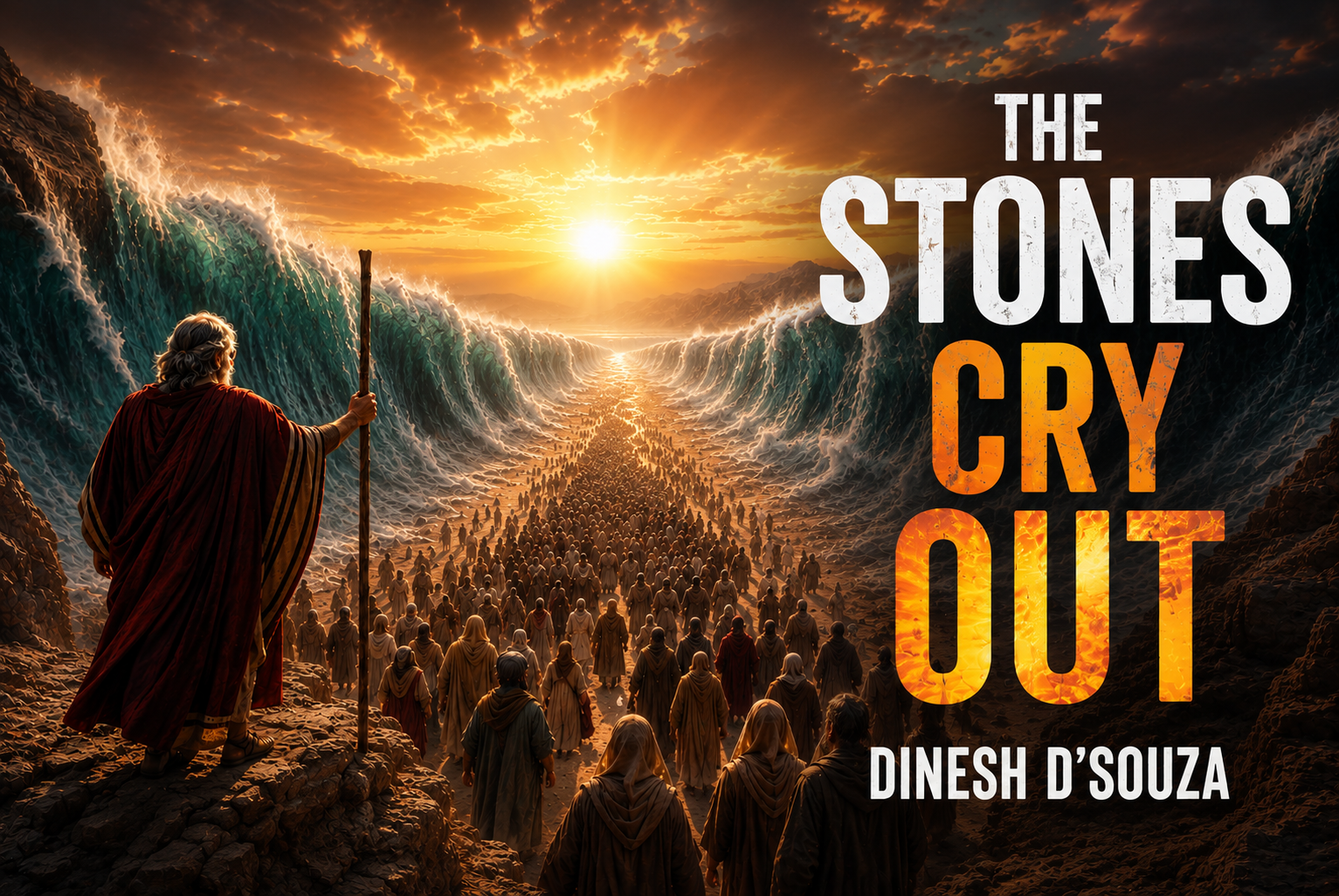
“When Israel came out of Egypt.” This phrase, from Psalm 114:1, captures the story of the Exodus, one of the central themes of the Bible. The story of the enslavement of the Jewish people in Egypt, followed by their escape to the Promised Land, is commemorated by Jews each year during Passover,
This narrative has also had incalculable influence on the West. During the American Revolution, several of the founders saw America as a “new Israel” escaping “Pharaoh” represented by the British monarch. For centuries, the Exodus narrative consoled black slaves in America and offered them the hope of liberation and redemption. Think of the Negro spiritual, “Go down Moses, way down to Egypt land, and tell old Pharaoh: Let my people go.”
Yet there is no direct evidence that the events of the Exodus happened, or even that there was an entire tribal nation of Israelites who were slaves in Egypt. Partly this is to be expected; Egypt was a great empire, and a relatively small tribe of Israelites at the lowest rungs of society would hardly have attracted official notice.
Even so, is there an indirect way to confirm the biblical account of the Jews in Egypt and of the Exodus? The archeologist Kenneth Kitchener and the Egyptologist James Hoffmeier have devoted much of their careers attempting to do so.
Let’s begin with the story of Jacob’s son Joseph—Joseph of the “coat of many colors”—who, the Bible tells us, was sold into slavery by his brothers and taken to Egypt. Genesis 37: 28 even specifies the price: 20 shekels. Archeologists have confirmed that this is precisely the price of a slave in the eighteenth and nineteenth centuries B.C.
This can be confirmed from the evidence of transactions in Mari, the laws of Hammurabi and other ancient Babylonian writings. Nor is 20 shekels a consistent price across the centuries. Prior to the period when Joseph lived, slaves cost less. Later, they cost more. The point is that no one writing centuries later, or making up the Joseph story, could have gotten this detail right. The biblical source quite obviously had direct knowledge of what it cost to buy a slave in Joseph’s time.
Joseph rose up from captivity to become a high official in Egypt. On the surface, this seems unbelievable, that a foreigner could ascend to such a status. But Hoffmeier has shown that this is not without precedent. He gives several examples of Semites and Canaanites who served as vizier and other high positions under the Pharaohs. From 1720-1570 BC Egypt was ruled by foreigners. This was the Hyksos, who were Semites from Canaan. It would hardly be unusual for these Canaanites to pick one of their own, Joseph, to serve right under Pharaoh.
There is good evidence, from Egyptian writings and paintings, of the presence of Semitic slaves and workers throughout Egypt from the mid to late second millennium B.C. Most of these slaves and workers seem to have been brought to Egypt as prisoners of war, from well-known military campaigns conducted by the leading power in the region throughout this period.
The Ibscha Relief is a tomb painting discovered at the site called Beni Hasan in central Egypt. Dated to the mid nineteenth century B.C., it shows a procession of Semitic or Asiatic men, women and children arriving in Egypt from somewhere around Canaan. The Semites are distinguished by their skin color, hair, beards and clothes, of a similar sort described in the biblical account, wearing brightly-colored clothing.
Most of them worked as slaves or servants. From the tomb of Rekhmire, the vizier of Pharaoh Thutmose III, we see painted scenes of foreign laborers making bricks. We see them scooping water, mixing water and soil to make mud, and carrying dried bricks to where they are needed, all under the watchful eyes of Egyptian overseers. This is from a later period, as Thutmose ruled from 1479 to 1425 B.C., but it corresponds closely to the estimated date for the Exodus, which is within the fifteenth century B.C.
In fact, the Rekhmire art evokes the scene in Exodus 5: 7-8 where Pharaoh says of the Hebrews, “you shall no longer give the people straw to make bricks, as before; let them go and gather straw for themselves. But the number of bricks they make must be the same as before; you shall not lessen it.”
Archeological excavations in Egypt have verified that straw was customarily used in the brickmaking process in Egyptian cities like Rameses, which the Bible says the Hebrew slaves built.
So far we have focused on searching for Israel in Egypt. But, as it turns out, there is another, quite ingenious, way to support the biblical narrative of the Exodus. That is to look for Egypt in Israel, or to put it differently, to look for Egypt in the Bible.
This is the approach adopted by a number of modern scholars whose premise is if the biblical writers of the early books of the Bible show a close familiarity with the customs and mores of Egypt at the time, that could only be because they or their sources lived in Egypt. There is simply no way for people living elsewhere, or concocting a narrative centuries later, to be able to get the details right.
As it turns out, the writers of the Exodus use terms and phrases that are distinctive to the Egyptian New Kingdom period. These phrases are not repeated elsewhere in the Bible. Also, the author of the early books of the Bible seems to have a detailed familiarity with life and landmarks in Egypt, while being much less familiar with the geography of towns and villages in Canaan. He knows about dietary practices, and accurately notes that Israelite slaves were fed leeks and onions.
The chief protagonist of the early books of the Bible is Moses. That is a name closely linked with the common Egyptian name Mosis or Mose. Egyptian records show that during the mid second millennium B.C. this was an important name among Egyptian royalty. We see echoes of the same name in New Kingdom figures like Thutmose, Amenmose, Ramose and Ramesses.
Over the centuries, biblical scholars have expresses frustration that the Bible speaks of Pharaoh but never names which pharaoh the text is referring to. At least three pharaohs have been identified as the pharaoh of the Exodus: Amenhotep II, and Ramesses II and Thutmose III. But as it turns out the biblical style is in keeping with ancient Egyptian royal records which typically refrain from recording the specific names of rulers during this period but simply refer to them as pharaoh.
How did the Israelites get from Egypt to Canaan? Many efforts have been made to trace the correct route of the Exodus through the Sinai desert. None have succeeded, and theories abound. The Bible says that the Israelites did not go by way of the land of the Philistines “lest the people change their mind when they see warfare, and go back to Egypt.” (Exodus 13: 17-18)
Archeologists have subsequently confirmed the existence of military fortifications along that route, which confirms why the Israelites did not take the obvious and shortest path. Instead they took a longer route but there are competing proposals for which one.
The Israelites crossed the Red Sea—which may more accurately be rendered the “reed sea”—but the precise location of this body of water is unknown. Neither has anyone definitively located Mount Sinai, where Moses received the Ten Commandments.
What we do know is that the Israelites reached Canaan. We know this, Kenneth Kitchen points out, because archeologists have discovered a whole rash of new settlements, and the population of the region seems to have first doubled, then quintupled. Moreover, a late nineteenth century discovery at a pharaoh’s mortuary temple definitively confirms the presence of the Israelites in Canaan.
In February 1896, while excavating near the Valley of the Kings near the modern town of Luxor, Egypt, the archeologist Sir William Matthew Flinders Petrie, often called the Father of Egyptology, found a stone tablet or stele commemorating the triumphs of the Pharaoh Merneptah. This so-called Merneptah Stele, which is currently in the Cairo Museum in Egypt, includes the following lines. “Canaan is plundered” and “Israel is laid waste, his seed is no more.”
This hieroglyphic inscription dates to 1207 B.C. What is proves is not merely that Israelites were in Canaan by that time, but that they had already formed a cohesive unit that could be identified as a people. They were a group identifiable enough to be worth naming in a pharaonic victory declaration as one of the vanquished. The context of the inscription makes it clear that it is a reference to Israel not as a place but as a people.
The Merneptah Stele also establishes that whatever the date of the Exodus into the Promised Land, it could not be later than 1207 B.C. and is quite likely significantly earlier, to give the Israelites time to unify their various tribes and consolidate their power as a group or political entity. So that’s what we know about how Israel came out of Egypt, and all of it, despite our gaps of knowledge, is consistent with the biblical account.
This content is from Dinesh D’Souza’s Substack, which you can read here.
Born in Mumbai, India, Dinesh D’Souza came to the United States as an exchange student in 1978. After graduating from Dartmouth College, he served as a policy analyst in the Reagan White House and a scholar in two prominent think tanks, the American Enterprise Institute and the Hoover Institution at Stanford University. He is a New York Times best-selling author who has written books on politics, religion, culture, and economics— including Illiberal Education, The End of Racism, What’s So Great About America, and United States of Socialism—and three books on Christian apologetics: What’s So Great About Christianity, Life After Death, and Godforsaken. D’Souza has made eight political documentary films and produces a daily podcast called The Dinesh D’Souza Podcast, which is seen and heard by about 100,000 people daily.
