
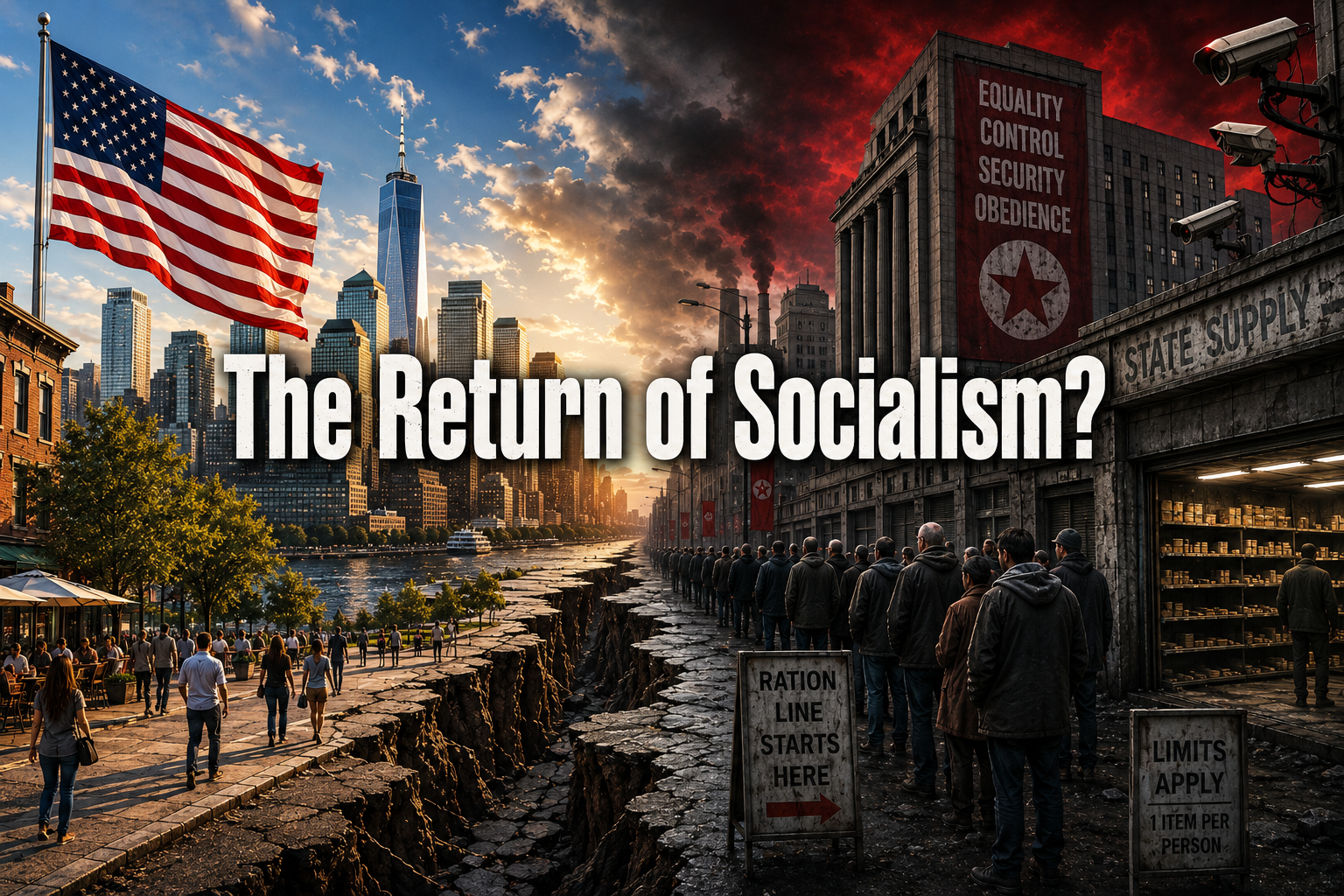
A specter is haunting America—the specter of socialism. We got a nasty preview of it during the Covid-19 period. We experienced empty shelves, food shortages, limits on what you could buy, and also attacks on civil liberties, on freedom of assembly, on religious liberty, on privacy. We endured state propaganda, censorship and arbitrary societal controls. Some of us went along, at first, because we thought we could trust the health authorities. Many of us eventually figured out we were being lied to. A surprising number continued to act like sheep. Some even enjoyed it, and a few took pleasure in delivering Karen-type scoldings to anyone who didn’t conform.
Looking back, it was horrible. And yet it was relatively short-lived. In short, we suffered on a temporary basis what, under socialism, we will suffer on a permanent basis. Yet socialism has somehow entered the mainstream of political debate. It started with Bernie Sanders, AOC, Rashida Tlaib and Ilhan Omar. Now, almost out of nowhere, we have Mamdani and his acolytes in New York, and also socialist candidates winning Democratic primaries in other blue cities and blue areas. It’s a trend that’s likely to continue, and many people worry that socialism is the future of the Democratic Party, if not of America.
These developments are surpassingly strange, because socialism is arguably the most discredited idea since slavery. Slavery lasted for centuries, even millennia, before it was recognized as a thoroughly wicked and tyrannical form of human exploitation. Socialism, which dates back to 1917, when Lenin founded the world’s first socialist state, has had a much shorter shelf life. It too collapsed around the world because it was understood by the people who lived under it to be a form of slavery.
We see the connection between socialism and slavery in all the important works on socialism. Friedrich Hayek’s critique of socialism is appropriately titled The Road to Serfdom. George Orwell depicted the tyrannical dimension of socialism in his two classic novels Animal Farm and 1984. Using both the techniques of fiction and nonfiction, Alexander Solzhenitsyn in a series of works—The Gulag Archipelago, One Day in the Life of Ivan Denisovich—depicted Soviet socialism as a vast network of slave camps stretching from Europe to the farthest reaches of Asia.

To order Dinesh D’Souza’s new book, The Stones Cry Out, visit Amazon.com.
Slavery in its most obvious form has been abolished worldwide, although enslavement in other forms—sex trafficking for instance—continues as a gruesome relic of this barbaric practice. Even so, no serious person today could advocate for the return of slavery! How ridiculous it would be to hear someone say, “The failures of slavery were all failures of implementation. This time we’re really gonna make it work!”
Yet here we have socialism in America attempting a comeback and on precisely those terms. “This time we’re gonna get it right.” Serious people advocate it; there’s a sustained cultural push to promote it; a major political party is pushing aggressively toward it. How is this possible? Apparently socialism means never having to say you’re sorry. Socialism has proved to be a living hell pretty much everywhere it’s been tried. It’s been tried pretty much all over the world. Let’s not forget that within about a century since Marx wrote, and less than half a century since the Bolshevik Revolution, 60 percent of the world’s people were living under governments that embraced some form of socialism.
At one time, Josh Muravchik writes, “It was the most popular political idea ever invented, arguably the most popular idea of any kind about how life should be lived or society organized.” The biggest socialist experiment was the Soviet bloc, an orbit of countries including the Soviet Union, Poland, Yugoslavia, Albania, Czechoslovakia, Hungary, Romania, Bulgaria and East Germany. Prior to the Soviet occupation of its eastern region, Germany tried its own distinct version of socialism, National Socialism or Nazism, which lasted for 12 years, from 1933 to 1945.
In Asia, Vietnam, Laos, Cambodia, North Korea and China all adopted socialism. In South America, Cuba, Nicaragua, Bolivia and Venezuela tried it. Most of Africa went socialist in the aftermath of colonialism: Angola, Ghana, Tanzania, Benin, Mali, Mozambique, Zambia and Zimbabwe. I count here 25 experiments in socialism, not one success story, all ending in unmitigated disaster. The worst forms of socialism proved not only totalitarian, but also murderous to an unprecedented degree. In the Soviet Union alone, socialist regimes killed some 20 million of their own citizens and enslaved tens of millions of others. The Chinese socialists, in the period known as Mao’s Cultural Revolution, killed another 20-25 million. The Nazis murdered in comparable numbers, including Jews and gypsies and other occupied peoples, Poles, Russians, Eastern Europeans and others.
Orwell’s description from 1984 seems appropriate here: “A boot stamping on a human face.” Socialists today—Bernie Sanders, Mamdani and the others—disavow this historical record, insisting those were authoritarian forms of socialism that they have no intention of copying. While socialism may have been the economic program of Communism and early Fascism, modern socialists seek to dispense with the tyranny and merely keep the economic program.
Yet it’s worth stressing that socialism wasn’t merely a political failure; it was also an economic failure. Orwell somehow missed this. Interestingly, neither of his two great works offers an economic critique of socialism. There is no economic problem in Animal Farm; the only problem is the pigs seize power.
In 1984, the ruling party creates poverty and scarcity to keep people in line. We see something like this in our blue cities today, and Orwell was on to it. Yet great as he is, Orwell confines himself to a political critique; he exposes the totalitarian tendency of socialism. But he never shows how socialism creates this totalitarianism, and he leaves open the possibility of a more benign socialism that avoids it. In the real world, however, the political collapse of socialism was brought about by its economic failure. This was certainly true in the Soviet Union, where Gorbachev’s rescue efforts—glasnost and perestroika—failed spectacularly, first bringing down the Soviet empire, then the Communist ruling party and finally the socialist system itself. China, too, abandoned socialism for its economic shortcomings. And look how poorly socialism has fared in Cuba and Venezuela.
So how can anyone adopt socialist ideas once again without considering the economic track record of socialist regimes? Rarely in history is there a chance to actually compare social systems to see which one works better. One might compare the Plantagenet kings of England with the Tang Dynasty in China, but even if we line up the dates we are talking about two completely different societies: different people, different culture.
Consequently, England’s superiority and China’s inferiority—or the other way around—can hardly be attributed to their rival systems of government, since so many other factors are involved. In the case of socialism, however, we have two perfect test cases: North and South Korea, and East and West Germany. The perfection of these examples comes from the fact that we’re dealing with the same people, same background, same culture, merely two rival economic systems. North Korea is socialist; South Korea, capitalist. East Germany was socialist; West Germany, capitalist.
When the results came in, they were decisive. At reunification the per capita gross domestic product in socialist East Germany was just about one-third of the capitalist West German level, with other measures of economic performance showing a similar chasm. Even the poorest part of West Germany, Schleswig-Holstein, was two and a half times as wealthy as the richest East German region, Saxony. To this day, East Germany gets nearly 15% of its domestic product in net transfers from the western part of Germany.
The North Korean example is even more telling, in part because the separation of the two societies has lasted long and continues to this day. South Korea is now more than 20 times richer than North Korea, a difference manifested in virtually all indicators of human welfare. South Koreans are obviously freer than North Koreans, but they also seem happier: Have you even seen a North Korean smile? South Koreans are also taller, healthier and live about 12 years long than North Koreans. Every year thousands of North Koreans risk their lives seeking to escape to South Korea.
I realize of course that today’s socialists in America insist they want socialism of a particular kind: democratic socialism. So not any kind of socialism, but democratic socialism. I grew up under Indian socialism, which was democratic socialism, and experienced its two signature institutions.
The first was everyday corruption; literally nothing could be done without paying some petty bureaucrat under the table. The second was the ration card, which specified the paltry ration of sugar or cooking oil that a family was permitted to purchase each month. Ah, yes, and during this period in the 1970s there was a seven-year wait to get a phone.
India was for decades known as the begging bowl of the world. Americans told their children, “Eat your food because there are millions of starving people in India.” A whole generation of Indians saw no future for themselves and fled to sea, like my brother, or to Dubai to do manual labor, like some of my cousins, or to Australia, Canada and America, like me. Today’s young Indians plan no such mass exist, because there are now opportunities for them at home. India is doing measurably better, and now there is a large and newly-prosperous middle class. How did this change come about? Through economic liberalization, otherwise known as free market capitalism. China came up the same way, starting in the late 1970s, when Deng Xiaoping abandoned the socialism of Mao for a new brand of capitalism. In doing so the Chinese inaugurated a new experiment in social organization. Call it totalitarian capitalism. The Chinese married Communist political control to free market liberalization. It’s a weird marriage, but in economic terms, it has worked.
If socialism has produced a worldwide record of misery and tears, and if countries must flee socialism to experience prosperity, what then are American socialists up to? Why would they want to import misery and tears? Why would they want a system that has never worked before and shows no indication of working now? The short answer is: It works, but not in the way that we expect. Viewed from the point of view of society, socialism is an abject failure. It doesn’t work. The socialists too know, deep down, that it doesn’t work. But they don’t care, because it works for them. Viewed from the perspective of the socialists, socialism is an effective scheme to gain money and and power.
Think about it this way. Socialists like Bernie Sanders and Zohran Mamdani are not productive people. They have rarely, if ever, held real jobs. They have never started a business, and wouldn’t know how to begin doing that. Their record of innovation is a null set. They are, from the entrepreneurial perspective, useless people. But this does not mean they are untalented. Nor does it mean they are unproductive. They are incapable of producing goods and services, but they are skilled at producing resentment. They are masters at cultivating envy. They are talented in spreading hatred against people who are productive.
So what we’re seeing in places like New York, and increasingly around the country, is a contest of elites. The socialists don’t market it that way. They market it as the elites versus the people. But in no society have the people ever ruled themselves. All societies, whether monarchies or aristocracies or democracies, are run by elites.
Socialism represents an effort on the part of the activist elite—the professors, the journalists, the community organizer types—to seize power from the entrepreneurial elite, the group that actually drives the wealth of a society. The socialist scheme is to seize that wealth by capitalizing on the people’s incomprehension about how wealth is created, and the natural human desire to grab what isn’t yours through some self-serving illusion that you are entitled to it. Socialism spreads this gospel of entitlement, but not really for the people’s benefit, but rather to recruit the people into a scheme that will turn the reins of society over to the socialists. This is how socialism proves highly profitable to the Ilhan Omar and Bernie Sanders types.
They have mastered the art of what may be called political entrepreneurship. I am confident that, in the end, America will reject socialism. But that’s only because the large majority of Americans know that socialism is in fact a form of slavery. And just as Republicans had to defeat slavery by defeating the Democrats in the Civil War, we must defeat the Democrats again on this barbarous idea of socialism.
And that’s the way I see it.
This content is from Dinesh D’Souza’s Substack, which you can read here.
Born in Mumbai, India, Dinesh D’Souza came to the United States as an exchange student in 1978. After graduating from Dartmouth College, he served as a policy analyst in the Reagan White House and a scholar in two prominent think tanks, the American Enterprise Institute and the Hoover Institution at Stanford University. He is a New York Times best-selling author who has written books on politics, religion, culture, and economics— including Illiberal Education, The End of Racism, What’s So Great About America, and United States of Socialism—and three books on Christian apologetics: What’s So Great About Christianity, Life After Death, and Godforsaken. D’Souza has made eight political documentary films and produces a daily podcast called The Dinesh D’Souza Podcast, which is seen and heard by about 100,000 people daily.
