
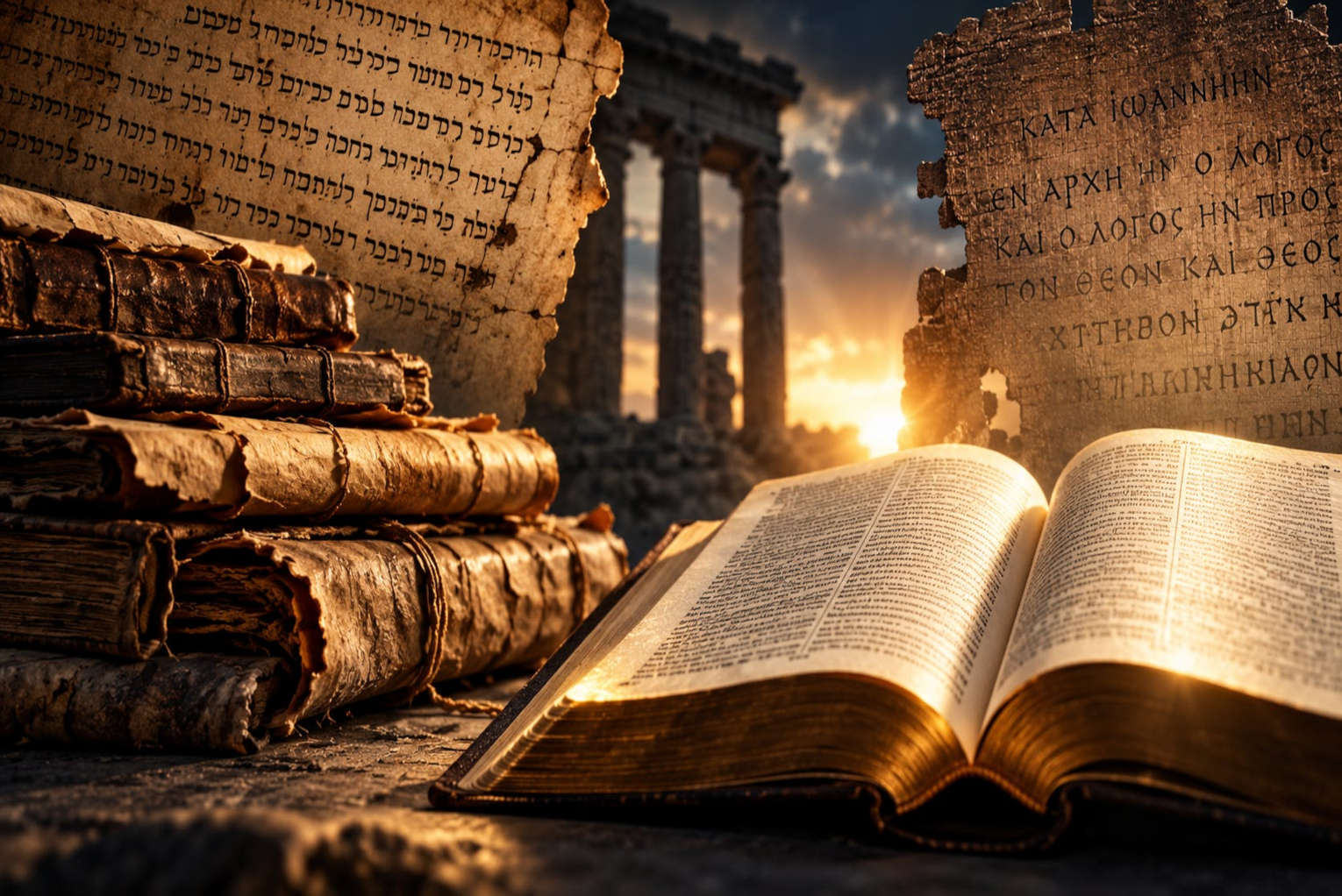
As Christians we revere the Bible which we consider to be an inspired text and a recipe for life, and for life after life—life in the hereafter. Even so, it cannot escape the attention of intelligent people that the Bible has come down to us through the ages. For 1400 years, before the advent of printing, the Bible was copied by monks and scribes, and this was done by hand.
So the obvious questions arise. When we read the first five books of the Old Testament—what the Jews call the Torah—are we reading the same Torah the ancient Israelites read 3500 years ago? When we read the Old Testament as a whole, is it the same Old Testament that Jesus knew? And the same question applies to the New Testament: is our New Testament today the same one that the early Christians studied and circulated among themselves?
The issue, in other words, is not the veracity of the Bible—whether it describes real people and true events. I’m considering that issue separately. My new book on that topic comes out this fall. It’s called The End of Time: Biblical Archaeology, Prophecy and the Last Days. You can pre-order it now; it’s a ground-breaking book that I want you to have, and to read. But that’s not our topic for today. Nor are we considering how the early Christians and the early Church, decided on which books should be included in the Bible. I recently did a monologue on that subject. Or alternatively, you can go to my Substack channel, DineshDSouza.substack.com and read the monologue. By the way, I convert all my monologues into articles and you can find them on my Substack.
Here we are considering the reliability of the biblical text, how accurately it has been transmitted to us through time. This is a crucial issue because it goes to the heart of whether we can trust that the Bible we have is the real Bible, the inspired word of God as it was originally written down. And this is where the debunkers come out in droves, academic debunkers, pop culture debunkers, online debunkers.
Their common project is to discredit the Bible, and they do so by insinuating that the Bible we have today is a corrupted version, replete with changes and errors passed down, either deliberately or inadvertently, by monks and scribes through the ages. Perhaps the most famous and influential debunker is the New Testament scholar Bart Ehrman, author of a number of bestselling books on Christianity.
I’ve crossed paths—or maybe I should say crossed swords—with Ehrman a few times. We’ve debated two or three times on the issue of theodicy, the issue of God and suffering. Ehrman is professor of religious studies at the University of North Carolina at Chapel Hill; incidentally his wife, whom I also know, who teaches at nearby Duke University, is a believing Christian.
I recently watched some of Ehrman’s interviews, and he says that he once believed in the Bible as the inspired word of God. Then, he recounts, he found out that biblical manuscripts were copied by hand through the centuries, and many of these copies had errors and changes, mostly minor, some of them just errors of punctuation or spelling, or a word left out here or there, but occasionally the changes were more significant than that.
Order Dinesh D’Souza’s New Book, “The Stones Cry Out” on Amazon.com!
Ehrman concluded that if God really wanted His people to have an inspired, uncorrupted text, He would have made sure such errors did not occur. He would have protected the incorruptibility of the original text. Since He didn’t, we can reasonably conclude the text is not inspired, it’s a human creation, and it has come down to us through the fallible human process of copying and perhaps even editing, which means that our text might not be strictly identical with the original one.
Ehrman’s conclusion: Our Bible is only an approximation of what was first written, and therefore it is somewhat unreliable. In our words, our Christianity itself rests on a shaky foundation. In my view, Ehrman’s reasoning, which seems watertight to so many people, is quite obviously fallacious. I’d like to illustrate the point by way of a thought experiment. Let’s take one of my earlier books, say What’s So Great About America or What’s So Great About Christianity. Let’s now give the book to 100 eighth-grade students and ask them to copy it out word for word.
I’m making my own thought experiment difficult for my case by picking today’s generation of under-educated, distracted, low-attention-span students. Even so, let them do the copying by hand, which they are not used to doing, and let’s collect the 100 versions they come up with. Now comes the fascinating part: let’s throw out the original. Let’s set it aside. So we have only the 100 copies, no original.
And yet, I contend that from those 100 copies, however careless or defective, we can reconstruct the original word for word. We can entirely recover the original even from the faulty copies. Why? For the reason that even when second-rate students make lots of copying mistakes, they don’t make the same mistakes.
So if you find an error or deviation, all you have to do it compare it to the other 99 manuscripts, and you can easily discover what the error is, and fix it. Even if there are errors on every page, they can be corrected using the same procedure. Problem solved! Yeah, you say, but that depends on having a decent number of manuscripts to work with. In my thought experiment, we had 100 copies. The experiment would not work if we had a much smaller number of copies, say two or three. I agree, of course, but let’s ask how many manuscript fragments and versions we have of the New Testament. Answer: 5,000. We have approximately 5,000 manuscripts, found in different languages, in many parts of the world, Rome, Greece, Turkey, Jordan, Egypt, Mesopotamia, some of them partial copies of the whole, but many of them full copies of all 27 books.
In other words, we possess far more copies than we did in my thought experiment. Recovering the original New Testament becomes relatively easy. Not only that, but the scribes who copied the New Testament weren’t bored, distracted, social media numbed eighth graders. They were monks, religious scholars and trained scribes. They were convinced they were transmitting a sacred text—a text produced with divine assistance—and so they labored diligently to avoid a single mistake. They did their work under the most exacting rules and with the most rigorous supervision.
We can trust the reliability of their transmission more than we can trust any similar human enterprise—I’m not talking about photocopying or computer reproduction—attempted today. No group of Harvard graduates could copy any work, whether the Bible, Homer’s Iliad or Milton’s Paradise Lost, and come even close to the level of accuracy the medieval and early Christian monks and scribes achieved. It’s worth recalling, in this context, that the entire New Testament was written in the first century A.D., which means it was written between two and six decades after the death of Christ, and within the lifetime of many who lived through Christ’s ministry and death.
It’s also noteworthy that with other ancient texts—including some of the most famous works of Greek and Roman philosophy and literature—the copies we have date to many centuries after they were first written, and even more centuries away from the events they describe. Even so, scholars do not doubt the accuracy or authenticity of these texts. The New Testament is the most comprehensively authenticated ancient text in existence; no other book comes close.
While Ehrman is a New Testament scholar, and aims his critique mostly at the New Testament, his case would seem to be stronger if he were to focus on the Old Testament. Here, there does appear to be a serious problem. Prior to the middle of the twentieth century, the oldest copies of the Hebrew Bible—the so-called Masoretic text—dates back to around 900-1000 A.D.
Wow! This is a very long way from the composition of these books and even more distant from the events they describe. How can we be sure that the Masoretic text is trustworthy, even if we trust the group of scholars and scribes called the Masoretes, even if we know the punctilious procedures they underwent to ensure that they made no, or very few, mistakes?
This question was decisively answered by the discovery in 1947 of the Dead Sea Scrolls. The Dead Sea Scrolls, found in the hills near the Dead Sea, are often called the greatest discovery in biblical archaeology to date. There are some 1100 ancient documents consisting of several intact scrolls and thousands of fragments. These date from the third century B.C. to the first century A.D. They are more than a thousand years earlier than any existing text of the Hebrew Bible. An astounding, invaluable find.
Among the Dead Sea manuscripts are copies of all the books of the Old Testament—the Hebrew Bible—missing only the Book of Esther. The most famous scroll, the Great Isaiah Scroll, contains the entire text of the Book of Isaiah. When this scroll was matched to the Masoretic text, scholars found they were virtually identical. The only discrepancies were minor errors of copying, which made no difference to the meaning or significance of the text at all.
The same is true when other books are compared. Essentially the accuracy of the Masoretic text, of the existing Hebrew Bible, was firmly established by the Dead Sea Scrolls. A whole mode of skeptical questioning of the Bible, from the early nineteenth century to the mid twentieth century, was discredited. The entire Old Testament was stunningly vindicated, at least in terms of its authenticity as a true and accurate replica of the original.
Does it follow then that prior to 1947 there was no way to confirm the accuracy of the Hebrew Bible? Actually, it does not. In fact, there was a surefire way to confirm its reliability even though virtually none of the nineteenth and twentieth century scoffers availed themselves of it. Here’s how the issue could have been resolved, even prior to and without the Dead Sea Scrolls. During the second and third centuries B.C. the Jewish Scriptures were translated from their original language, Hebrew and Aramaic, into Greek. This famous translation was done in Alexandria, Egypt. It is known as the Septuagint. The term Septuagint means “seventy”—it supposedly refers to the number of scholars who produced the translation.
Most scholars believe it was the Septuagint that Jesus and the apostles used and quoted from, not the original Hebrew Bible. If this is so, it means that Jesus had some knowledge of at least three languages, Aramaic, which was his native tongue, and also Hebrew and Greek. Now here’s the point. We have in our hands the Hebrew Bible—the Masoretic text that dates back to 900-1000 A.D. We’re trying to figure out if this is the same Bible that the ancient Hebrews used, the Jews of the second and first centuries B.C, the Jews of Jesus’s own day.
Well, the easy way to resolve the issue is to simply compare the Masoretic text to the Septuagint. Since the Greek translation dates back to the Hellenistic era—at least two centuries before the time of Christ—surely one can see if the Masoretes, who produced their work between the seventh and tenth centuries A.D, made meaningful changes in the intervening period. As it turns out, they did not.
My conclusion is that whether we’re talking about the Hebrew Scriptures or the New Testament—when it comes to the Bible as a whole—Ehrman and his fellow debunkers are wrong. The debunkers have themselves been debunked by the evidence of history and archaeology. Whether or not you agree with the Bible, it’s the same Bible the ancient Hebrews used, the same one Jesus himself taught from, the same Bible the early Christians studied and circulated.
And that’s the way I see it.
Born in Mumbai, India, Dinesh D’Souza came to the United States as an exchange student in 1978. After graduating from Dartmouth College, he served as a policy analyst in the Reagan White House and a scholar in two prominent think tanks, the American Enterprise Institute and the Hoover Institution at Stanford University. He is a New York Times best-selling author who has written books on politics, religion, culture, and economics— including Illiberal Education, The End of Racism, What’s So Great About America, and United States of Socialism—and three books on Christian apologetics: What’s So Great About Christianity, Life After Death, and Godforsaken. D’Souza has made eight political documentary films and produces a daily podcast called The Dinesh D’Souza Podcast, which is seen and heard by about 100,000 people daily.
