

For generations, skeptics have attempted to pick apart the Bible, questioning whether its people existed, whether its places were real and whether its historical accounts could withstand serious scrutiny.
But Dinesh D’Souza says archaeology has created a major problem for that argument: The more researchers dig, the more the biblical world keeps showing up.
In a wide-ranging conversation with PragerU CEO Marissa Streit about his new book, The Stones Cry Out: Biblical Archaeology, Prophecy and the Last Days, D’Souza argued that archaeology was once expected to become a weapon against Scripture.
“When biblical archaeology started, the skeptics were really excited,” D’Souza said. “They’re like, ‘This is going to be the battering ram that we’re going to use to bring down the Bible.’ But it hasn’t worked out that way.”
D’Souza has now taken that argument one step further, declaring that in the long-running battle between biblical “maximalists” and “minimalists”—those more willing to accept the Bible’s historical framework versus those deeply skeptical of it—the believers are winning.
His reasoning is simple but provocative: The Bible makes an enormous number of historical claims across thousands of years, involving countless people, kingdoms, cities and events. That means it opens itself up to scrutiny.
If Scripture’s historical framework were fundamentally fabricated, D’Souza argues, archaeology should have uncovered devastating contradictions by now.
Instead, he says researchers keep finding remarkable points of corroboration.
When the Little Details Matter
One example D’Souza points to comes from the account of Joseph.
Genesis 37 says Joseph’s brothers sold him for 20 shekels of silver. On the surface, the price appears to be an insignificant detail. Yet D’Souza noted that archaeological research into the ancient Near East indicates 20 shekels was consistent with the price of a slave during the period traditionally associated with Joseph.
“It turns out that the Bible gets that little detail precisely right,” D’Souza said.
For D’Souza, those seemingly insignificant details are among the most fascinating discoveries because they raise an obvious question: If biblical accounts were invented centuries later, how did their writers repeatedly get such minute historical details right?
Then there is Balaam.
Numbers records the story of Balaam son of Beor, the diviner summoned by the king of Moab to curse Israel. D’Souza pointed to an ancient plaster inscription discovered in Jordan containing references to “Balaam son of Beor,” describing a figure associated with warnings and sayings.
“So in other words, Balaam is now today a historically validated figure because of this plaster inscription that came straight out of the ground,” D’Souza said.
The House of David Emerges From the Ground
Perhaps one of the most consequential examples D’Souza discussed involves King David.
For years, skeptics questioned whether David was the powerful historical figure described in Scripture. Then came the discovery of the Tel Dan Stele in northern Israel.
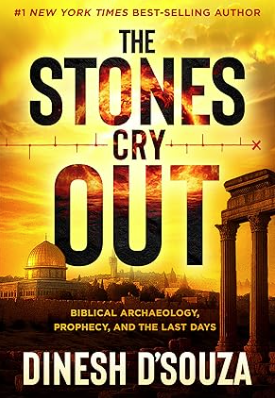
To order Dinesh D’Souza’s new book, The Stones Cry Out, visit Amazon.com.
The inscription came not from ancient Israel but from an enemy kingdom. As D’Souza explained, the monument boasts of military victory over the “house of David.”
That distinction matters.
The inscription does not merely point toward an individual named David. D’Souza argues that its reference to the “house of David” indicates a recognized Davidic dynasty generations after the biblical king.
“You have a hostile king validating not just David but the Davidic dynasty,” D’Souza said.
And the archaeological connections don’t stop in the Old Testament.
D’Souza also highlighted the discovery of an ornate ossuary associated with Joseph Caiaphas, the high priest central to the Gospel accounts surrounding Jesus’ trial. He described how the burial box, discovered in Jerusalem, contained an inscription bearing the Caiaphas name and bones identified as belonging to a man from the first-century period.
“You’re looking at his bones,” D’Souza said while describing the significance he sees in the discovery.
What Archaeology Cannot Prove
D’Souza’s argument is not that archaeologists have proved every statement in Scripture.
He acknowledges there are enormous portions of the biblical narrative for which no definitive archaeological evidence has been discovered. The Tower of Babel has not been conclusively identified. Neither has the Ark of the Covenant.
Nor does archaeology prove theology.
“You can’t prove the theology of the Bible,” D’Souza said. “I’m not trying to prove the miracles.”
But he believes establishing the Bible’s historical reliability matters tremendously.
“If the historicity of the Bible can be confirmed, well, that makes it more likely that the whole narrative is true,” he said.
That distinction is important. Archaeology cannot dig up the divinity of Christ, excavate the power of the Holy Spirit or place the resurrection beneath a microscope.
But stones can testify that kings existed. Inscriptions can preserve names. Coins can identify rulers and nations. Ancient roads can lead to places Scripture describes.
And sometimes, something buried beneath the earth for thousands of years suddenly brings the biblical world into startling focus.
Are the Stones Crying Out?
For D’Souza, there may be something even bigger happening.
He believes the timing of these discoveries is significant.
D’Souza pointed out that biblical archaeology stretches back roughly 150 years, but he believes the pace of significant discovery has accelerated, particularly since the establishment of the modern state of Israel and again in the 21st century.
“It is of great significance that the stones are crying out in the way they are today,” D’Souza said.
But D’Souza’s conversation didn’t remain confined to what archaeologists are pulling out of the earth. It eventually turned toward something far stranger: the bizarre encounter involving Rabbi Jonathan Cahn and the now-infamous “duct-taped man” aboard an American Airlines flight.
PragerU CEO Marissa Streit highlighted the incident on X, recounting D’Souza’s discussion of what unfolded after Cahn spent hours having what appeared to be a normal conversation with the passenger seated beside him.
According to Streit, D’Souza described how everything changed when Cahn opened his computer and pulled up his book involving the “Altar of Satan.” The passenger allegedly became violent, attempted to grab Cahn’s computer and eventually had to be restrained by other passengers. Streit also noted Cahn’s belief that the man’s behavior felt as though he were “demonically possessed” and the passenger’s later reported claim that he could not remember what happened.
D’Souza similarly recounted the episode in the interview, describing how the man had initially appeared perfectly normal before suddenly becoming extremely agitated. He said the later report that the passenger claimed to have no memory of the incident made the entire episode even more unsettling.
For D’Souza, the story feeds into a much broader question about this cultural moment.
“We’re living at a time when the spiritual is like pushing its way into our empirical world,” he said.
That is a striking statement when placed alongside his archaeological argument.
On one side, ancient stones, seals, inscriptions, burial boxes and roads are emerging from the ground, providing tangible connections to people and places described in Scripture. On the other, D’Souza sees modern events raising questions about a spiritual reality that a thoroughly secular culture has spent decades attempting to explain away.
He described archaeology almost as a different kind of language. Not the thunderous revelation of Scripture, but a quieter testimony emerging piece by piece from beneath the earth.
A clay seal here. An inscription there. A forgotten road uncovered after centuries.
For Christians, none of this replaces faith. Scripture does not require an archaeologist’s stamp of approval to be the Word of God. Nor does one disturbing encounter aboard an airplane prove demonic activity.
But together, D’Souza believes these developments should cause people to pay attention.
Jesus declared in Luke 19:40 that if His followers remained silent, “the stones would immediately cry out.”
Thousands of years later, the stones are still coming out of the ground.
In an increasingly skeptical age, perhaps the bigger question is whether we are willing to listen.
Abby Trivett is a writer and editor for Charisma Media and has a passion for sharing the gospel through the written word. She holds two degrees from Regent University, a B.A. in Communication with a concentration in Journalism and a Master of Arts in Journalism. She is the author of the newly released book, The Power of Suddenly: Discover How God Can Change Everything in a Moment. For interviews and media inquiries, please contact [email protected]. Learn more about Abby at abbytrivett.com.
