
This is the ninth in a series of 12 articles adapted from my new book The Stones Cry out: Biblical Archaeology, Prophecy and the Last Days. It’s out October 13 from Charisma Books, but you can pre-order now from Amazon by clicking on the link below.
By the rivers of Babylon—there we sat down
And there we wept, when we remembered Zion.
Psalm 137: 1-2
It was Judah’s unfortunate fate, in the centuries following David and Solomon, to be besieged by two powerful empires, first the Assyrian and then the Babylonian. Some 70 years after Sennacherib’s death, the Assyrian empire was overthrown by the Babylonians, and Nebuchadnezzar emerged as the ruthless king who would conquer and destroy all of Judah.
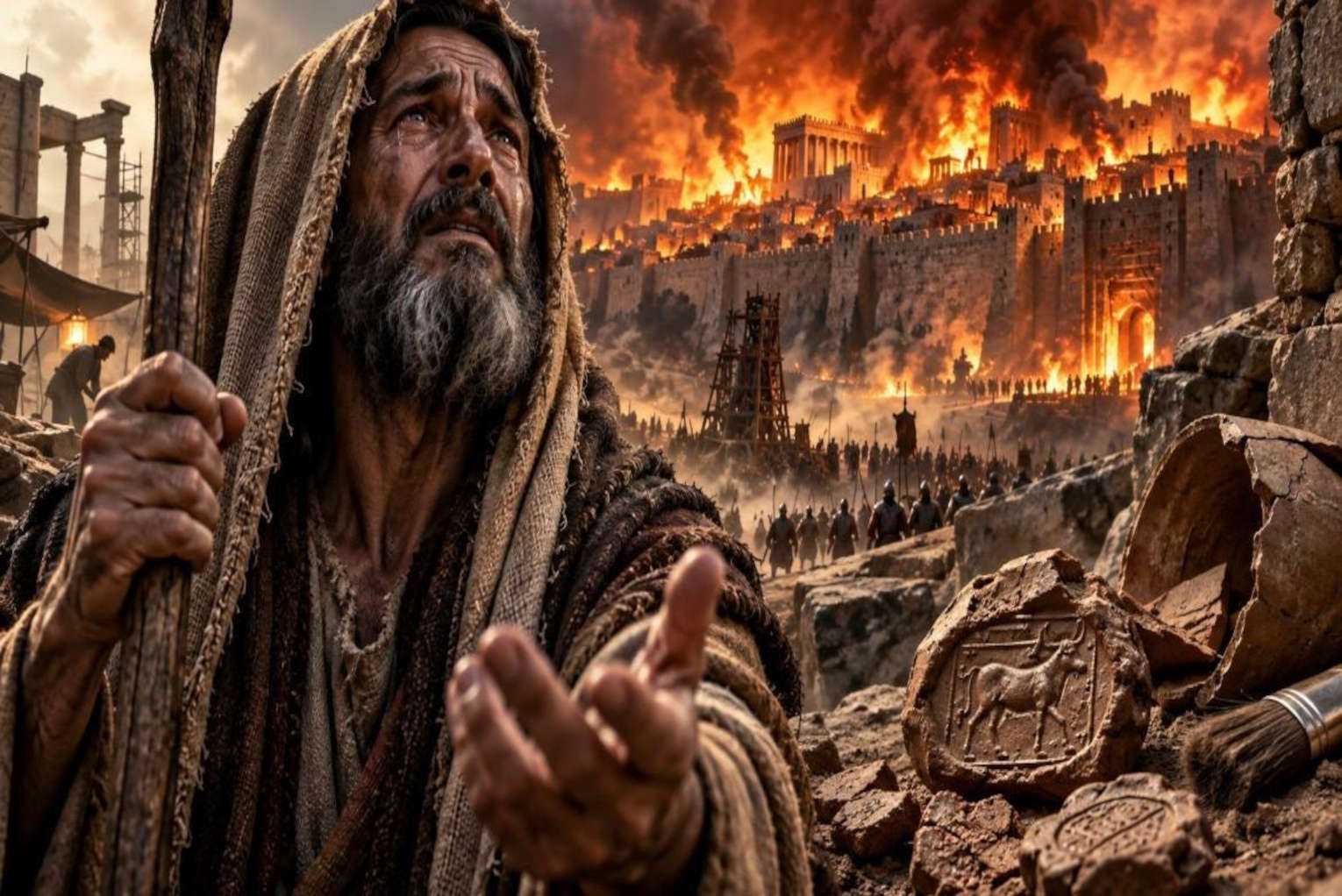
Nebuchadnezzar is one of the villains of the Bible. He is a sort of evil counterpart to King David. This Babylonian king would even level and burn the Solomonic temple in 586 B.C., and turn the entire Jewish nation into captives and exiles. This fall is extensively documented in the Bible, and it is known as the Babylonian captivity.
The prophet Jeremiah lived in these tempestuous times. It was an era of weak kings, with names like Jehoiakim, Jehoiachin and Zedekiah. They were vassals of Babylon, paying humiliating tribute and taking instructions from their foreign superiors. The last of them was Zedekiah, who finally rebelled against Nebuchadnezzar and provoked the final destruction of Judah.
Jeremiah was a doom and gloom man. In contrast to Isaiah, who stood alongside King Hezekiah, Jeremiah preached against the wicked kings of Judah, warning them that God’s punishment was coming, that even Jerusalem would fall, that a grim fate eventually awaited the king, and—even more shocking—he urged the Jews to surrender to the Babylonians, because this represented an acquiescence in divine judgment.
King Zedekiah did not want to hear this. He wanted to strengthen Judah’s resistance to the Babylonians, and he was not happy with Jeremiah’s counsel of surrender. According to the Bible, he rounded up several of his aides, including two particular princes named Jehucal son of Shelemiah and Gedaliah son of Pashur, and told them to keep an eye on Jeremiah. They urged Zedekiah to kill Jeremiah, but he refused. On their own, they took Jeremiah captive, and threw him into a cistern, but Jeremiah escaped.
By the way, I’ve stood in the very cistern into which they tossed Jeremiah.

Order Dinesh D’Souza’s New Book, “The Stones Cry Out” on Amazon.com!
The point is that these two fellows, Jehucal and Gedaliah, are barely mentioned in the Bible. They are minor figures, akin to movie characters who say just a few lines. We don’t hear much of them again. Later all of Jeremiah’s prophecies came true, Jerusalem was despoiled just as he said it would be, Zedekiah was blinded and his sons were killed, Judah as a nation was no more, and Jeremiah himself became an exile.
Now fast forward two and a half millennia. We are in the twenty first century, in the years 2005-2008. Archeologist Eilat Mazar and her team are excavating in the City of David area near the site of the temple and also of King David’s palace. Out of the ground come a number of clay seal impressions, also called bullae. Ironically the seals are preserved because of the burning of Jerusalem. The extreme heat hardens the clay, so that although the letters or documents are gone, the seals endure through time.
Once of the seals bears a name: Jehucal, son of Shelemiah. At first Mazar doesn’t recognize the name. Nor does anyone on her team. It’s just one seal among others. But then on a hunch she looks at a biblical concordance and there it is, right in the Bible. The seal is dated to the sixth century B.C. It is unmistakably the same guy. That’s 2005. And three years later, another name appears on a seal: Gedaliah, son of Pashur.
These are the same two individuals that King Zedekiah sent to solve the Jeremiah problem. And now they’re back, courtesy of biblical archeology. What are the chances? You can’t make this stuff up, and I mean that literally.
Skeptics and minimalists say the Bible was written centuries after these events, in the Persian period following Babylon’s own collapse and perhaps even later, during the Hellenistic era, but that can’t be right. Centuries later, who would know about minor court officials who served under King Zedekiah?
This would be like us today, using no written records, accurately giving the names of several members of the domestic staff who served nearly 200 years ago in President Van Buren’s White House. So if Jehucal and Gedaliah were real people, so obviously was Jeremiah, and equally obviously so was King Zedekiah. The Bible is vindicated here down to its smallest details.
The Babylonian destruction of Judah is well documented both historically and archeologically. Before the Babylonians attacked Jerusalem, they laid siege to the city of Lachish, which is also in Judah, southwest of the capital. In the 1930s the British archeologist James Leslie Starkey discovered several ostraca—which are pottery fragments containing written inscriptions—which are now known as the Lachish Letters.
These inscriptions, dated to the sixth century B.C., include a message from the commander of the fortress of Lachish to his commander in Jerusalem, basically saying he can no longer see the signal fires at the outpost of Azekah, because the Babylonians have overrun the city. Lachish is itself on the verge of collapsing, and we get a rare glimpse of the desperate urgency of its last holdouts.
The Lachish Letters support Jeremiah 34:7 which says that “the Great King of Babylon had laid siege to Jerusalem, Lachish and Azekah—the only fortified cities left in Judah.”
In 586 B.C., the armies of Nebuchadnezzar invaded and destroyed Jerusalem. This event, vividly recounted in the Bible, is extensively corroborated from Babylonian records, the so-called Babylonian Chronicles which are contemporary records kept on clay tablets that record the main events from each year, which have been recovered and deciphered by archeologists.
Here I want to focus on two telling details. Excavations in a Babylonian temple dedicated to the god Marduk produced a small cuneiform tablet, relatively mundane, that referred to a small gold offering made by the chief eunuch Nebo-Sarsekim in the tenth year of Nebuchadnezzar’s reign.
Who is this Nebo-Sarsekim? Not a figure of any importance in Jewish history. But he is mentioned in the Bible. Jeremiah 39: 3 states, “All the officials of the king of Babylon came and sat in the Middle Gate—Nergal-Sharezer of Samgar, Nebo-Sarsekim the chief officer.” Here is Jeremiah naming Babylonian officials who were present at the capture of the city. And once again, a minor character pops out of the biblical text and into the historical record.
The scattering of the Jews, which occurred after the fall of Jerusalem in 586 B.C., is known as the Jewish diaspora. It was perhaps the first diaspora of the whole nation, but it would not be the last. There would be another sacking, by the Romans, in 70 A.D. Once again, many Jews would be forced to leave their homeland. Diaspora has become a tragically familiar trope in Jewish history.
But it is important to note that, in every case, the Jews did not go willingly. They did not give up their claim to the land. Had they departed voluntarily, one could argue that they forfeited their ancestral claim to the land, which was understandably occupied by newcomers. This is indeed the unstated premise of Palestinian claims to the land. “The Jews left so naturally other people showed up and took their place.”
The Jews, however, did not abdicate—they were driven out. The Babylonians turned them into exiles, as the Romans would later make them refugees scattered across many nations. Consequently, upon their return many centuries later, the Jews insisted with good reason that they were simply reclaiming the land that had always been theirs, not merely by divine allocation, but also through the documented records of archeology and history.
Born in Mumbai, India, Dinesh D’Souza came to the United States as an exchange student in 1978. After graduating from Dartmouth College, he served as a policy analyst in the Reagan White House and a scholar in two prominent think tanks, the American Enterprise Institute and the Hoover Institution at Stanford University. He is a New York Times best-selling author who has written books on politics, religion, culture, and economics— including Illiberal Education, The End of Racism, What’s So Great About America, and United States of Socialism—and three books on Christian apologetics: What’s So Great About Christianity, Life After Death, and Godforsaken. D’Souza has made eight political documentary films and produces a daily podcast called The Dinesh D’Souza Podcast, which is seen and heard by about 100,000 people daily.
