

A strange mark on Mars can set imaginations racing. NASA’s Curiosity rover recently photographed broad, shallow pits in the bedrock of Mount Sharp, including one that looks a little like a footprint.
It isn’t one. But the rover team says the pits present a puzzle it has not encountered in 14 years of exploring the Red Planet.
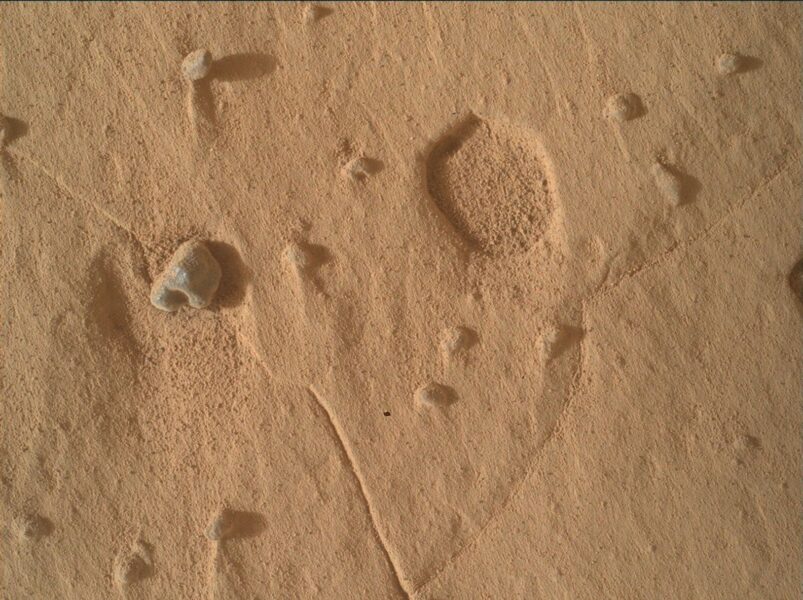
“Both of our workspaces this week contained features unlike quite anything we have seen in the past,” Michelle Minitti, deputy principal investigator for Curiosity’s Mars Hand Lens Imager, wrote in a NASA mission update.
Pits on Mars are common. Pebbles or hardened nodules can leave holes when they weather out of rock. These pits, however, are wider and shallower than ones the team has examined before. Researchers also saw no obvious objects that once filled them. One pit pictured by NASA measures about 0.39 inches across.
Curiosity used its cameras to document the pits and examined nearby rock with instruments that study its composition. Researchers found layers that appear chemically different from the surrounding bedrock. They have not determined how the pits formed or what those layers reveal about the area’s history.
Space.com’s description of the pits as odd “footprints” captures what makes images like these so compelling: We recognize a familiar shape in an unfamiliar place, then want to know what made it.
That fascination reaches well beyond Mars. People are also paying closer attention to what governments are doing in the space around Earth. This week, the United States publicly acknowledged that it has deployed weapons in orbit, adding a military dimension to a place many of us still picture chiefly as a frontier for exploration.

Order Paul Bock’s New Book, “The Disclosure Agenda” on Amazon.com!
“We are increasing readiness against existing threats, and the United States has on-orbit space control weapons capable of defending the Joint Force against hostile adversary action,” Air Force Secretary Troy Meink said Monday, according to the U.S. Space Force. Officials did not disclose how the weapons work or when they were deployed.
The two developments tell separate stories, but both invite the same careful attention. Curiosity’s images give us a new Martian feature to investigate. Meink’s announcement tells us that military activity in orbit is more advanced than officials had publicly acknowledged. Each leaves substantial questions open — and gives the public a reason to keep watching what happens beyond Earth.
James Lasher, a seasoned writer and editor at Charisma Media, combines faith and storytelling with a journalism background from Otterbein University and ministry experience in Guatemala and at the LA Dream Center. A Marine Corps and Air Force veteran, he is the author of The Revelation of Jesus: A Common Man’s Commentary and a contributor to Charisma magazine. For interviews and media inquiries, please contact [email protected].
