
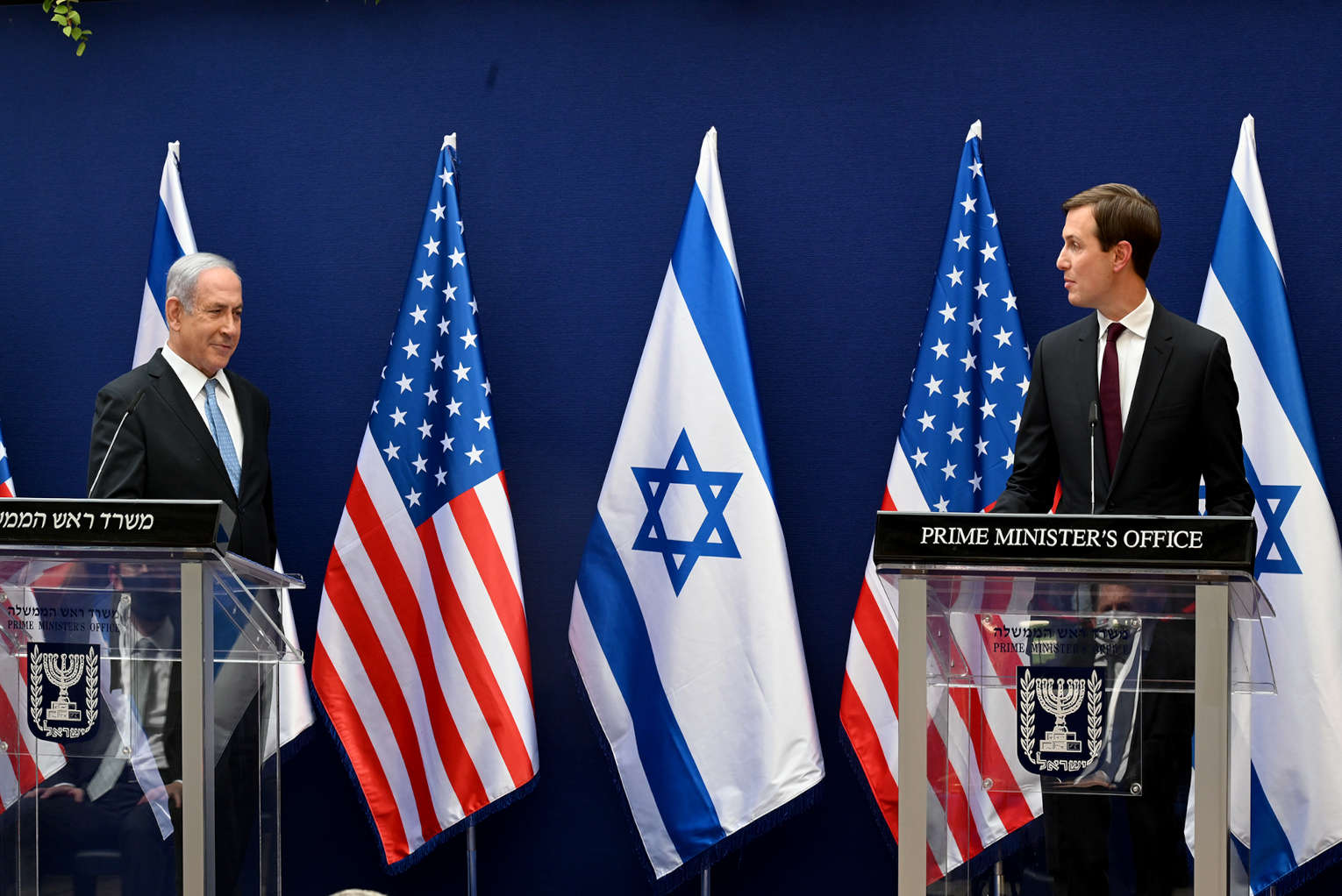
Israel’s Prime Minister Benjamin Netanyahu and U.S. President Donald Trump’s envoy, Jared Kushner, met for over four hours in Jerusalem on Monday, discussing the U.S.-backed framework to end the Gaza war, which Hamas ostensibly approved.
Netanyahu rejected the 15-point proposal by the Board of Peace (BoP) last week and has since come under pressure from the U.S. to enable continued discussions on this basis by scaling back airstrikes against Hamas in the Gaza Strip.
The Prime Minister’s Office stated that Netanyahu and Kushner, who were later joined by BoP High Representative Nikolay Mladenov and BoP envoy Tony Blair, “had deep and constructive discussions.”
It added that they agreed to establish two working groups, “one on disarmament and demilitarization of Gaza,” which they said should be “prompt and completed before any reconstruction happens.”
The second working group is to focus “on sanitation, clean water and other public health issues for the people of Gaza.”
At the time of publication, the official statement had only been published in English, highlighting Netanyahu’s efforts to control the political narrative and prevent the talks from being used as munition for attacks from his right, as election season is in full swing.
Highlighting this issue, Finance Minister Bezalel Smotrich promptly urged Netanyahu to forgo the talks and instead “conquer [the Gaza Strip] completely, establish a military government there, establish Jewish settlement there.”

Order Dinesh D’Souza’s New Book, “The Stones Cry Out” on Amazon.com!
Smotrich has repeatedly criticized the BoP’s plans, arguing on Monday that “there is no one in the world who will do the work for us. There is no country in the world that will send its soldiers to shed their blood and forcibly disarm Hamas.”
The Board of Peace said in a statement cited by several Israeli media outlets that “it was agreed that there would be no redeployment of IDF forces out of Gaza until Hamas is completely disarmed and the entire Gaza Strip is demilitarized — all weapons, light and heavy, and all tunnels.”
According to Israeli media reports, Kushner and the BoP assured Netanyahu that, while the weapons would be transferred to warehouses under the authority of the new technocratic government (NCAG), a U.S. general would be tasked with supervising their decommissioning.
The statement noted that “Israel retains its full right to self-defense: if Hamas turns to terrorism, violence, or attempts to rearm, Israel retains the right to act accordingly.” This leaves unclear whether the U.S. opposes targeted assassinations of terrorists, which could be argued don’t always constitute “imminent” threats.
While the meeting was ongoing, Trump told Fox News that Israel should stop airstrikes in Gaza, again without specifying exactly what he meant. A BoP official told the news outlet Axios that the president talked about strikes that are not against imminent threats.
According to i24 News’ Amichai Stein, the issue was left unresolved, as Netanyahu stated that targeted assassinations would continue and Kushner made clear that he opposed them.
“With the support of President Trump, the parties share clear objectives: a fully demilitarized and deradicalized Gaza that poses no threat to Israel, where the people of Gaza can pursue prosperity and dignity through peaceful means,” the BoP stated.
“The direction of the meeting was positive, and there is a mutual desire to give this a chance,” a BoP source told Ynet News.
“Within a few weeks, Hamas will have to demonstrate real and tangible steps showing that it is actually beginning to disarm. Not just ‘on paper.’ If it does so, that will be a very positive step. If it does not, it will be clear to everyone that it does not intend to actually implement the commitments it signed. In that case, Israel will have international diplomatic backing to act to disarm Hamas,” the source claimed.
“The Israelis are going to give this a chance. Now it is up to Hamas to show whether it really intends to comply.”
After the meeting with Netanyahu, Kushner and the BoP officials also met President Isaac Herzog.
The president later expressed his thanks for their efforts to advance the peace plan, noting he was “impressed that Israel’s security interests are an important and central element of their plan. I commended and encouraged their efforts to ensure a brighter and more secure future for the people of Israel, the people of Gaza, and the entire region.”
This article originally appeared on ALL ISRAEL NEWS and is reposted with permission.
