
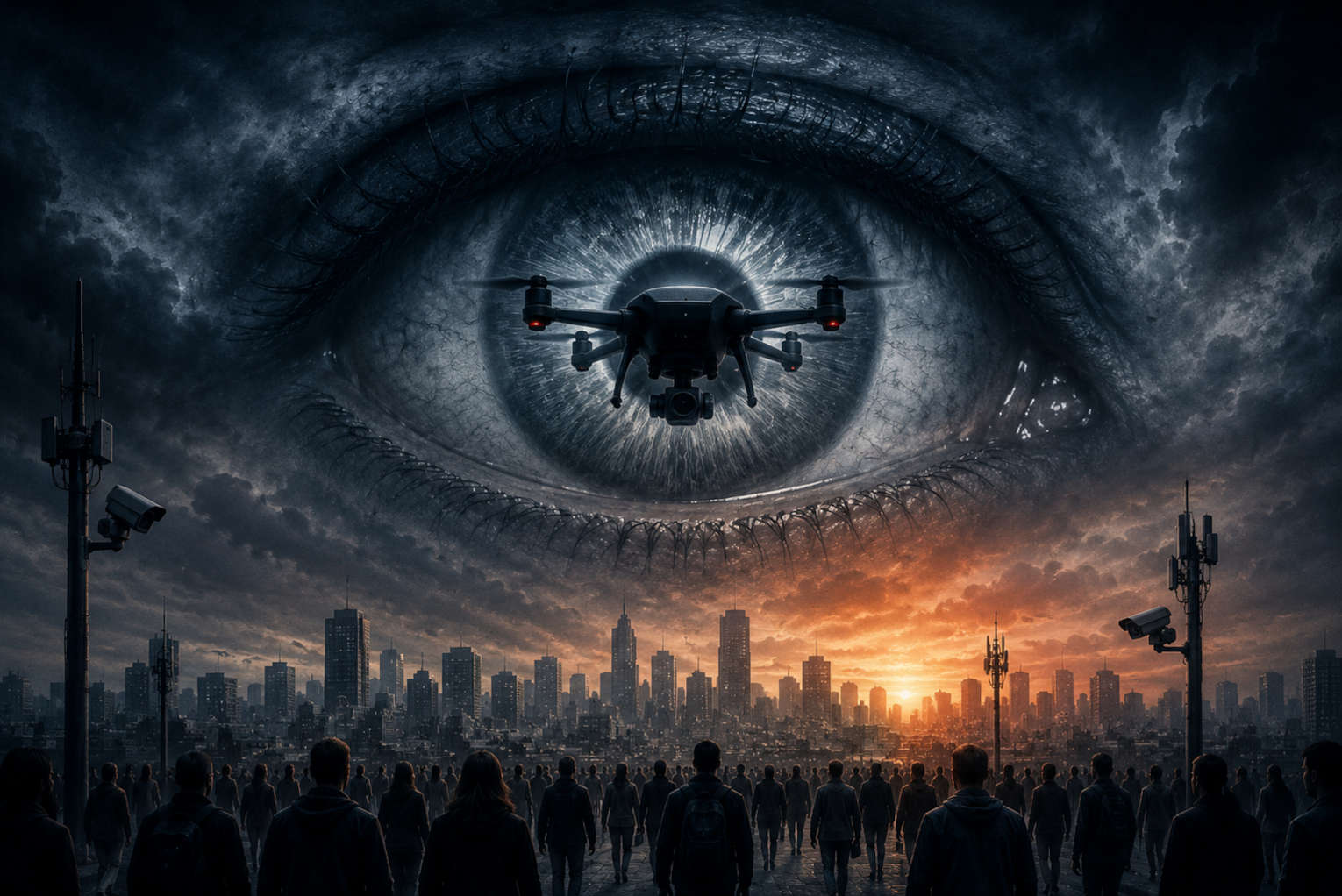
When George Orwell wrote Nineteen Eighty-Four in 1949, the idea of authorities monitoring citizens with near-constant awareness seemed like dystopian fiction.
Today, police departments across America are deploying drones that can fly into homes, track suspects, locate individuals before officers arrive and, in at least one California case, physically remove a weapon from a suspect’s hand.
Officials hailed the incident as a “nationwide first.”
Most Americans watched the video and saw an innovative law enforcement tool. Many likely viewed it as a safer alternative to a potentially deadly confrontation.
And to be fair, there is a strong argument that such technology can save lives.
But we should be asking a deeper question.
Not whether this particular drone was justified.
Not whether this particular suspect deserved to be arrested.
But what kind of world is being built around us?
The Infrastructure Before the Empire
The Sacramento County Sheriff’s Office recently demonstrated how a drone equipped with a magnet could enter a residence and remove a knife from the hand of an armed suspect, according to SFGate. Elsewhere in California, drone-as-first-responder programs are expanding rapidly, with drones arriving at emergency scenes before deputies in more than 70% of cases.
Law enforcement agencies describe the technology as a force multiplier. Supporters say it protects officers and civilians alike.
Yet history teaches us that technologies rarely remain limited to their original purpose.
The internet connected the world and transformed communication. It also became a tool for surveillance, censorship and data collection.
Smartphones gave people unprecedented access to information. They also created the most comprehensive voluntary tracking system in human history.
Artificial intelligence promises extraordinary benefits while simultaneously raising concerns about privacy, autonomy and control.
The issue is never the technology alone.
The issue is what happens when powerful tools become integrated into powerful systems.

Order Mark Biltz’s New Book, “The Final Tyrant” on Amazon.com!
Orwell’s Warning Was Never About the Machines
The author of Nineteen Eighty-Four was not primarily concerned with machines. He was concerned with centralized authority empowered by technology. The famous telescreens of Orwell’s world were merely instruments that enabled a government to monitor behavior, suppress dissent and enforce conformity.
In many ways, modern technology has surpassed Orwell’s imagination.
Big Brother watched from a screen mounted on a wall.
Today’s technology flies overhead, identifies faces, tracks locations, analyzes behavior and increasingly operates with artificial intelligence.
If Orwell feared what governments could do with a camera on a wall, what might he have thought of autonomous drones, biometric databases and artificial intelligence capable of processing vast amounts of information in real time?
When Revelation Becomes Technologically Possible
For us, this raises another question—one rooted not in fiction but in biblical prophecy.
Revelation 13 describes a future global system capable of controlling commerce, enforcing allegiance and punishing those who refuse to comply. For centuries, skeptics mocked such a scenario as impossible. How could any government monitor billions of people? How could authorities enforce restrictions on a worldwide scale?
Those questions are becoming easier to answer.
Drones. Artificial intelligence. Biometric identification. Digital currencies. Real-time surveillance networks.
None of these technologies are the mark of the beast.
None of them, by themselves, fulfill biblical prophecy.
But together they reveal something important: humanity is constructing tools that make the level of control described in Revelation technologically conceivable.
That should not produce fear in us.
It should produce discernment.
The Bible never commands us to panic when we see the world changing. It calls us to remain watchful, grounded in truth and aware of the times.
Watching the Signs of the Times
A police drone removing a knife from a suspect’s hand is not the Beast system.
But it is another reminder that the technological barriers that once made global monitoring and enforcement seem impossible are rapidly disappearing before our eyes.
Orwell warned about a future in which people would surrender freedom for security.
The apostle John saw a future system, the Beast System, that would demand allegiance and exercise unprecedented control.
As we watch these technologies emerge, we should not respond with fear. We know who sits on the throne. But we should be discerning. We should be watchful. And we should recognize that many of the capabilities once dismissed as science fiction now exist in the real world.
Whether these developments ultimately play a role in the fulfillment of biblical prophecy remains to be seen. What cannot be denied is that the infrastructure for unprecedented surveillance, monitoring and enforcement is being built before our eyes.
As Jesus instructed, we must watch, discern the times and remain faithful. The technology may be new, but the warning is ancient.
James Lasher, a seasoned writer and editor at Charisma Media, combines faith and storytelling with a journalism background from Otterbein University and ministry experience in Guatemala and at the LA Dream Center. A Marine Corps and Air Force veteran, he is the author of The Revelation of Jesus: A Common Man’s Commentary and a contributor to Charisma magazine. For interviews and media inquiries, please contact [email protected].
