
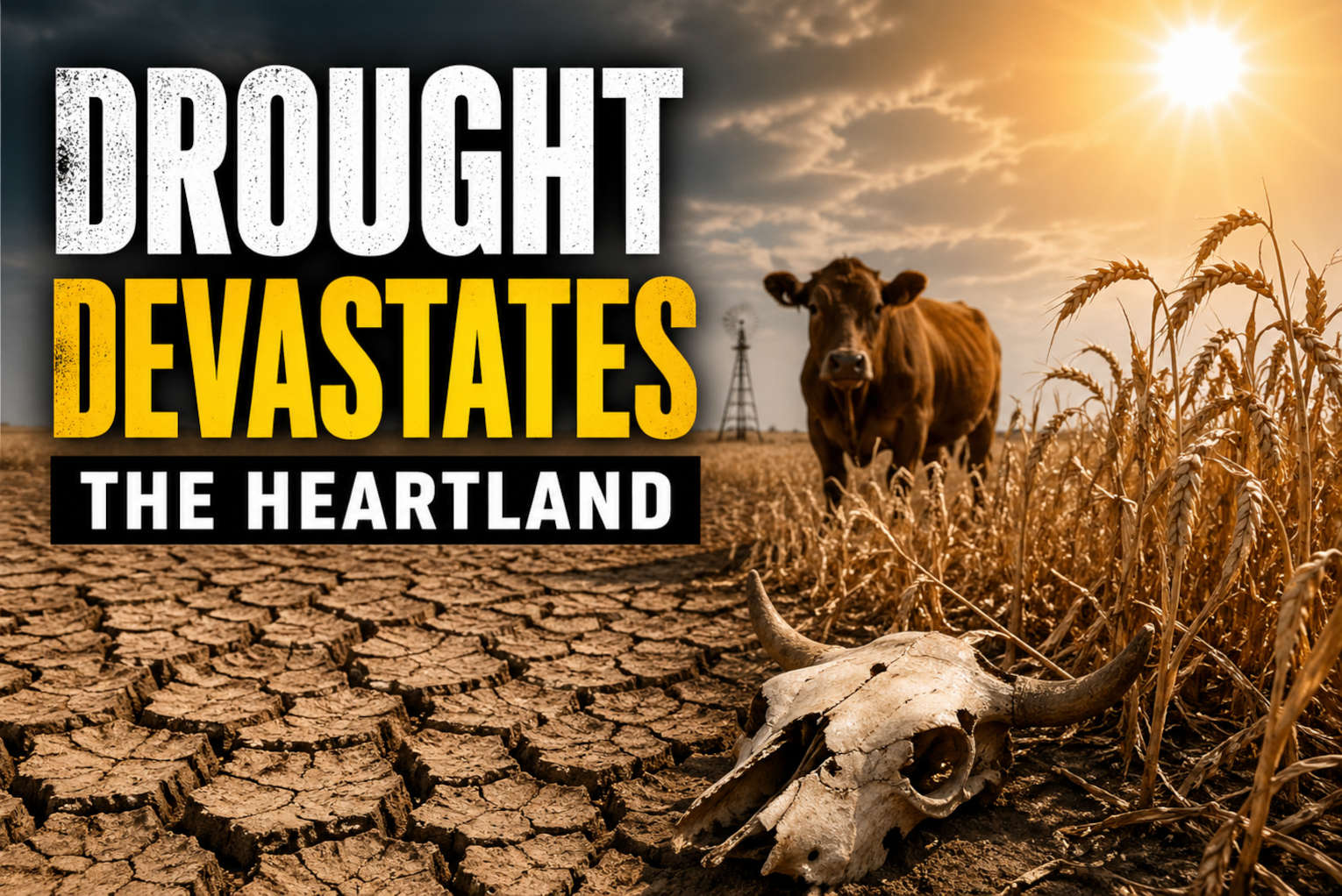
A worsening drought across the Great Plains is threatening America’s winter wheat harvest and forcing ranchers into painful financial decisions as dry conditions continue to intensify across key agricultural states.
As reported by Fortune, nearly 90% of Nebraska and Oklahoma are now under drought conditions, with more than half of Nebraska classified in “extreme” drought after months of limited rainfall, unusually warm temperatures and depleted soil moisture.
The drought is striking at one of the most important moments of the growing season as winter wheat matures ahead of the summer harvest. Without rain or irrigation, crops are struggling to produce grain, and some farmers are abandoning harvest efforts altogether and allowing cattle to graze the damaged fields instead.
“We’ve got a lot of modern precedent for these very rough conditions heading into the spring growing season, but this certainly ranks up there with some of the worst we’ve seen,” said Brad Rippey.

Order Jonathan Cahn’s New Book, “The Altar of Pergamon” on Amazon.com!
The latest USDA data shows only 30% of the U.S. winter wheat crop is rated good to excellent, the weakest condition rating since 2023. Roughly half the crop across major wheat-producing states including Colorado, Nebraska, Oklahoma and Texas is now categorized as poor to very poor.
At the same time, farmers are dealing with soaring production costs. Fertilizer prices have climbed sharply following military strikes involving the United States, Israel and Iran, adding even more financial pressure to an already strained agricultural sector.
“I didn’t have enough moisture — it wouldn’t have done any good,” said Frank Lucas regarding his decision not to purchase nitrogen fertilizer for his wheat fields. “Number two, I’m not even sure what the cost would be.”
The drought is also hammering cattle producers. Dry pastureland and a wave of destructive wildfires have burned roughly 1 million acres of hayfields and grazing land across the southern Plains, damaging efforts to rebuild the U.S. cattle herd after years of decline.
“Drought just sets everything back,” said Ben Smith, a field operations manager with Farm Rescue. “That’s when guys start to have to make tough decisions on liquidating some of their herd if they can’t afford to buy feed or can’t find alternative feed.”
Forecasts show little immediate relief. Climate outlooks call for continued heat and below-average rainfall through much of the summer, increasing evaporation rates and further drying already stressed farmland.
“Moisture is desperately needed,” Rippey said, warning that the coming weeks will determine whether the winter wheat crop is “made or broken for 2026.”
James Lasher, a seasoned writer and editor at Charisma Media, combines faith and storytelling with a journalism background from Otterbein University and ministry experience in Guatemala and at the LA Dream Center. A Marine Corps and Air Force veteran, he is the author of The Revelation of Jesus: A Common Man’s Commentary and a contributor to Charisma magazine. For interviews and media inquiries, please contact [email protected].
