
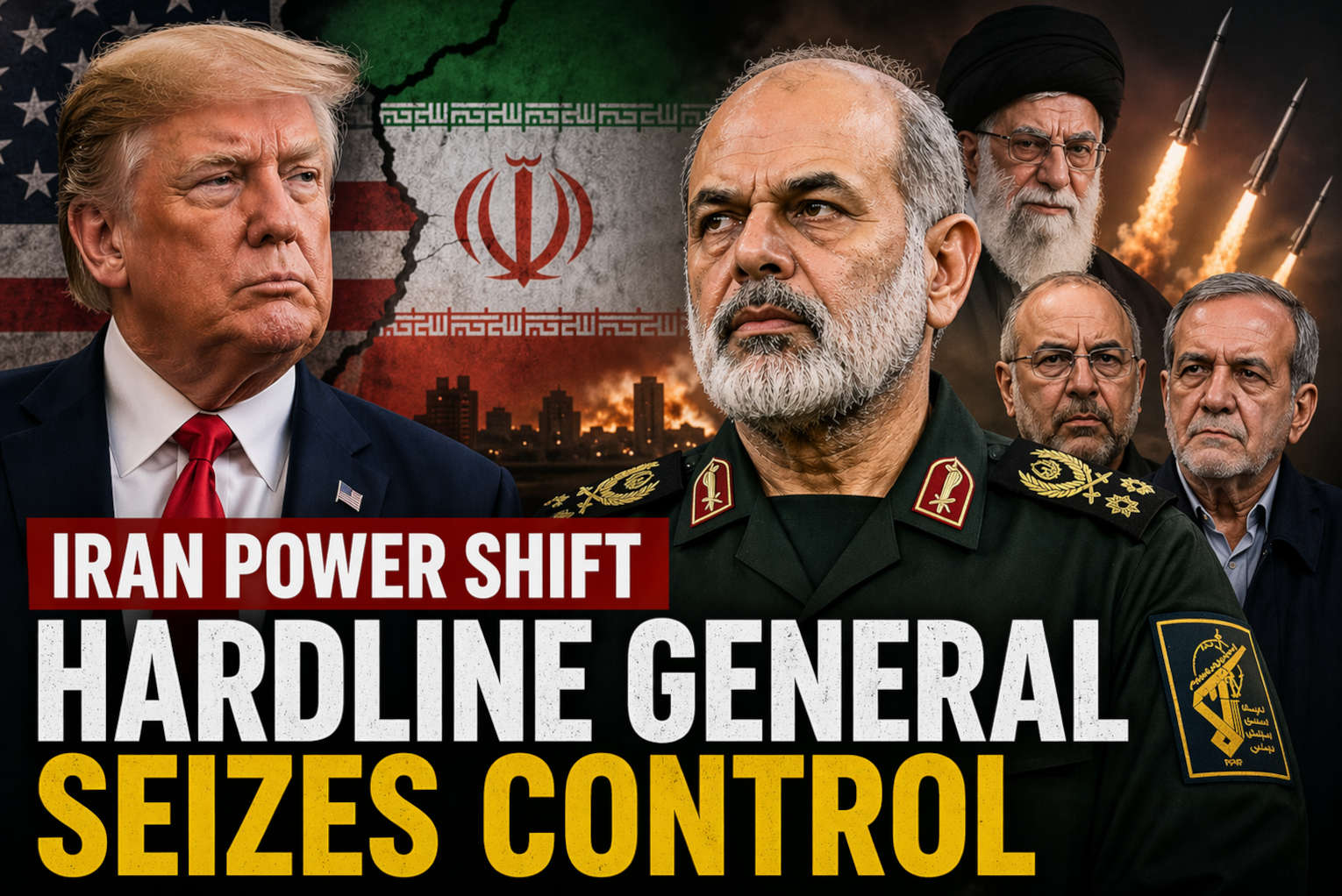
Days before the temporary ceasefire between the U.S. and Iran is supposed to expire, the regime’s most hardline faction, led by Major-General Ahmad Vahidi, commander of the Revolutionary Guard Corps (IRGC), has seized the reins of power, according to several reports.
On Tuesday evening, U.S. President Donald Trump appeared to confirm that something was shifting in Tehran, announcing an extension of the ceasefire based on “the fact that the Government of Iran is seriously fractured, not unexpectedly so.”
“During these three past days, something weird happened, especially in the space around who is ruling Iran,” said Aimen Dean, a former Al Qaeda terrorist turned intelligence analyst.
In Monday’s episode of the Conflicted podcast, which he co-hosts, Dean explained that, since the elimination of several senior leaders, the regime had been under the thumb of Parliament Speaker Mohammad-Bagher Ghalibaf, who wanted to present himself as the new “Gorbachev” of Iran, a reference to the last leader of the Soviet Union, Mikhail Gorbachev.
When Trump spoke of having already achieved a “regime change” in recent weeks, Dean explained that he was referring to Ghalibaf.
He helped build Iran’s global terror network — now he’s gaining more power within the regime as a ceasefire hangs in the balance.
— Fox News (@FoxNews) April 20, 2026
Meet Ahmad Vahidi, a former Quds Force commander who led the group of fighters before Qassem Soleimani took over the elite unit, and a firm believer… pic.twitter.com/QAaKK6VL4v
The former IRGC general had seemingly managed to coopt the powerless Iranian President Masoud Pezeshkian, Foreign Minister Abbas Araghchi, and more economically-minded IRGC officials into a ruling faction.
“He was leading a coup… he had the support of Russia, of China, some GCC members, including Saudi Arabia, most importantly from Turkey and of course, the Pakistanis wanted to support him. Of course, the Pakistanis were presenting him to the Trump administration as ‘this is now the face of the regime change,’” Dean said.
However, the past week was marked by various, contradictory signals from Tehran regarding its position in the negotiations with the United States.
U.S. Vice President JD Vance already said after a first round of talks that Iran’s “on-site negotiating team lacked the authority to produce an agreement and had to return to Tehran to seek approval from the supreme leader and others.”

Order Jonathan Cahn’s New Book, “The Altar of Pergamon” on Amazon.com!
Vahidi, a veteran IRGC commander, was instrumental in building ties with proxies like Hezbollah as the first leader of the Quds Force, before serving as defense and interior minister.
“He is a very violent man and belongs to a generation that fought in guerrilla warfare,” Beni Sabti, an Iran expert at the Israeli Institute for National Security Studies, told Fox News.
Vahidi assumed leadership of the IRGC last month, and soon after, experts began to sounding alarm bells: “While the egotistical Ghalibaf has played to the limelight, a far more powerful figure is likely to be silently pulling the strings,” wrote Kasra Aarabi and Saeid Golkar in The Telegraph.
BREAKING:
— דרור בלאזאדה | Dror Balazada (@DBalazada) April 20, 2026
A source close to the IRGC told Channel 14: “IRGC Commander Vahidi is taking a positive stance toward not continuing the negotiations. From his perspective, there is no need to rush into a deal. He believes Trump will eventually back down and does not believe his… pic.twitter.com/0531GYMrQh
They described Vahidi as “a Khamenei absolutist,” who had remained in the shadows due to being “the key cog in the regime’s chain of command,” whose survival is “essential to its continuity.”
Vahidi quickly bolstered his influence in the regime before apparently deciding to make his move. Over the past week, public statements made by Araghchi and other officials were quickly contradicted by IRGC-affiliated media outlets.
The Institute for the Study of War (ISW) think tank concluded on Saturday that Vahidi and his inner circle “have likely secured at least temporary control over not only Iran’s military response in this conflict but also Iran’s negotiating position and approach within the past 48 hours.”
In its report, ISW noted an IRGC attack on a commercial vessel that came only a day after Araghchi had announced the Strait of Hormuz was “completely open” to commercial traffic.
The report also stated that the Supreme National Security Council (SNSC) said on Saturday that Iran would “exercise supervision and control” over the Strait until the end of the war. It added that the statement “would almost certainly not have been released” without approval from its new secretary, Mohammad Bagher Zolghadr, suggesting the powerful council is aligned with Vahidi.
This appears to confirm earlier reports that Vahidi pushed for Zolghadr’s nomination despite objections from Pezeshkian.
The opposition-aligned outlet Iran International reported on April 1 that Vahidi and the IRGC had “blocked presidential appointments and decisions while erecting a security perimeter around the core of power, effectively sidelining the government from executive control.”
After the first round of negotiations in Pakistan, Ali Abdollahi Aliabadi, commander of the unified military headquarters, called Khatam al-Anbiya, reportedly took part in meetings with Pakistani Field Marshall Asim Munir, indicating the growing direct involvement of the military in the negotiations.
“Vahidi and individuals close to him may have effectively controlled the negotiations process throughout the war, which is traditionally a role reserved for political leaders,” ISW concluded.
“Vahidi holds the most influential position in the regime at this time, apart from the Supreme Leader, who is reportedly seriously injured or incapacitated.”
ISW also cited a report from Israel’s Channel 14 indicating that Vahidi is the only official with direct access to the hospitalized supreme leader, Mojtaba Khamenei.
According to Dean, citing a senior Saudi intelligence official and a senior intelligence official in another “important” regional country, Vahidi entrenched his power with a coup over the weekend. On Tuesday, unconfirmed rumors even suggested that Ghalibaf, Pezeshkian and Araghchi had been placed under house arrest.
Meanwhile, Vahidi’s influence over the negotiations has quickly become apparent.
“We are talking about a formidable individual… he is now in charge of Iran, he led the countercoup and immediately paraded Ghalibaf and the president on national TV to explain themselves, that they are not negotiating away Iran’s achievements in the nuclear field, to give up Iran’s rights on the Hormuz Strait,” said Dean.
STATEMENT BY PRESIDENT DONALD J. TRUMP: pic.twitter.com/ATdRyY1qqK
— The White House (@WhiteHouse) April 21, 2026
A source close to the IRGC told Channel 14, “Vahidi holds a positive stance toward not continuing the negotiations. From his perspective – there’s no need to rush into an agreement. He believes that Donald Trump will lose patience and fold and does not believe his threats.”
On Tuesday evening, Trump declared that the war against Iran would be suspended “until such time as their leaders and representatives can come up with a unified proposal,” and the ceasefire would be extended “until such time as their proposal is submitted.”
“These extremists, the generals of the IRGC, do not care if Trump or Netanyahu intend to bomb every bridge, power plant, or piece of infrastructure in the country,” warned Babak Taghvaee, a defense and security analyst, who is also an Iran expert.
“They are willing to sacrifice the entire Iranian population for their barbaric, terroristic ideology, including the development of nuclear weapons intended to eradicate Israel. From their perspective, this could trigger an apocalyptic event, facilitating the return of the Imam Zaman to Earth. This is the foundation upon which their regime is built.”
(Imam Zaman is the 12th Imam also known as the Mahdi, who will emerge at the end of time to establish peace and justice under Islam over the whole Earth, according to Shia Muslim eschatology)
This article originally appeared on ALL ISRAEL NEWS and is reposted with permission.
