
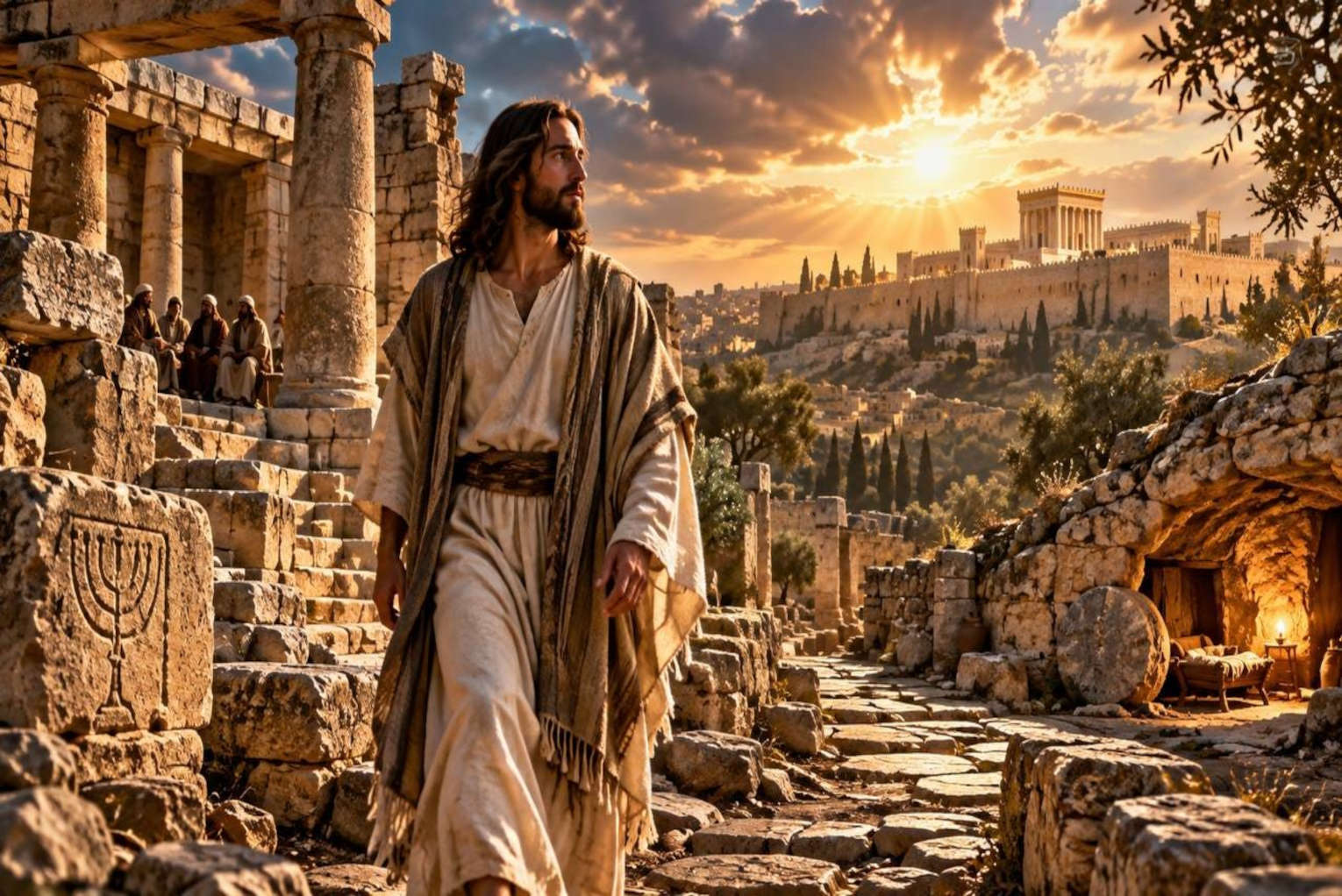
Jesus Christ is the most famous and influential figure in human history. Yet from an archeological point of view, Jesus would seem very hard to find. He was in some respects like Abraham: a nomadic figure, with no settled abode, leaving virtually no physical footprint on the sands of time. How, then, can we hope to walk in the literal footsteps of Jesus?
Jesus also represents the ordinary man. His father was a carpenter, and he became one too. His associates were fishermen, drawn from the lower strata of society. Prior to Jesus, great men of history were presumed to be kings and aristocrats and high priests and prophets, all of them far removed from the common people.
But the gospels confer on Jesus and the apostles so much sublime dignity that they inaugurate a moral revolution, one in which the ordinary man has the same worth, and is capable of the same great deeds, that were previously the prerogative of the high and mighty.
Jesus produced what the philosopher Nietzsche would later call a “transvaluation of values.” In Christian terms, one can say that the last were now first and the first were now last. In today’s language, the big people dropped down a notch, and the little people rose up a notch. Many changes—ethical, cultural and political—would arise out of this important shift.
Jesus is also a Jew. His name is Yeshua, his mother is Miriam, his father is Yosef. Jesus celebrates the Jewish holidays and goes to the Jewish temple. He teaches out of the Hebrew Scriptures. He is part of a flourishing intramural Jewish debate in the first century A.D. In this respect, it would not be inaccurate to say, as Dennis Prager has, that Jesus carried a Jewish message to the world.

Order Dinesh D’Souza’s New Book, “The Stones Cry Out” on Amazon.com!
Not the Jewish message, because Jesus’ message is today rejected by Jews, but a Jewish message, because he was a Jew who spoke as a Jew to other Jews. His life mission was almost entirely among the Jews. The New Testament, in this respect, is no less Jewish than the Old. All its writers, with the exception of Luke—a medical doctor and a Gentile—are Jews.
This is important because Jesus is himself the connection between Judaism and Christianity. He saw himself not as replacing or supplanting Judaism but as fulfilling it. His apostles including Paul—the missionary to the Gentiles—remained Jewish until their deaths. They were Jewish followers of Jesus, whom they regarded as the messiah. In a sense, they were the first Judeo-Christians.
The historicity of Jesus has never been open to serious doubt. The evidence for Jesus’ existence is very strong, and goes beyond the four gospel writers who describe his life in vivid detail, quite obviously speaking of a real person and not a fictional character. But there are also non-biblical attestations for Jesus that date to just decades after his death. What makes these even more credible is that they come not merely from non-Christian sources, but from sources hostile to Jesus and Christianity.
The Roman historian Tacitus in his Annals speaks of a figure he calls “Christus” who is executed during the reign of Tiberius Caesar and whose followers are persecuted by the emperor Nero. The Jewish historian Josephus writes of “Jesus, who was called the Christ,” and refers to his death by order of Pontius Pilate. The Roman governor Pliny the Younger, in a letter to emperor Trajan, describes Christian practices and notes that these people worship “Christus” as a god. The Roman historian Suetonius speaks of Jews expelled from Rome due to unrest “at the instigation of Chrestus.”
Historians consider this ironclad evidence of Jesus’ existence, execution and subsequent role in inspiring the rise of Christianity. Incidentally “Christus” and “Chrestus” are references to “Christ,” which is not Jesus’s last name but rather the title assigned to him by the early Christians. “Christ” means “anointed one,” which is to say, messiah.
According to the Bible, Jesus was born in a manger in Bethlehem. A manger is a place for storing cattle, so mangers were not part of residential homes. Typically mangers were in caves, often called shepherd’s caves. The early church father Justin Martyr said that Mary gave birth to Jesus in a manger “in a certain cave.” Still, what are the chances of locating the cave or caves where Jesus was born?
Here, incredibly, the Roman emperor Hadrian comes to the rescue. Hadrian reigned from 117 to 138 A.D., and he made it his mission to stamp out the Christian holy sites, including the sites of Jesus’s birth and death. Obviously he knew where the early Christians venerated those sites, so he built pagan monuments and shrines right on top of them.
Little did Hadrian realize that he was marking those sites for later identification. It is one of the ironies of history—and archeology—that just as the historicity of Old Testament, and of the kings and prophets of the Bible, is affirmed by some of the most hostile enemies of Israel, so too, the precise locations of the holiest sites in the New Testament are possible with the assistance of a Roman emperor unremittingly hostile to Christianity.
When Constantine converted to Christianity in the early fourth century A.D., he sent his mother Helena to the holy land to identify the holy sites associated with Jesus. Helena knew just where to look! She found the pagan monuments erected by Hadrian, and she removed them and replaced them with churches.
In Bethlehem, Hadrian had commissioned a cultic grove in honor of the Greek god Adonis. Today the Church of the Nativity stands in that spot. Beneath the church is a cave that has been venerated since ancient times as the place where Jesus was born. The Israeli archeologist Gabriel Barkay, who is not a Christian, says that he is convinced this is the authentic birthplace of Jesus.
Jesus grew up in Nazareth, which was in that time a small village of a few hundred people. In 1881 the French Sisters of Nazareth were digging in that area to build a convent. They found an ancient cistern which encouraged them to excavate further. To their astonishment, they found the remains of a church that dated back to the Crusader period.
Interesting! But even more interesting was what was beneath that church. The nuns found the remains of a fifth century Byzantine church, and below that building, there were steps leading to a small courtyard house. It had graffiti from early Christians linking the humble dwelling to Mary and Jesus. This graffiti, plus the presence of the ancient church, suggest the veneration of the site through the centuries as one of the holiest of Christian sites. In the view of archaeologist Ken Dark, this is quite likely the childhood home of Jesus.
Jesus was raised in Nazareth, but his ministry was headquartered at Capernaum in the Galilee region of northern Israel. The gospels say that Jesus “made his home in Capernaum by the sea,” and that “when the Sabbath came, Jesus went to the synagogue and began to teach.”
Today, in Capernaum, we find the grandiose structure of the synagogue. This synagogue is built of white limestone, and dates back to the fourth or fifth century A.D., but underneath it are the remains of an earlier synagogue built out of black basalt. Pottery from that synagogue dates it to the first century A.D. That’s the synagogue in which Jesus taught.
Just a few yards from that synagogue are the ruins of a first century house, now encompassed in a church. We can see the ancient dwelling through the glass floor of the church. While this was once a residence, it is also clear that it had been modified to be a sort of meeting room. Excavators found in the dwelling graffiti mentioning the names of Jesus, Peter and several pilgrims who visited. The pilgrims were there for a reason—they believed that this was no ordinary dwelling.
We know from gospel passages that next to the synagogue in Capernaum was the house of the apostle Peter—or more accurately, Peter’s mother-in-law’s house. And now, virtually without doubt, it has been found. This is quite likely where Jesus stayed in Capernaum, and it is most likely the place he gathered with Peter and the other apostles. The church encompassing the humble dwelling is called the Pilgrimage Church of St. Peter.
In the final phase of his life, Jesus’s ministry took him to Jerusalem, and it is here that we can trace the steps that Jesus walked, thanks to a breathtaking archeological discovery that has been called the most significant to date of the twenty first century. It is the unearthing of the Pilgrimage Road linking the Pool of Siloam to King Herod’s Second Temple.
When I asked Ze’ev Orenstein of the City of David Foundation, the group completing this excavation, what the chances are that Jesus ritually purified himself in the Pool of Siloam and walked the upward path to the Temple, he replied—himself an observant Jew—“One hundred percent.” While Jews living in Jerusalem often had their own ritual baths to purification rites, out of town Jews like Jesus immersed themselves in the Siloam pool before trekking the 600 meter distance to the Temple.
Millions of Jews did this through the centuries; Jesus was one of them.
How were the pool and the accompanying pathway to the temple discovered? In 2004, a sewage pipe burst underneath a road at the southern end of the City of David. The workers getting ready to repair the pipe noticed a series of ancient stone steps. These steps were similar to another set of stone steps leading toward Herod’s temple.
Archeologists Eli Shukron and Ronny Reich excavated the area and found the ancient Pool of Siloam, which is mentioned four times in the Bible. The pool is huge, covering the space of two Olympic-sized swimming pools. This means that tens and maybe hundreds of thousands could use it for ritual immersion on a single holiday.
The Pool of Siloam is connected to the Temple by a walking path known as the Pilgrimage Road. Excavating the Pilgrimage Road has proven to be a formidable enterprise, because it runs underneath residential neighborhoods. But with careful and innovative excavation and the installation of massive iron girders, the City of David Foundation pulled it off, and we can now walk the very road the pilgrims walked two thousand years ago.
It is a moving experience for both Jews and Christians. For Jews, it’s where their ancestors bathed and then ascended to the temple. No less than 15 Psalms (Psalm 120 to 134) begin with a “song of ascent” and when you walk this path you realize that the verses aren’t metaphorical; they are describing a physical upward climb. There is ash alongside the walls here that was produced when the Romans burned Jerusalem in 70 A.D.
I’ve seen the ash; I’ve even had some deposited in the palm of my hand.
And for Christians it is indescribably moving to stand where Jesus stood, and walk where he walked. Here, in Israel, and only in Israel, the Bible comes alive and we realize, both Jews and Christians, that our sacred texts are well grounded in history. As it turns out, what we believe and what our civilization is anchored on is not simply a matter of faith; it is also a matter of fact.
Born in Mumbai, India, Dinesh D’Souza came to the United States as an exchange student in 1978. After graduating from Dartmouth College, he served as a policy analyst in the Reagan White House and a scholar in two prominent think tanks, the American Enterprise Institute and the Hoover Institution at Stanford University. He is a New York Times best-selling author who has written books on politics, religion, culture, and economics— including Illiberal Education, The End of Racism, What’s So Great About America, and United States of Socialism—and three books on Christian apologetics: What’s So Great About Christianity, Life After Death, and Godforsaken. D’Souza has made eight political documentary films and produces a daily podcast called The Dinesh D’Souza Podcast, which is seen and heard by about 100,000 people daily.
