
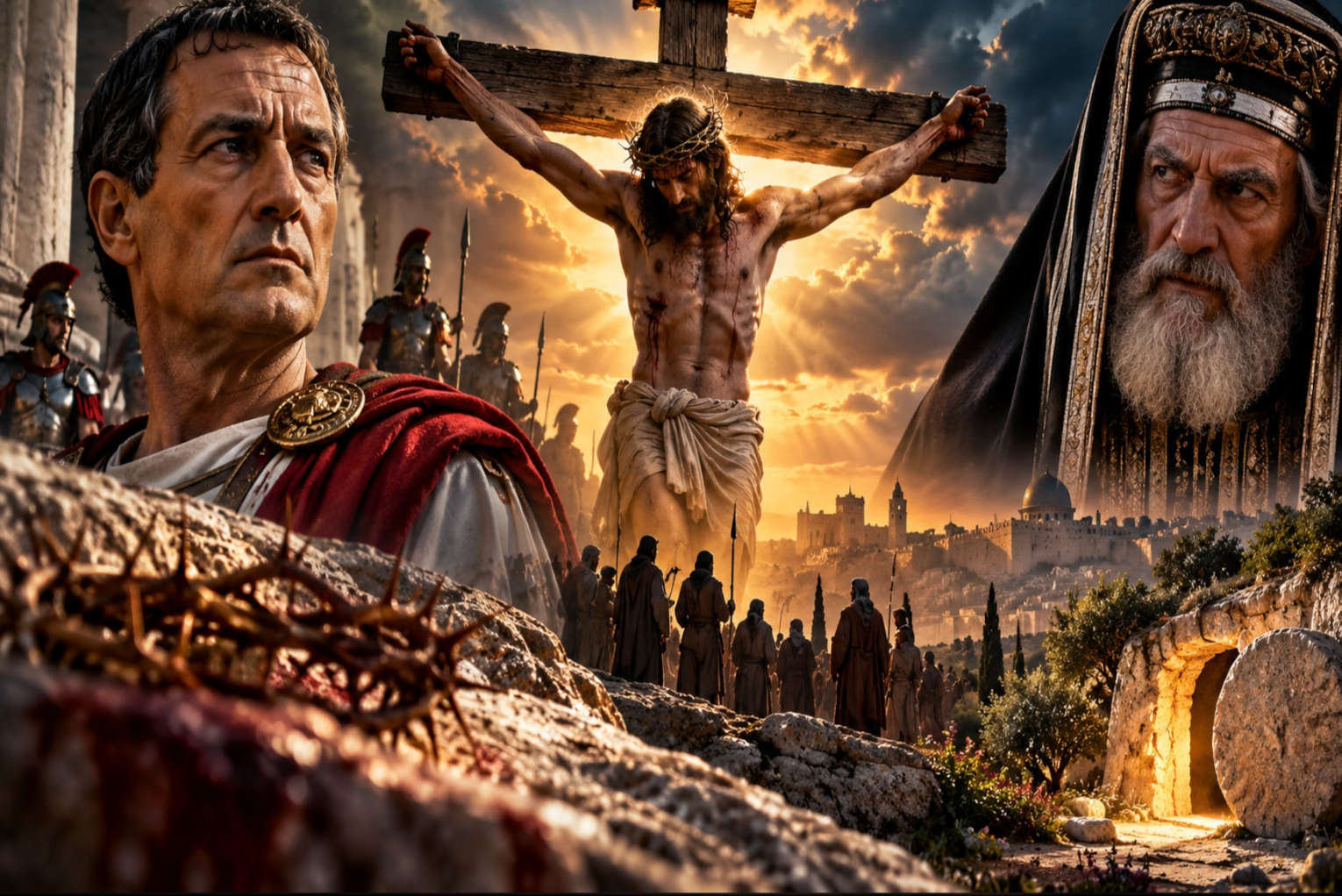
The trial, conviction and crucifixion of Jesus is presented in the gospels as high drama. The drama revolves around three key figures: Jesus himself, the Roman governor Pontius Pilate, and the Jewish high priest Caiaphas. King Herod is also involved, but he chooses not to be. He allows the matter of Jesus to be settled between Pilate and the high priest.
The dramatic tension is increased by the fact that the three men involved have very different personalities, and even more, that their personalities are indicative of the larger movements they represent. Pilate is the Roman governor, typically stoical and “above the fray.” He cannot understand what these Jews are squabbling about. He would rather, in his own words, wash his hands off the matter.
Jesus is one of the strangest of accused men. He refuses to make any defense of his innocence. He says virtually nothing, and when he speaks it is in cryptic terms. The high priest asks him, “Are you the messiah?” Jesus replies, “You have said so.” This is the equivalent of saying, “Your words, not mine.” It is an evasion. Jesus neither denies nor admits the charge.
Yet Caiaphas takes it as an admission. His reason for wanting Jesus to die is that Jesus is a blasphemer. He pretends to be the son of God, the messiah sent by God to deliver the Jews. But Caiaphas does not merely object to Jesus’s theological masquerade. Jesus is a populist teacher with a big following. Caiaphas fears an erosion of the power of the priests if Jesus’s claims are widely believed by the Jewish people.
In presenting the case against Jesus to the Sanhedrin—the priestly council—Caiaphas unwittingly makes a prophetic statement. “You do not understand,” he says, “that it is expedient for you that one man should die for the people, and that the whole nation should not perish.” At one level, this is disingenuous. Caiaphas is acting like the interests of the priestly class are identical with those of the Jewish nation. Yet, for Christians, Caiaphas spoke truly without knowing it, because Jesus was sent by God to die for all people so they could live forever with God rather than perish. Jesus was, in this theological sense, a divine scapegoat.
Order Dinesh D’Souza’s New Book, “The Stones Cry Out” on Amazon.com!
The problem for Caiaphas is that in order to have Jesus put to death, he needs the permission of Rome. That means Pilate. But why would Pilate, who is, as a good Roman, himself a polytheist, care about whether Jesus claims to be a Jewish messiah or not?
Pilate is not interested in philosophical inquiry. When Jesus states he has come “to bear witness to the truth” Pilate retorts, “What is truth?” His point is not that truth does not exist but that it is not his job to adjudicate what it is. Pilate’s only concern is with maintaining order among the Jews, so that his superiors in Rome don’t have to worry about a Jewish revolt or insurrection that would require them to send Roman legions to crush it.
So Caiaphas ingeniously switches the charge against Jesus. He steers it away from his real concerns and toward Pilate’s secret concerns. He accuses Jesus of being a seditionist, of seeking to turn the Jews against Caesar. Backed up by his priestly council—the Sanhedrin—Caiaphas intimidates Pilate, and Pilate relents. Pilate is unconvinced, but he gives in on a note of indifference, “Do it yourselves.”
In subsequent centuries, right to this day, there are those who would say, “The Jews killed Jesus.” This is just as incoherent as saying, “The Romans killed Caesar” or “the Americans killed Lincoln” or “the Indians killed Gandhi.” In each case, a controversial populist figure is killed by a rival faction of his own countrymen that fears his influence.
Caiaphas did not represent the Jewish people. He was the head of a particular priestly caste. He represents an aristocratic family line associated with the Sadducees. The Sadducees were themselves opposed by the Pharisees. Neither represented the people; indeed, Caiaphas’ greatest concern is that Jesus would win over the affections of the people.
So the Jews did not kill Jesus; indeed, it would be more accurate to say that “some powerful Jews advocated for the killing of a renegade Jewish teacher named Jesus to prevent him from winning more acclaim from his Jewish countrymen.” I’m not even getting here into the Christian teaching that Jesus came to die—that his death was part of a divinely appointed mission from the outset.
However vividly the Bible portrays the trial, passion and death of Jesus, the question remains whether this is literary fiction of a high order or whether it’s real. Were Pilate and Caiaphas historical figures, and can we know that for sure? Where exactly was Jesus crucified and where is his burial tomb? These are questions for modern archeology to try and answer.
Prior to 1961, there was virtually no firm non-biblical confirmation of the existence of Pontius Pilate. One might say he lived in the Bible, but only in the Bible. Admittedly there were one or two references to him by other writers, but the sources were not entirely reliable. So one group of skeptics doubted that Pilate even existed.
A second group conceded that Pilate existed but insisted the biblical writers got his title wrong. The Bible refers to Pilate as the Rome’s “prefect” in Palestine—the Roman name for Israel—but later Roman sources list the title for that post as “procurator.” These titles are different: a prefect is a governor; a procurator is a sort of financial administrator. The critics said the erroneous title meant the biblical text was written much later, and without a close familiarity with the events it described.
Then in 1961, an Italian archeological expedition in the region of Caesarea Maritima uncovered a limestone stab with a four-line Latin inscription. Now on display in the Israel Museum, the inscription reads, “Pontius Pilate, Prefect of Judaea.” It also has a dedication to the Emperor Tiberius, although part of that inscription is missing.
With this single discovery, Pontius Pilate makes his debut as an undisputed historical figure. Not only that, but the Pilate stone shows the Bible got his title right. It was in fact “prefect,” not “procurator.” Possibly the Romans later changed the title of that position to procurator, but in Pilate’s own day he was prefect.
And what about Caiaphas, the high priest? He too lived a shady historical existence until 1990. The Bible gives him only a single name, “Caiaphas.” The Jewish historian Josephus refers to him in one of his writings as “Joseph Caiaphas.” So Joseph was evidently his first name and Caiaphas the family name. In 1990, Caiaphas in a sense came back to life with the discovery of an ossuary near the old city of Jerusalem.
An ossuary is a stone box used to store the bones of the dead. It was customary in first century Judaism to bury people, and then when they had decayed down to their bones, to move the bones into an ossuary bearing the name of the deceased. A number of these ossuaries were found and one especially ornate one had an Aramaic inscription, “Yehosef bar Qayafa” which is “Joseph, son of Caiaphas.” The ossuary is dated to the first century A.D. and the bones are those of a 60 year old man.
It’s Caiaphas. Who else? And the remarkable thing is that we don’t just have his burial box; we even have his bones.
Finally let’s look for the site of Jesus’s crucifixion and burial, which for a long time was unknown, or at least disputed, but is now known with a high degree of certainty. According to the gospels, Jesus was crucified, an especially gruesome form of death known to have been practiced by a number of ancient civilizations. The Romans did not invent the practice.
In 1968, archeologists found the bones of a man named Yehonanan who had obviously been crucified because there was a large nail stuck in his heel bone. Yehonanan’s bones were found in an ossuary, which means he had been buried in a tomb and his bones later transferred to the box. This strange and important archeological find showed how the Romans crucified people, and it also supported the gospel account that Jesus was buried in a tomb.
But where exactly? Until fairly recently, we could not say for sure. There were two main contenders: the Church of the Holy Sepulchre and the so-called Garden Tomb. For many centuries, the traditional location of Jesus’s tomb was the location of the Church of the Holy Sepulchre in Jerusalem. This was the location identified in the fourth century by Constantine’s mother Helena.
Helena located the spot where a number of Christian sources said Christ had been crucified and buried. Sure enough, she found there a monument to pagan deities that had been erected in the second century by Hadrian. Once again, the Romans who sought to stamp out the Christian holy sites ended up unwittingly marking them for later identification.
Helena built a church on that location. It was later replaced by another church built in the Crusader period. Today the Church of the Holy Sepulchre occupies the site, and remarkably we can see underground the outlines of rock-cut tombs. Constantine had one of these tombs marked to designate that it was the one in which Jesus lay. These tombs are dated precisely to Jesus’s time and match the biblical description of Jesus being buried in a new tomb offered by a rich man Joseph of Arimathea.
There was only one problem with identifying this site as the precise location of Jesus’s death and burial. It was inside the old city of Jerusalem, while the Bible is clear that Jesus was buried outside the city. We also know that it was customary for crucifixions to occur outside the city, so as not to contaminate or defile the city.
But in recent years archeologists realized that this objection is invalid. In Jesus’ time, the Church of the Holy Sepulchre was outside the boundaries of the old city. The confusion arose from the fact that the boundaries of the old city had expanded over the centuries. Jerusalem itself had moved! Consequently today there is widespread though not universal agreement that the Church of the Holy Sepulchre is where Jesus died and was buried.
Born in Mumbai, India, Dinesh D’Souza came to the United States as an exchange student in 1978. After graduating from Dartmouth College, he served as a policy analyst in the Reagan White House and a scholar in two prominent think tanks, the American Enterprise Institute and the Hoover Institution at Stanford University. He is a New York Times best-selling author who has written books on politics, religion, culture, and economics— including Illiberal Education, The End of Racism, What’s So Great About America, and United States of Socialism—and three books on Christian apologetics: What’s So Great About Christianity, Life After Death, and Godforsaken. D’Souza has made eight political documentary films and produces a daily podcast called The Dinesh D’Souza Podcast, which is seen and heard by about 100,000 people daily.
