
I have a big book coming out this Fall, so in a few weeks, on the greatest discoveries of biblical archaeology. This book has huge implications, for the historicity of the Bible, for the presence of the Jews in their ancestral homeland, for the foundations of America and the West. The good news is that you can pre-order it now from Amazon, and you’ll be one of the first people to get it.
It’s called The Stone Cry Out. Subtitle: Biblical Archaeology, Prophecy and the Last Days.
Today I want to tell you how I got into this. In December 2022 my wife Debbie and I visited Israel for the first time. I was invited by Salem Media to be a speaker, along with the political commentator Sebastian Gorka, on a nine-day Israel tour. We went with 300 or so guests, many of them visiting for the first time. For my wife and me, it would be an experience like no other.
In Israel, I found myself in the land of the Bible. I have traveled widely, and I know that many of the cities of the world are now homogenized; they have become virtually indistinguishable from one another. But Israel is not like that. Its cities are not like that.
In Jerusalem, we are standing amidst the monuments and ruins of ancient biblical times. Fascinating! But that could also be said, for example, of Rome. In Greece, we can stand at the Acropolis or the Parthenon. But Jerusalem is living out its past: here are the same people speaking the same language and walking the same streets and following the same rituals and praying to the same God that their ancestors did in biblical times.
In Israel, history comes to life in a way that is unique. Not only that, but for Christians there is also a feeling of déjà vu, of having been there before. And of course we have, through the pages of the Bible and countless church sermons and Bible studies.
Now it’s one thing to learn about a place and something quite different to experience it. My wife and I both felt a strange feeling of being at home. She’s from Venezuela and I’m from India, so we were born elsewhere. We now live in America and have made America our home. But Israel almost immediately became our spiritual home.
We are at home in Israel because our faith was born here. This is where the God of the Universe entered history through His relationship with Abraham and the patriarchs. This is where Jesus was born, taught and was crucified. This is where the Holy Spirit descended on the apostles, inspiring them to take the good news to the Gentiles.
“Gentiles.” That’s us. And Israel, we believe, will also be the place to which Jesus returns, once the end times prophecies of the Bible are all fulfilled.
We began our trip at the northern tip of Israel, the Sea of Galilee. We were in boats, similar to the boats in which Jesus and the apostles rode the waves on this very body of water. The boats were fastened together, and I was asked to speak to the crowd.
What a feeling! I had thought about what to say and had decided to talk about the miracles of the Bible, Jesus’ miracles in this place, and how a belief in miracles is in no way contradicted by modern science. Even so, I hesitated. I turned to my wife Debbie, “What should I talk about?” She quipped, “Just give your Sea of Galilee speech.”
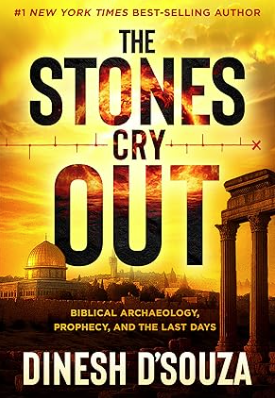
Order Dinesh D’Souza’s New Book, “The Stones Cry Out” on Amazon.com!
Of course I had no Sea of Galilee speech, but her response made me chuckle, and I relaxed and gave the talk I had planned to give.
We visited Nazareth, where Jesus spent his childhood, and some of the places where Jesus lived and taught, Capernaum, and also the small village of Magdala, home of one Mary of Magdala—also known as Mary Magdalene. We went across the narrow torso of Israel, making our way to the western side.
“There!” our guide Ido Keynan said, pointing from Megiddo toward some distant mountains. “That’s Mount Carmel. That’s where Elijah had his showdown with the prophets of Baal.”
When we reached the west end of the country, we visited Caesarea Maritima—Caesarea by the Sea—where the Roman prefect Pontius Pilate had his palace and headquarters. And from there we went to Caesarea Phillipi, where we stopped at a hillside spot with niches in the rock alongside a large cave. In Jesus’ time these niches held various cult statues to Greek gods like Dionysus and Pan.
These are the gods associated with lack of restraint and sexual orgies. Dionysus is the god of wine, pleasure, fertility and sexual frenzy. Pan is the Greek god of nature, the wilderness, shepherds and goats. He was represented with the legs, hooves and horns of a goat, and the arms and the upper body, arms and head of a man. In his honor, the site was called Paneas.
The shrine had existed from the third century B.C. to the fifth century A.D., when the region became Christian and the site was abandoned. But in Jesus’ time, people came from faraway places to indulge in the rites of Dionysus and Pan. Some even engaged in child sacrifice. Below is a small river that was used to dump the bodies of children who were killed to appease these gods. A gruesome image!
The massive cave that descends deep into the earth was considered by many pagans to be a gateway to the underworld, to Hades. For this reason, Paneas conventionally came to be known as the “Gates of Hell.” My mind flashed back to Jesus’ words to Peter in Matthew 16: 18 about building his church so strong that “the gates of hell shall not prevail over it.” Jesus was standing pretty close to where I stood, overlooking the caves and the stream.
But now I understood something about Jesus’ words that I hadn’t before. Jesus wasn’t just speaking metaphorically about the gates of hell. He was speaking specifically about what this place represented: idolatry, worship of false gods, and various forms of cultic and sexual immorality. Jesus meant to say his church would stand firm not just against Satan but also against the ungodly temptations of the world. Basically when Jesus said, “the gates of hell,” he meant, “You’re looking at it.”
Most of our trip—five days—was in Jerusalem. These are five of the most memorable days of my life. Debbie and I saw and learned so much, and what we saw brought the Bible to life in a new way for us. Imagine standing among the ruins of King David’s palace, and looking across to the homes and terraces where, three thousand years ago, David first saw Bathsheba.
Imagine standing in the Pool of Siloam, where Jesus healed a blind man, and then walking the Pilgrimage Road connecting the pool to the Temple. These sites were recently discovered, and what are the odds? I wouldn’t give very good Polymarket odds on finding these places after two thousand years.
Yet they are here. God, I believe, has chosen this time in history to speak through the stones. The stones are literally crying out, if we have eyes to see and ears to hear.
Jewish pilgrims ritually cleansed themselves in the Pool of Siloam and walked that upward path to the Temple more than 2500 years ago. I asked Ze’ev Orenstein of the City of David Foundation, which is excavating those sites, what the chances were that Jesus bathed in the Pool and walked the Pilgrimage Road.
He answered, “One hundred percent.”
At the Church of the Holy Sepulcher, the site of Jesus’ crucifixion, our guide Ido Keynan reminded Debbie and me of the accounts in John chapter 20 and Luke chapter 24 where the apostles enter the empty tomb. They don’t find Jesus there, but they do find the burial linens with the cloth that had been around Jesus’ head folded separately.
Keynan is a messianic Jew—a Jewish believer in Jesus. He told us about Jewish customs of Jesus day, and today, that give us a deeper understanding of the significance of this scene. “Even today,” Keynan said, “when my father has a bunch of people at a meal, if he has to leave, he will either fold his napkin and place it on the table, or he will toss it and then leave.”
“What,” I asked, “is the meaning of that?”
“If he tosses it,” Keynan said, “that means the meeting is over. People are free to leave. But if he folds it, that means no one should get up. That means he is coming back.”
A strange feeling came over me as I applied what Keynan said to the folded clothes in Jesus’ empty tomb. Debbie and I were with another couple from Montreal, “cultural Christians” who had never previously considered seriously whether the things they had been taught in childhood were actually true. I saw the expression of astonishment on their faces, which they tried quickly to conceal, almost as if it came with a note of reluctance.
In that nine-day trip, Debbie and I got a brief but unforgettable introduction to biblical archeology, biblical history, and also biblical prophecy. We saw how those three things are closely connected.
As we returned to America, I said to Debbie, “I don’t understand why the things we saw and heard are not shouted from the rooftops of every church in the world.”
“Pastors study theology,” Debbie said. “They don’t study archeology.”
That’s part of the answer. But as I learned later, there’s a corollary to this. Archeologists are mostly secular scholars who don’t want their discipline to be connected to the Bible. They fear it makes their work less “scientific.” So they minimize the relevance of archeological findings to the Bible, even when there is an obvious connection.
Biblical archeology is a discipline that is somewhat ashamed of itself.
Since early 2023, I have immersed myself in a three-year study of biblical archeology. My wife and I have also returned to Israel, several times. We went back in early 2025 for the filming of my documentary “The Dragon’s Prophecy,” which includes a section on biblical archeology. We went again in September 2025 for the opening ceremony for the Pilgrimage Road, a project that we have donated to every year since 2022. In early 2026, we were in Israel where I spoke at the annual international conference on anti-Semitism.
All this time, I have continued to read, and reflect, and study. I have come away with the exhilarating recognition that the events and people of the Bible are real. It’s all true. What I previously accepted on faith is now supported and corroborated by scientific fact. The events of the Bible and the events of history do not exist separately; rather, they come together as a single story of God working through time to achieve His plans and purposes.
I now understand my Bible in a newer and fuller way. I have in my mind the full track of events described in Scripture, from Genesis through Revelation, encompassing the Old Testament and the New. But now I also have a parallel track, pegging these biblical events and figures to historical dates and places, and I can also identify the archeological findings that prove, supplement and illuminate this biblical narrative.
I have written this book to share this fuller understanding, which I hope will enrich and deepen your encounter with God’s word and God’s plan for the end of the age—the end of time. And if you’re a skeptic, this book will challenge your faith in skepticism. I dare you to read it. Once again, it’s The Stones Cry Out, and you can preorder it now from Amazon.
Biblical archeology and biblical prophecy are intimately connected. As I intend to show, biblical archeology is not merely about the past, it is also about the present and the future. This book will corroborate the events and people of the Bible, demonstrate how biblical prophecy is being fulfilled today, and also reveal how the ancient stones help us prepare for the momentous events to come, the end times or last days envisioned in the Book of Revelation.
And that’s the way I see it.
Born in Mumbai, India, Dinesh D’Souza came to the United States as an exchange student in 1978. After graduating from Dartmouth College, he served as a policy analyst in the Reagan White House and a scholar in two prominent think tanks, the American Enterprise Institute and the Hoover Institution at Stanford University. He is a New York Times best-selling author who has written books on politics, religion, culture, and economics— including Illiberal Education, The End of Racism, What’s So Great About America, and United States of Socialism—and three books on Christian apologetics: What’s So Great About Christianity, Life After Death, and Godforsaken. D’Souza has made eight political documentary films and produces a daily podcast called The Dinesh D’Souza Podcast, which is seen and heard by about 100,000 people daily.
