

Put on the full armor of God, so that you can take your stand against the devil’s schemes. For our
struggle is not against flesh and blood, but against the rulers, against the authorities, against the powers of this dark world and against the spiritual forces of evil in the heavenly realms.— Ephesians 6:11–12
Darkness cannot drive out darkness; only light can do that. Hate cannot drive out hate; only love can do that.
— Martin Luther King Jr.
No matter how loudly people are shouting in your face, never mistake the chess pieces for the hands moving them.
I’ve had people shout in my face and attack our stage, try to unplug our amps and squirt superglue on our keyboards during a worship service, and even play kazoos to drown out the sound of our voices when we raised them in praise. They act like our enemies, but we know better. They are just pawns in a larger strategy being manipulated by dark spiritual forces trying to extinguish the light. If they knew better, they would do better.
There are numerous military terms for what spiritual war is like. A proxy war is when you attack an ally of
your enemy or encourage one of your allies to attack one of their allies. A similar move is called a false flag operation. You put soldiers in the uniforms of an enemy’s ally and have them attack a neutral country
unprovoked. This makes it look like your enemy is the aggressor and causes counterattacks and strife. You
can sit back and reap the rewards of the deception.
Both are pretty good descriptions of what we are experiencing today. Darkness is manipulating the
language of culture to attack the people of the light, and too many of us are falling for it. We’re caught in the difficult place of standing up for what is right and being labeled as haters for it. The reward for taking a stand for truth, righteousness, and justice is to be called a bigot, a homophobe or a nationalist. I have been personally labeled all these—and even worse! The rhetoric is toxic. The problem is that too often we are embracing the same tactics by shouting back. When we defend ourselves in anger, we can sound like the very people they are accusing us of being.
Once you scapegoat a person or group as “the problem in our nation today,” you’ve done half the
devil’s work for him. You’ve already seeded discord and strife in your own heart. And you’ve brought the fight into the natural realm and out of the spiritual realm. That’s fighting in the wrong territory.
Godly warfare is not fought against people; it’s fought in the spiritual realm by embracing God’s
promises and lifting them back up to Him in prayer. It’s fought by proclaiming the victory the cross has already won. It’s fought by showing we have a different Spirit—a Holy One—behind our actions and attitudes.
That’s the way Jesus fought. Jesus knew who He was and to whom He belonged. He knew who was in
charge. He prayed and then did only what His Father showed Him to do. And by doing so, He cracked open a dark, legalistic world and let in the light of salvation.
I remember being in Afghanistan, behind Taliban lines in the mountains outside Kabul, with a missionary from India who became a great hero and mentor to me. I was the only American I saw the whole time I was there, and everyone seemed afraid for me. My Indian friend, though, was less concerned. “God called us to do this,” he told me, “so He will make a way, and He will protect us.” He seemed to have no fear. He continued, saying, “Sean, when you go to these places, you’re going to sense heaven celebrating, ‘Finally, someone has shown up here! We’ve been waiting so long for you to arrive!’” My friend knew who he belonged to and who had the real power.
Romans 8:19 tells us, “For the creation waits in eager expectation for the children of God to be revealed.” The earth is longing and groaning for the sons and daughters of God to show up and release the light of the gospel. In every village I went to in Afghanistan, I brought my guitar, and we worshipped, even though we were behind Taliban lines. There’s just something about hearing the call of God to go to a place and then showing up and bringing the kingdom. It’s like heaven applauds. I remember singing as the stars came out in the evening, filling the sky. It was as if I could hear the heavens proclaiming, “We’ve been waiting for you!” We were in a war zone, but in those moments I had no fear. The presence of God was greater. I’ve rarely felt so truly alive.
It’s not a matter of courage as much as perspective. You have to know who you are, who you belong to and who is calling the shots. It demands seeing things from a heavenly vantage point. We must “come up
here”—come up now—and view things from God’s higher point of view.
We often think this happens only in the mission field, but every place can be like that if you get a spiritual
perspective on it. It might be in your workplace, in your local coffee shop, on the street in front of your
house, or at a park in the middle of your city. There are dark places all over where the earth is groaning,
waiting for a son or daughter of God to lift up a song and a prayer and call heaven down into that place.
Real change begins in the place of prayer. As the sons and daughters of God, we’re called to come to the
throne of heaven and lay down our concerns. We are called to be like the righteous kings of Israel and Judah and not let false gods build their temples all around us. We are to speak up for what is right and oppose that which is evil and exploitative. We’re called to bring the things that are wrong before the throne of God the Father—the true authority of the universe—for justice.
Moses was a powerful man of God, but he was also known for his meekness. He had this habit, when
faced with adversity, of falling to his face in prayer. Other Bible prophets acted similarly. Just look for the
phrase “fell on his face” in the Bible, and you will see it all over. The Book of Matthew even tells us that
Jesus “fell with his face to the ground and prayed” before facing the cross (26:39).
Falling to one’s face is an act of surrender, of contrition—but surrender and contrition to what? To
God. To His Word. To His promises. It’s an act of faith. It’s an acknowledgment of where the real power lies. It’s an act of saying, “Not my will, but Yours be done.” It’s an act of recognizing God as the highest authority and turning judgment over to Him.
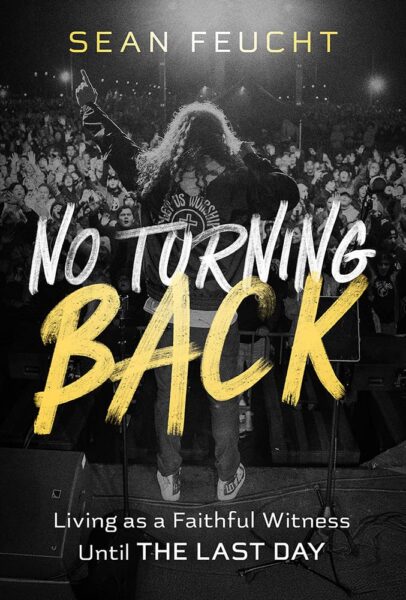
Order Sean Feucht’s New Book, “No Turning Back” on Amazon.com!
Knowing Who We Are
All of this begins with knowing who we are. You can’t kneel nonviolently in prayer like this in the face of
violent opposition unless you know to whom you belong—unless you know the battle is not yours but
the Lord’s.
Identity has become a loaded term in recent times, but the question “Who am I?” is still one each of us
must answer. The word identity comes from the French word identité, derived from the medieval Latin phrase identitatem, meaning “sameness.” In other words, we get who we are not from some internal mixture of gifts, talents and desires as much as by comparing ourselves with others and determining who we are the “same as” and who we differ from.
Psychologist René Girard calls this mimetic desire, meaning we mimic those we look up to by wanting the
same things they have. This is how advertising works. They show you a cool, famous person with something, and you naturally want it too. We tend to desire the things of the people we want to be like, because down deep we think it will make us the “same as” them.
This happens without us consciously realizing it. If I asked you why you wanted something, you’d probably answer, “I like it. That’s just what I want.” We rarely realize that it’s because we want to be like
[fill in the blank], who we think is cool and secretly want to be like. This is how peer pressure works as well. It’s hard to be the one voice in a group that believes or speaks differently. We want to look and sound like our favorite celebrities, movie characters and music artists. This is why the media is so powerful: Through its constant exposure and access to millions of minds, it shapes culture, and culture shapes human attitudes and actions.
Subversive indoctrination is all around us: from the subtle things that happen in schools to the violence of
video games and to the radicalization of hate that can happen in online forums. Satan has had centuries of practice in how to manipulate culture and identities to his own ends. This is why we urge parents to pay attention to what their kids access through their screens. My wife and I are very intentional about this
with our four children. We must be the ones to set boundaries and guidelines. Parents need to talk with
their kids about what they’re experiencing, how it’s affecting them, and how these things are designed to
prey on their insecurities.
How many times do we need to hear a story about someone who was just a normal kid, and then
suddenly, they went on a shooting spree after being radicalized online? It’s horrifying, and it’s happening
every single day. Young adults are being groomed, targeted, and isolated while falling for dark conspiracies designed to manipulate, incite violence, and create mayhem.
Identity is usually considered to be who we are as individuals—how we stand out from others—but it
begins with how we fit in with our friends and society as a whole. Every generation approaches it differently, and those differences tend to be obvious. We are formed by the interactions around us and the gifts, talents, and desires inside us. Our identity is formed between outside voices and the things God has placed inside us. It’s a crucible of sorts—with heat and pressure from both directions.
Jesus got His identity from His Father and did only what His Father showed Him to do. As He said it, “The
Son can do nothing by himself; he can do only what he sees his Father doing, because whatever the Father does the Son also does” (John 5:19). When Jesus was baptized before the beginning of His ministry, He heard His Father’s approval from heaven:
As soon as Jesus was baptized, he went up out of the water. At that moment heaven was opened,
and he saw the Spirit of God descending like a dove and alighting on him. And a voice from
heaven said, “This is my Son, whom I love; with him I am well pleased.”
— Matthew 3:16–17
There were times when the disciples would wake up, and Jesus was nowhere to be found. Where was
He? He was off spending time with His Father—time that was more important to Him than His ministry
itself. Crowds would be looking for Him, hungry to hear Him speak, and He’d be off walking in the hills,
conversing with His Father.
To put it simply, Jesus wanted to be like His Dad.
Forming our identities should follow the same pattern. The approval of the Father in our lives will
shatter the performative cycles we create to feel known, seen and heard. We need approval from an
authority figure and the love of our parents—particularly our fathers—because these things are crucial to fully understanding our worth.
According to the 2020 census, though, about 23 percent of children grow up without a father present, a
percentage that has doubled since 1968 and continues to increase. So many fathers have left their families. So few are willing to stick around and work things out rather than choose the easy option of walking away. No wonder children feel abandoned today and get caught up in a cycle of striving for approval that’s unstable. Instead, we need the affirmation of a father and mother who are committed to each other. Without this kind of love as a foundation to who we are becoming, it’s far more difficult to build a happy, fulfilling life where we act in obedience to heaven rather than striving for the approval of fickle peers and a manipulative society.
Jesus’ ministry was initiated by the approval of His Father, which He received before He preached His first
sermon or performed His first miracle. We need the same affirmation from our fathers and from our Father in heaven, who gives it freely to His sons and daughters through Jesus. Without a similar connection, we lose track of who we were created to be and try to “find” an identity that will make life meaningful and joyful.
We may give our lives to Jesus at a church service, but if we don’t continually feed our minds with biblical,
truth-based material—reading the Bible itself is, of course, the best possible “soul food”—we can easily be overcome with what Jesus called “the worries of this life, the deceitfulness of wealth and the desires for
other things” (Mark 4:19). These things fill the worldly media we consume. The world doesn’t know—or even really care—who you are called to be or why God put you on the earth.
When we are unsure of who we are becoming and randomly snack on what the world feeds us through
every new image we scroll past, we’re susceptible to being blown every which way by the winds of opinion around us. It’s evil’s play to keep us uncertain because then we never really accomplish anything of note. We’re just sleepwalking through life, swept along by the currents of this world. We become orphans trying to gain approval wherever we can find it, and that’s a dangerous game. There’s nothing solid to rely on. We grow discouraged, disconnected, disheartened, and disillusioned. We long for significance and to be loved and respected by others—to be truly seen—but instead it’s constantly implied that we don’t measure up, we’re less than we should be, and no one really cares anyway.
Let me make a prophetic statement over your life, right here, right now: It’s time to put down your phone and pick up your Bible.
Sean Feucht is a speaker, author, missionary, artist, and activist who founded Burn 24-7, Light A Candle, Hold the Line, and Let Us Worship— global movements mobilizing worship, prayer, compassion, and civic engagement across six continents and hundreds of cities, with multiple Let Us Worship albums reaching number one on iTunes in Christian Worship and several topping all genres for multiple days. His work rallies churches and the next generation to pursue revival, bring hope to hard places, and stand for integrity in the public square through worship-centered initiatives, events, and resources. He is married to his high school sweetheart, Kate, and they have four children—Keturah, Malachi, Ezra, and Zion—and make their home while serving through national ministry travel. His new book, No Turning Back, is available on Amazon.com.
