What if the greatest UFO mystery isn’t about outer space at all?
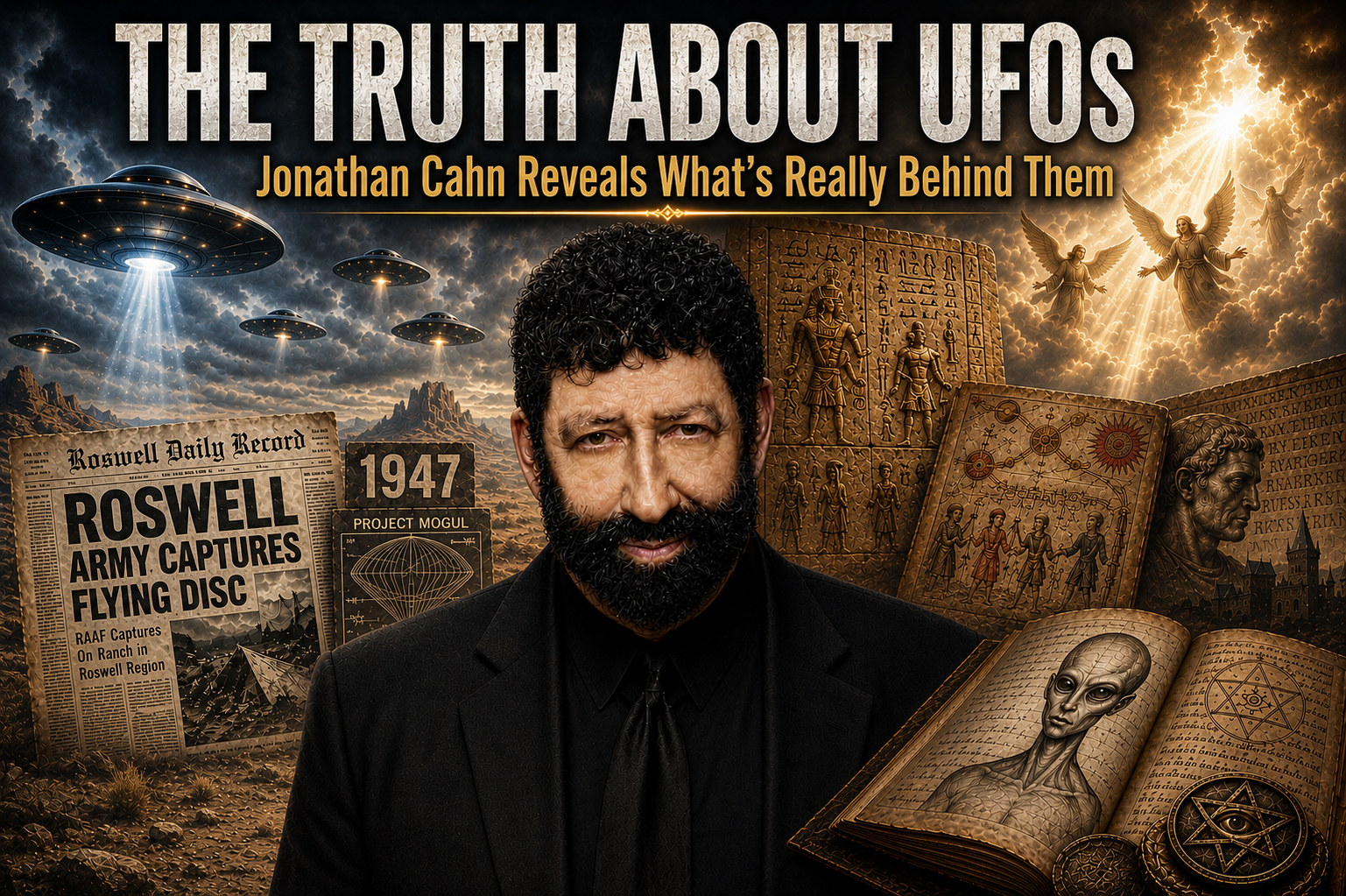
As governments release classified files and public fascination with extraterrestrials reaches new heights, #1 New York Times bestselling author Jonathan Cahn believes Christians are asking the wrong question.
The mystery, he says, may not begin in another galaxy—but in another realm altogether.
“Is there life beyond the Earth? Do aliens exist? Have we been visited? Are UFOs real? And if so, what are they?” Cahn asked as he opened a brand-new teaching devoted entirely to one of the most debated topics in modern culture. “What do the Scriptures say about them?… I’m going to give you the evidence that’s going to resolve the question.”
UFOs and aliens have long been dismissed as science fiction. But as public interest continues to surge—fueled by congressional hearings, declassified government documents and Hollywood’s enduring fascination with extraterrestrials—Cahn believes the church should respond with discernment rather than either fear or blind acceptance.
He begins by acknowledging something many Christians may find surprising: the Bible never explicitly states that intelligent life beyond Earth cannot exist.
“So what does the Bible say about this? Does it preclude the possibility of life beyond Earth and UFOs? Does it allow for aliens? Does it speak of them? Does the Bible say there can be no life beyond Earth? The answer is no, and it never says that,” he says. “Could there be extraterrestrials? Biblically, there could be. There’s no statement or doctrine against it. On the other hand, the Bible never says there is or that there could be. And the focus of the Bible is clearly on Earth. So one’s faith does not have to be touched in any way.”
That distinction, he says, is crucial. Scripture’s focus has never been on distant galaxies but on God’s redemptive plan for humanity. Yet that doesn’t mean the Bible is silent about unexplained phenomena.
Instead of beginning with modern UFO sightings, Cahn takes viewers on a journey through history.
Long before Roswell or Area 51 entered the American vocabulary, civilizations recorded strange events in the skies. He references ancient Egyptian writings describing fiery objects descending from heaven, Roman accounts of glowing ships and blazing lights, Irish chronicles describing ships appearing in the sky, and reports from 16th-century Europe describing what witnesses believed was an aerial battle.
Still, Cahn says one detail stands out above all others.
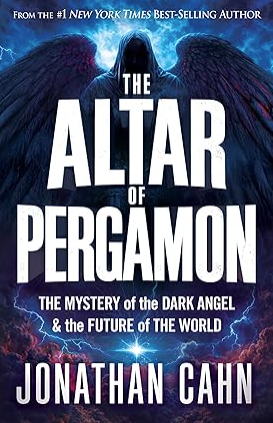
To order Jonathan Cahn’s new book, The Altar of Pergamon, visit Amazon.com.
“The real age of UFO sightings happens after World War II,” he explained.
He points to June 1947, when private pilot Kenneth Arnold reported seeing mysterious objects moving across the sky. Although Arnold never actually described them as flying saucers—he said they moved like saucers skipping across water—the media embraced the phrase. It quickly became embedded in popular culture.
Soon, reports of “flying saucers” exploded across the country.
Only weeks later came the infamous Roswell incident.
For generations, conspiracy theories have claimed a crashed alien spacecraft was recovered outside Roswell, New Mexico. Cahn acknowledges why the event continues to fascinate the public but notes that later investigations pointed to Project Mogul, a classified U.S. military program that used high-altitude balloons to detect Soviet nuclear testing. Because the project itself was secret, conflicting government statements created fertile ground for decades of speculation.
Cahn also argues that human psychology cannot be ignored.
He points to Orson Welles’ famous 1938 radio broadcast of War of the Worlds, which convinced countless listeners that an alien invasion was actually underway. In the aftermath, eyewitness reports poured in from people convinced they had seen extraterrestrial spacecraft—even though nothing had occurred.
To Cahn, it demonstrates what psychologists call perceptual bias: people often interpret what they see through the lens of what they already expect to believe.
Yet while he believes many UFO reports have ordinary explanations, he stops short of dismissing every account.
“There are some things that have remained unexplained,” he said before turning to what he believes is the Bible’s most compelling framework.
Drawing from Ezekiel’s famous vision of the “wheel within a wheel,” Elijah’s fiery chariot and Paul’s warning that believers wrestle against “spiritual forces of evil in the heavenly places,” Cahn suggests Scripture describes a supernatural realm that occasionally intersects with the physical one. Rather than proving extraterrestrial visitation, he believes these passages point toward another possibility entirely.
“Could it be,” Cahn asked, “that the UFO reports are instead linked to spiritual realities?”
That question leads him into perhaps the most explosive section of his message.
Cahn notes that several secular researchers—not Christian theologians—have concluded that unexplained UFO phenomena appear more “interdimensional” than interplanetary. Even more striking, he says, is the historical overlap between alleged alien encounters and occult practices.
“The lore of UFOs and aliens… has long been linked to something else,” Cahn said. “The occult.” He cited reports that individuals involved in witchcraft, spirit channeling and other occult practices have frequently reported encounters with mysterious beings claiming to possess higher knowledge or hidden revelation.
The discussion then shifts to one of the most chilling historical examples Cahn presents.
He recounts the story of notorious occultist Aleister Crowley, who in 1918 claimed to contact a supernatural entity through ritual magic. Crowley later sketched the being, known as “Lam.”
When Cahn displayed the drawing, he highlighted what he considers an astonishing resemblance.
The figure bears an elongated head, oversized eyes and a slight frame that, decades later, became the iconic image associated with the modern “gray alien.”
“This is not the drawing of a being from another planet,” Cahn said. “This is the drawing of an entity… contacted by an occultist.” He continued, “It’s the prototype of the little gray man… not from outer space, but from the demonic realm.”
Cahn also points to another recurring detail reported by some who claim close encounters: the smell of sulfur or burning. He connects that observation to biblical imagery associated with judgment, brimstone and the fallen spiritual realm, while emphasizing that Christians should avoid building doctrine on sensational claims alone.
Ultimately, Cahn says the conversation shouldn’t end with UFOs at all.
Whether unexplained phenomena prove to be natural, psychological or spiritual, he insists they cannot alter the central truth of the gospel.
“If it was ever proved that there was a real visitor from another part of the universe… it should not impact your faith,” Cahn said.
Then comes the message’s unexpected finale.
“Do I believe in extraterrestrials? Absolutely,” Cahn declared. “The extraterrestrial Gabriel, the extraterrestrial Michael… and all the heavenly hosts.”
Quoting 1 Peter, he reminds believers that they themselves are described as “aliens and strangers” because their true citizenship is in heaven.
“We are the aliens,” Cahn said. “Earth is not our home… Maybe we forgot our mission and who we are.” Instead of living like “earthlings,” he challenged Christians to remember they have been sent into the world as ambassadors of Christ, carrying the only message that can truly transform humanity.
Abby Trivett is a writer and editor for Charisma Media and has a passion for sharing the gospel through the written word. She holds two degrees from Regent University, a B.A. in Communication with a concentration in Journalism and a Master of Arts in Journalism. She is the author of the newly released book, The Power of Suddenly: Discover How God Can Change Everything in a Moment. For interviews and media inquiries, please contact [email protected].