
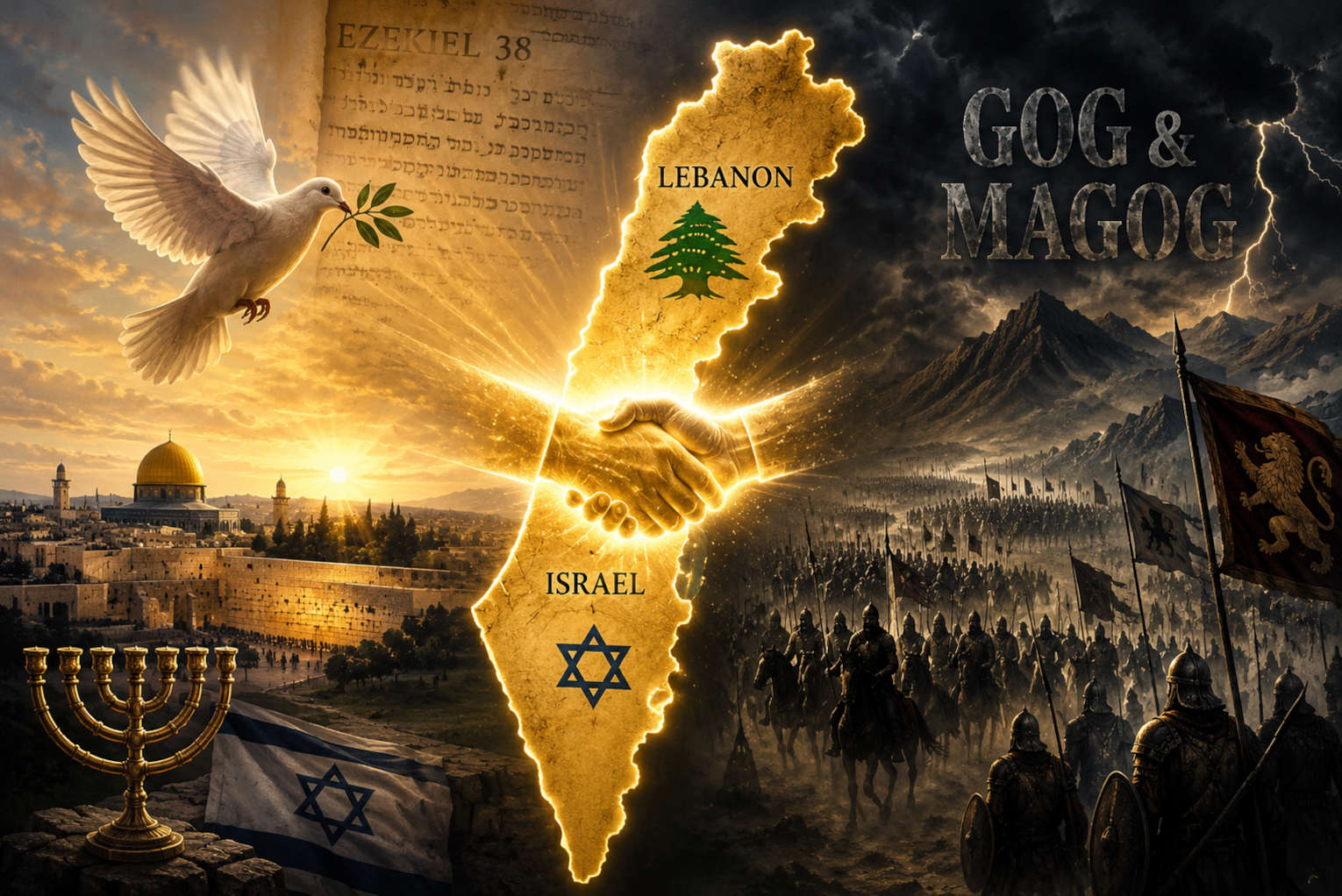
Peace between Israel and Lebanon is not a headline many Christians expected to see.
For decades, Lebanon has served as a launching pad for Hezbollah rockets, Iranian influence and constant threats against Israel’s northern border. Yet direct talks between Jerusalem and Beirut are now underway, raising a question that reaches far beyond geopolitics:
Could a future peace between Israel and Lebanon actually fit Bible prophecy?
While many believers associate Lebanon with the coming wars of the last days, author and Middle East analyst Joel Rosenberg argues Scripture may point to something surprising first—a season of peace.
“Direct peace talks between the governments of Lebanon and Israel are underway,” Rosenberg said during a recent episode of The Rosenberg Report. “And this is not only historic, it also raises three critical questions.”
Among them was whether Lebanon could ever make “a real peace, a true peace, a warm peace, an Abraham Accords style peace and normalization agreement with Israel.”
A Surprising Shift on Israel’s Northern Border
The idea sounds unlikely given Lebanon’s recent history. Hezbollah has dominated much of the country’s political and military landscape for years while serving as Iran’s most powerful terror proxy.
Yet Rosenberg sees reasons for optimism.
“I am an optimist when it comes to the possibility of Israel of peace between Israel and Lebanon in the near or medium term,” he said. “Before that, is it possible and I think yes, it’s possible that there could be quiet calm and even a treaty.”
Rosenberg also pointed to a reality often overlooked in discussions about Lebanon: a substantial Christian presence remains in the country despite years of conflict and instability.
“There are 30 to 40% of the Lebanese people who love Jesus, who love the Lord, and are calling out to him for mercy,” Rosenberg said.
He urged believers to pray for Lebanon and its people, noting that Christ Himself ministered in the region of Tyre and Sidon, located in modern-day Lebanon.

Order Jonathan Cahn’s New Book, “The Altar of Pergamon” on Amazon.com!
What Ezekiel 38 Says Must Happen First
The prophetic significance of a potential peace agreement becomes clearer when viewed through the lens of Ezekiel 38.
Many Christians rightly focus on the coming Gog and Magog war, a future conflict involving a coalition of nations that includes Iran and others attacking Israel from the north.
But Rosenberg believes many believers overlook what Scripture says happens before that invasion.
“The Hebrew prophet Ezekiel tells us in Ezekiel 38 that God will also help Israelis not only resettle our ancient homeland,” Rosenberg said. “But the text says that we will be increasingly peaceful and prosperous.”
He noted that Ezekiel describes Israel as dwelling securely before the invasion occurs.
“What that’s telling us in a sort of a poetic way is Israel’s going to be quiet,” Rosenberg said. “Israel’s going to have peace on all of its sides at least for a season, at least for a period of time before the Gog and Magog war kicks in.”
That detail raises an important prophetic question.
If Israel must be living securely before Gog and Magog unfolds, could today’s military campaigns against Hamas, Hezbollah and Iran’s regional influence be setting the stage for that future reality?
Rosenberg believes it is possible.
“I think that it’s very possible that this horrific war that erupted on October 7th, 2023 has set into motion this exact prophetic future,” he said, “a future in which Israelis live calmly and quietly and securely with all of our immediate neighbors.”
If that interpretation proves correct, a future peace agreement with Lebanon would not contradict Bible prophecy. It could help fulfill the conditions Ezekiel described before the invasion begins.
A Forgotten Biblical Alliance
The prospect of peace between Israel and Lebanon is not without precedent.
In fact, Scripture records one of Israel’s closest regional alliances involving the ancient kingdom centered in what is now Lebanon.
Rosenberg pointed to the relationship between King David and Hiram, king of Tyre.
“David not only becomes king but he makes peace with Lebanon,” Rosenberg said.
The friendship proved beneficial for both nations. According to Scripture, Hiram supplied materials and craftsmen who helped build David’s royal house.
That alliance expanded under Solomon.
“There was peace between Hyram and Solomon and the two of them made a covenant,” Rosenberg noted.
Lebanon supplied cedar and cypress timber for the construction of the Temple while Israel provided food and resources. The partnership became one of the most significant examples of cooperation between the two nations in biblical history.
Watching the Times
No one knows exactly how current events will unfold.
Scripture makes clear that future wars are coming. Gog and Magog remains ahead. Armageddon remains ahead. Yet the Bible also describes periods of peace before those conflicts arrive.
That is why developments on Israel’s northern border deserve careful attention.
“I think there is reason for optimism,” Rosenberg said.
As talks continue between Israel and Lebanon, we should pray for peace, pray for the strengthening of the church in Lebanon, pray for the liberation of people living under terrorism and oppression, and continue watching the signs of the times through the lens of Scripture.
The path to Gog and Magog may include developments few prophecy watchers expected to see—including peace on Israel’s northern border.
James Lasher, a seasoned writer and editor at Charisma Media, combines faith and storytelling with a journalism background from Otterbein University and ministry experience in Guatemala and at the LA Dream Center. A Marine Corps and Air Force veteran, he is the author of The Revelation of Jesus: A Common Man’s Commentary and a contributor to Charisma magazine. For interviews and media inquiries, please contact [email protected].
