
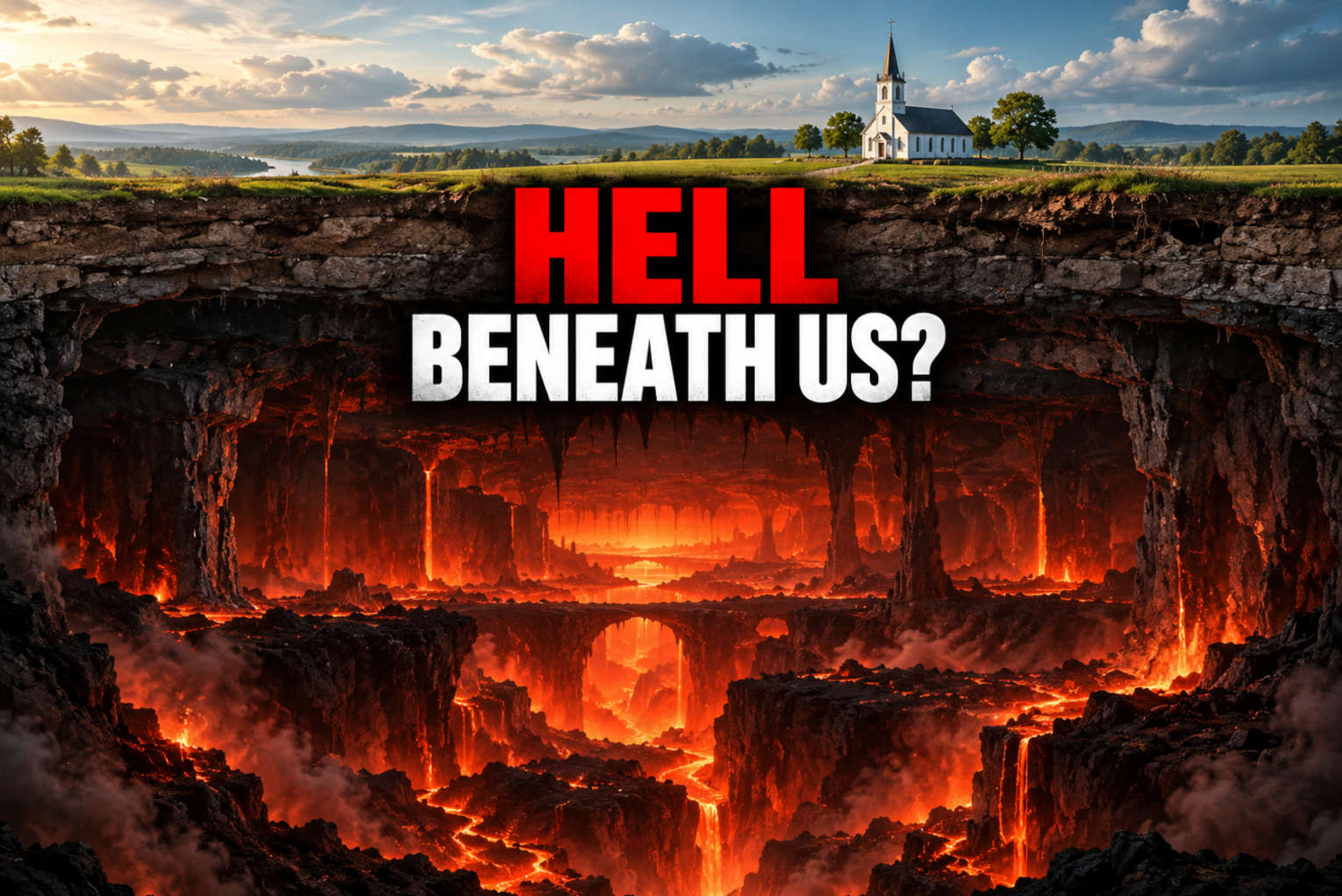
Could hell lie beneath our feet?
Pastor Fred Price Jr. explored that possibility on Taylor Welch’s podcast, “The Deep End,” connecting Christ’s descent, Samuel’s appearance to Saul and the rich man’s torment with his interpretation of an underworld inside the earth.
The pastor of Crenshaw Christian Center in Los Angeles said he subscribes to hell being near the earth’s center or core. His argument begins with a phrase Jesus used when describing His coming death and burial: “the heart of the earth.”
In Matthew 12:40, Jesus compares His coming three days and nights there with Jonah’s experience inside the great creature. Price connects that description with Ephesians 4:9, which speaks of Christ descending into the lower parts of the earth.
He also points to 1 Peter 3’s account of Christ preaching to imprisoned spirits.
“There are no spirits in prison in heaven. Heaven is not a prison,” Price said.
He reads those passages together as describing a descent into a spiritual realm within the earth.
The encounter between Saul and the medium at Endor supplies another piece of his argument. Price identifies the figure who appeared as Samuel and emphasizes that he emerged from below.
“And he did not descend down from heaven. He came up from out of the earth,” he said.
Price connects Samuel’s appearance with Abraham’s bosom, which he describes as the dwelling place of the Old Testament righteous before Christ’s resurrection. He maintains that Christ subsequently freed its occupants.
His understanding of the underworld includes distinct regions with different purposes.
“Hades is where the unrighteous are now,” Price said.

Order Bill Wiese’s Bestselling Book, “23 Minutes in Hell” on Amazon.com!
He distinguishes Hades from the final lake of fire described in Revelation. He also discusses Tartarus as a place associated with imprisoned angels and the abyss as a prison for demons, pointing to their plea in Luke 8 against being sent there.
But the account of the rich man and Lazarus in Luke 16 brings his discussion into especially vivid territory.
Price treats the account as an actual event. He emphasizes its description of the rich man in torment, Lazarus beside Abraham and a fixed gulf separating them.
“So the underworld has topography. There’s terrain,” he said.
Those details underpin Price’s interpretation of an underworld with boundaries and distinct places.
Luke 16 also confronts something more immediate than its possible location: a man pleading for relief after death, separated from comfort by a gulf that neither side can cross.
Describing that fixed separation, Price said, “So, we cannot cross from one side to the other.”
The rich man’s anguish could not reopen the life he had left behind. His desperate plea came after his earthly choices had become eternal consequences. Jesus’ account confronts every living soul with the urgency of this moment: Our days are numbered, eternity is real, and the time to turn to Christ is now.
James Lasher, a seasoned writer and editor at Charisma Media, combines faith and storytelling with a journalism background from Otterbein University and ministry experience in Guatemala and at the LA Dream Center. A Marine Corps and Air Force veteran, he is the author of The Revelation of Jesus: A Common Man’s Commentary and a contributor to Charisma magazine. For interviews and media inquiries, please contact [email protected].
