
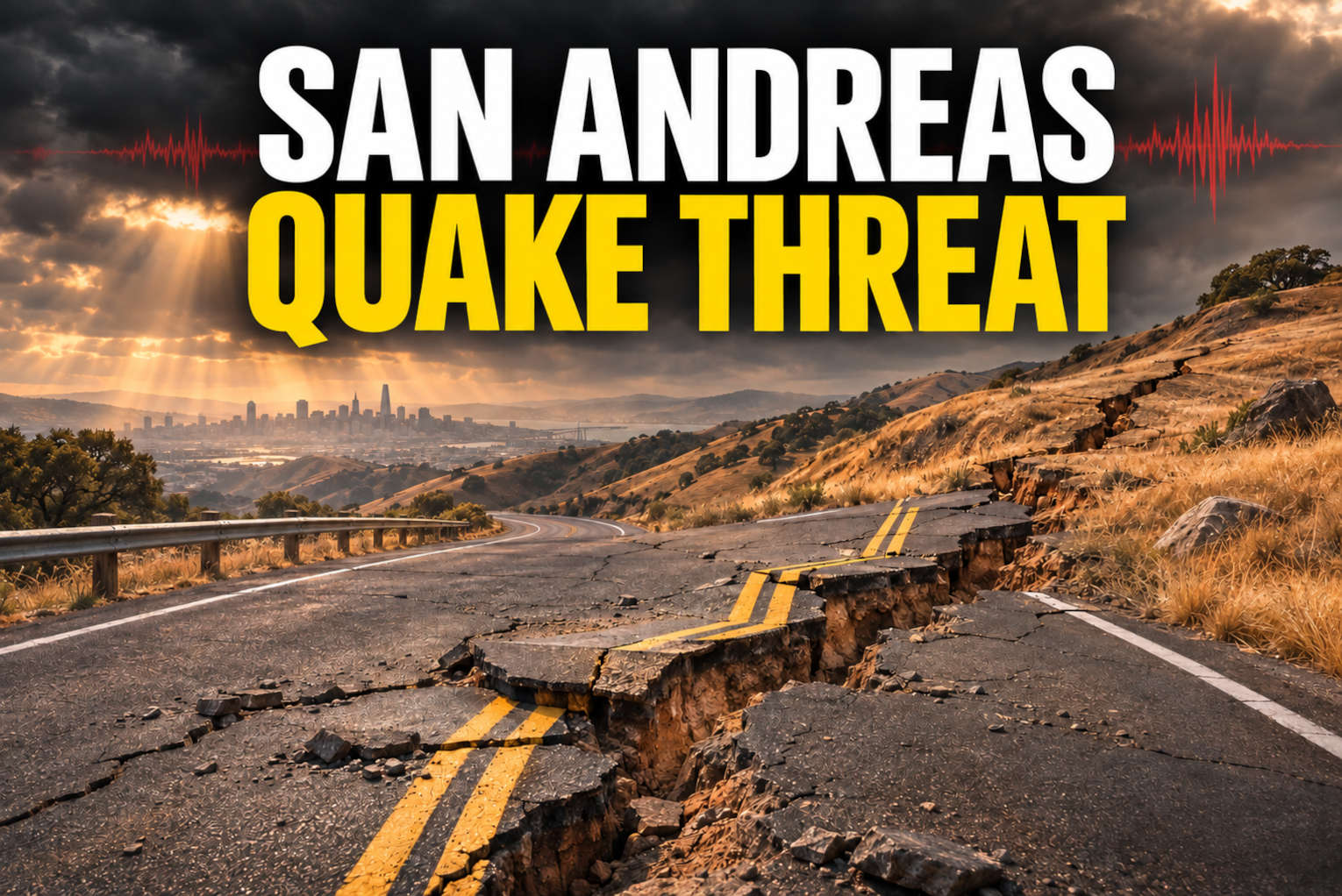
A swarm of small earthquakes rattled Northern California this week in a state where a major fault rupture could sever transportation routes and cripple water and power systems.
The Daily Mail reported more than two dozen tremors within 24 hours. A preliminary U.S. Geological Survey and UC Berkeley report recorded a magnitude 2.7 earthquake about 4 miles northwest of The Geysers on Nov. 2.
The shaking was minor. The potential consequences of a major San Andreas earthquake reach far beyond its epicenter.
“Things seem to be pretty locked and loaded,” USGS seismologist Ned Field told the San Francisco Chronicle in September. “We’d be wise to be ready.”
USGS calculations reported by the Chronicle put the Bay Area’s chance of a magnitude 6.7 or stronger earthquake over 30 years at 74.1%. That figure covers the region’s faults collectively. The San Andreas-specific probability within the Bay Area was 25.5%.
Those long-term estimates do not mean the current swarm signals an approaching catastrophe. USGS says small earthquake swarms frequently occur without a larger earthquake following.
The Geysers has its own well-documented source of seismic activity. Geothermal operations, including steam withdrawal and water injection, can trigger small earthquakes, according to USGS. Tremors there do not necessarily indicate a rupture on the San Andreas.

Order Jonathan Cahn’s New Book, “The Altar of Pergamon” on Amazon.com!
Elsewhere in the Bay Area, recurring swarms around San Ramon have prompted closer investigation. Cal State East Bay reported in May that geology professor Luther Strayer and students were working with USGS scientists to deploy temporary seismometers and pinpoint the faults involved.
Farther south, researchers have identified conditions that could make a future earthquake especially destructive.
A study published this year modeled roughly 1,000 years of earthquake history along the southern San Andreas and San Jacinto faults. Some present-day stress levels reached or exceeded the highest values in the simulation.
Researchers identified Cajon Pass as an “earthquake gate,” a junction where a rupture could stop or cross between fault systems. A combined rupture could expose a wider region to damaging shaking.
“The study is not a prediction of when an earthquake will occur,” lead researcher Liliane Burkhard said in a University of Bern release. She described the system as “critically stressed.”
A USGS planning scenario illustrates the stakes.
The ShakeOut simulation modeled a magnitude 7.8 earthquake rupturing 186 miles of the southern San Andreas, with ground displacement across the fault ranging from about 6 to 23 feet.
Roads and rail lines crossing the rupture could break. Damaged aqueducts and pipelines could interrupt essential services, while fires and landslides would compound the destruction.
The original 2008 ShakeOut report estimated about 1,800 deaths and $213 billion in economic losses under its hypothetical scenario. Those historical estimates describe one possible disaster, not the expected outcome of this week’s tremors.
James Lasher, a seasoned writer and editor at Charisma Media, combines faith and storytelling with a journalism background from Otterbein University and ministry experience in Guatemala and at the LA Dream Center. A Marine Corps and Air Force veteran, he is the author of The Revelation of Jesus: A Common Man’s Commentary and a contributor to Charisma magazine. For interviews and media inquiries, please contact [email protected].
