
This is the fifth article in a series on the greatest discoveries in biblical archaeology. It is adapted from my new book The Stones Cry Out: Biblical Archaeology, Prophecy and the Last Days which Charisma Books will publish this fall, but which you can pre-order now from Amazon. Just click on the link in the article!
If there is one topic that gives confidence to the academic opponents of the Bible—the so-called minimalists—it is the account of Joshua and his conquest of Canaan or modern-day Israel. This biblical narrative, which includes the famous description of the walls of Jericho falling down, has been investigated by archeologists for almost a century.
The majority view, echoed by archeologist William Dever, is that there is only a sliver of truth in the biblical story and that most of it has been proven false. Dever insists that of 31 cities supposedly razed and burned by Joshua and his Israelite army, in reality only two cities appear to have been destroyed in this way.
This paltry record has, almost by itself, convinced a generation of archeologists to give up on trying to confirm the Bible through archeology. Some even reject the term biblical archeology in favor of a more secular term like Near Eastern archeology. They insist that the Bible is a work of theology that cannot be measured through the standards of history or science.
The Joshua narrative skeptics and debunkers appear to be reacting to an earlier generation of biblical archeologists, typified by William Foxwell Albright, who claim to have verified the stunning conquests of Joshua’s armies, leaving fire and devastation in their wake. Albright is associated with what is now called the “conquest” theory, and it is this theory that is often rejected.
The conquest theory has given way to several alternatives, notably the “indigenous revolt” theory, which claims the Israelites were simply a group within the Canaanite population who rebelled against the ruling classes and took power. If the indigenous theory is right, then the Israelites never were in Egypt, there was no exodus, and there was no dramatic crossing over into the Promised Land.

Order Dinesh D’Souza’s New Book, “The Stones Cry Out” on Amazon.com!
According to archeologist James Hoffmeier, this whole debate rests on a misunderstanding. Hoffmeier argues that, read superficially, the Bible gives a bombastic victory account of Joshua’s long train of conquests. This account is not so much false as inflated. It is a triumphalist style typical of ancient battle narratives. The narratives themselves belie the tales of complete extirpation. Supposedly vanquished enemies fight on, defeated towns turn out not to have been occupied, and so on.
“Egyptian New Kingdom royal inscriptions,” Hoffmeier writes, “are replete with exaggerated claims of military success.” One such inscription, the so-called Merneptah stele, makes extravagant claims which would seem to suggest a conquest of the entire region—“all lands are united” under Merneptah, “all who roamed have been subdued,” and so on—side by side with a more modest listing of cities that have been defeated.
We find the same type of language in Joshua which on superficial reading suggests a complete wipeout of enemy forces but then follows with a reference to a surviving remnant. “When Joshua and the men of Israel had finished killing them with a very great slaughter, until they were wiped out, and when the remnant which remained of them had entered into the fortified cities, all the people returned safe to Joshua at the camp of Makkedah.” (Joshua 10:20)
When we re-read the biblical account, we see that it doesn’t say that Joshua razed and burned 31 cities. It doesn’t even say he occupied all those cities. He defeated some but did not occupy them. He burned only three: Jericho, Ai and Hazor. Even that was over the duration of three campaigns. The Israelite conquest—and it was a conquest—was a partial takeover of Canaan and it occurred over a much more extended period.
We want to look more closely at the purported burning of Jericho, Ai and Hazor, but before we do, consider a small detail in the biblical account of the Israelite crossing into the Promised Land.
The biblical site of Jericho is located in the Jordan Rift Valley, northwest of the Dead Sea. It is one of the most famous cities in the Bible, mentioned more than 50 times. It was the very first city captured by the Israelites in Joshua’s first military campaign. Consequently, the biblical account of Joshua’s assault on Jericho is quite detailed.
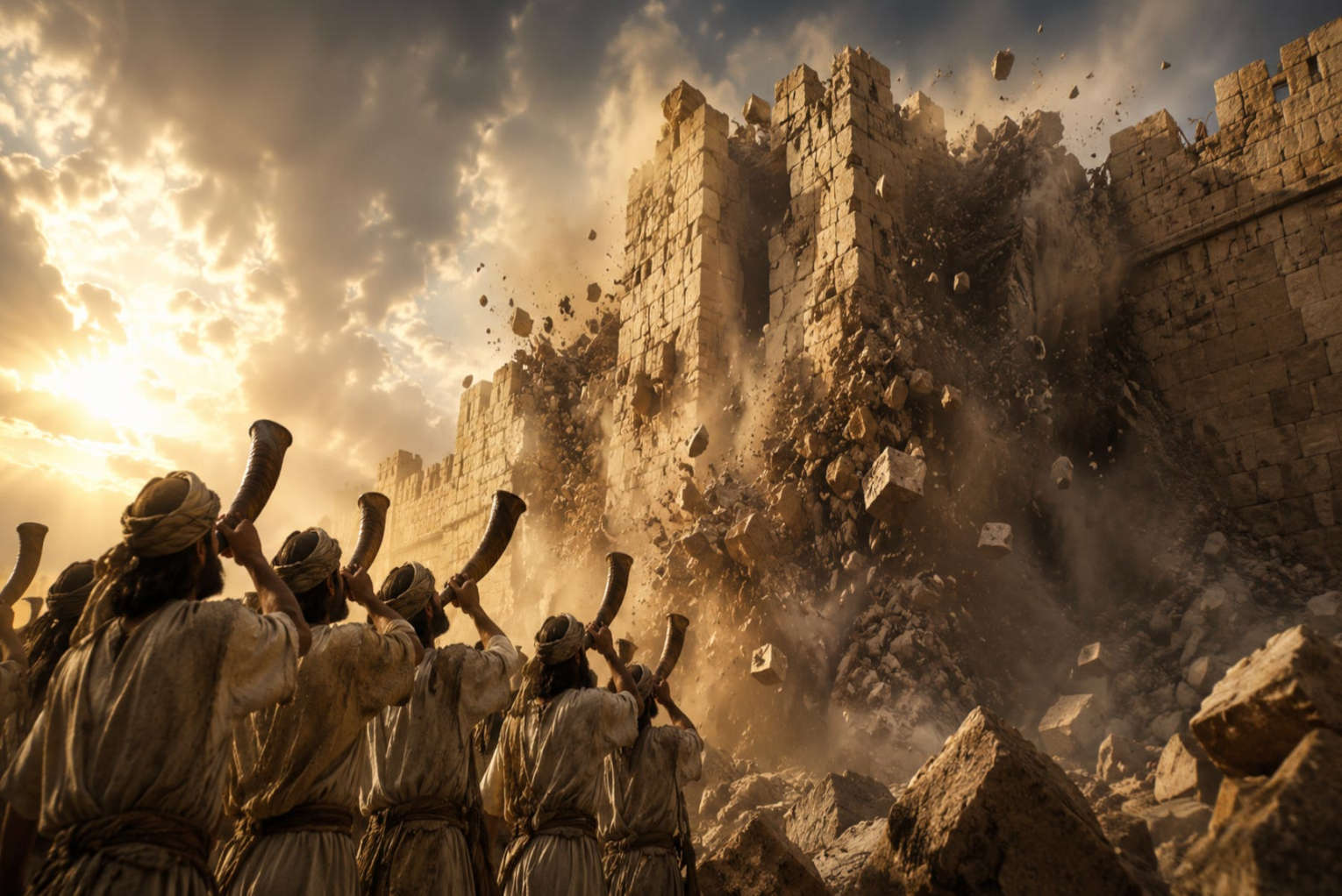
It was a seven-day attack, not a prolonged siege. It occurred in the spring, around harvest time. Jericho was burned, not merely overrun. And the distinctive touch: the Israelites walked around the fortified walls, without pulverizing them, at which time the walls miraculously fell down, facilitating the subsequent attack. “By faith the walls of Jericho fell, after the people had marched around them for seven days.” (Hebrews 11:30)
Jericho has been excavated multiple times over the decades. The excavations have confirmed all the elements of the biblical account. Joshua’s attack occurred in the spring; archeologists found storage jars containing large amounts of grain that had been stored in the city. The siege was short, since the grain stored had not been consumed. Customarily grain is plundered by invading forces in antiquity, but that wasn’t the case here, and it so happens that Joshua was given a divine command not to eat the grain. (Joshua 6: 17-18)
From large deposits of ash and charred remains in Jericho, archeologists can see that the city was massively destroyed by fire. And further—the most interesting part—ruins of the dense fortified walls show that the brick walls of Jericho collapsed outward. This is significant because if the walls had been battered down by attacking forces they would have collapsed inward.
These walls were around 15 feet high and five feet thick. The only explanation archeologists can give is that the walls of Jericho were toppled as a result of an earthquake. But if this earthquake occurred just at the time of Joshua’s attack, it would certainly qualify as the “miraculous” toppling described in the Bible. Finally, Jericho remained largely unoccupied for a significant period in accordance with Joshua’s curve cited in Joshua 6:26.
Alas, this perfect story has a wrinkle, and once again, it has to do with timing. In the 1930s the British archeologist John Garstang dated the destruction of Jericho to the mid 1400s B.C., right around the traditional date for Joshua’s invasion. But two and a half decades later, Dame Kathleen Kenyon, a renowned British archeologist, challenged Garstang’s findings and revised the date for Jericho’s destruction to around 1550 B.C..
This would time it more than a century too early for Joshua. Kenyon starkly suggested that Jericho was unoccupied in the 1400s when Joshua showed up. This does not bode well for the biblical account. Yet Kenyon’s own dates have subsequently been challenged by archeologist Bryant Wood.
Now admittedly these dates are all somewhat fluid. No one knows exactly when Joshua attacked Jericho. If the traditional dating system is off—if the patriarchs, for instance, lived somewhat earlier than previously thought, and the Exodus occurred in the 1500s rather than in the 1400s—then Kenyon’s dates are hardly a refutation of the biblical account. Leaving aside the date, the facts outlined in the biblical account of Jericho are archeologically sound.
The biblical city of Ai poses a different kind of problem in that no one is sure exactly where it is. We should pause to note here that biblical cities and towns do not come with name tags. Archeologists must surmise where they are based on various clues. For decades, Ai (the name simply means “ruin”) was associated with an archeological site called el-Tell. This seemed to match the location, given in the Bible as east of Bethel.
From the beginning, there were problems with that identification. Et-Tell is triple the size of Jericho, yet the Bible describes it as comparatively small compared to Jericho. But the biggest problem is that, despite many excavations, no burnt ruins have been found at Ai. Consequently, many archeologists continue to search for Ai.
This content is from Dinesh D’Souza’s Substack, which you can read here.
Born in Mumbai, India, Dinesh D’Souza came to the United States as an exchange student in 1978. After graduating from Dartmouth College, he served as a policy analyst in the Reagan White House and a scholar in two prominent think tanks, the American Enterprise Institute and the Hoover Institution at Stanford University. He is a New York Times best-selling author who has written books on politics, religion, culture, and economics— including Illiberal Education, The End of Racism, What’s So Great About America, and United States of Socialism—and three books on Christian apologetics: What’s So Great About Christianity, Life After Death, and Godforsaken. D’Souza has made eight political documentary films and produces a daily podcast called The Dinesh D’Souza Podcast, which is seen and heard by about 100,000 people daily.
