
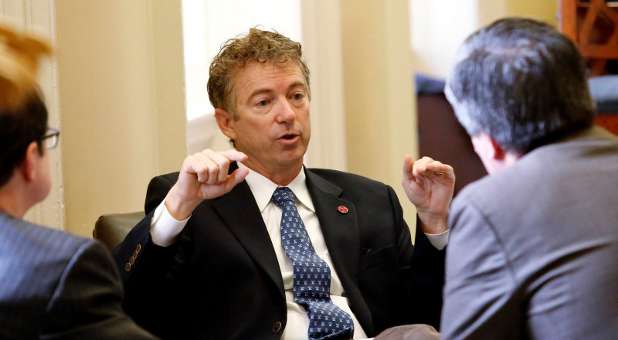
Republican Rand Paul interrupted debate in the U.S. Senate on Wednesday to make a speech opposing legislation that would extend U.S. spy agencies’ collection of Americans’ telephone data. The Kentucky lawmaker, a 2016 presidential candidate, ended his roughly 10 1/2-hour speech just shy of midnight. As the hours passed, he was joined by other legislators, including Democrat Ron Wyden, who also want to convince the Senate not to extend provisions of the USA Patriot Act that provide the legal basis for the collection of billions of telephone call records. “We shouldn’t be so fearful that we’re willing to relinquish our rights without a spirited debate,” Paul said. Paul was also joined by a laudatory Ted Cruz, who is also running for the White House, before yielding the floor at around 11:50 p.m. Although Republicans control both the Senate and House of Representatives, lawmakers have been unable to agree on how to deal with the June 1 expiration of the provisions. The data collection program was exposed two years ago by former National Security Agency contractor Edward Snowden. Opponents say it infringes on Americans’ privacy rights, while supporters see it as a means to protect the country from security threats. If Congress does not pass legislation to continue or reform current surveillance powers before leaving town on Friday for a 10-day recess, legal authorities used to collect the data will lapse. It is unclear if Congress would be willing to put new powers in place. The House voted 338-88 last week to approve another bill, the USA Freedom Act, which would end bulk data collection and replace it with targeted information retrieval. President Barack Obama would sign the measure into law if it reaches his desk. The legislation has yet to be voted on in the Senate, where Majority Leader Mitch McConnell said he favored renewing the Patriot Act as is, calling it essential to the safety of Americans. Paul and Wyden promised to block even a short-term extension of the program. McConnell said on Tuesday the Senate had “an obligation” to address the expiration and would deal with it this week. He said he would allow a vote on the USA Freedom Act. An official who has followed congressional discussions on the issue said that, given the political complications, he did not see how it would be possible for Congress to approve any surveillance legislation before June 1. © 2015 Thomson Reuters. All rights reserved.
