
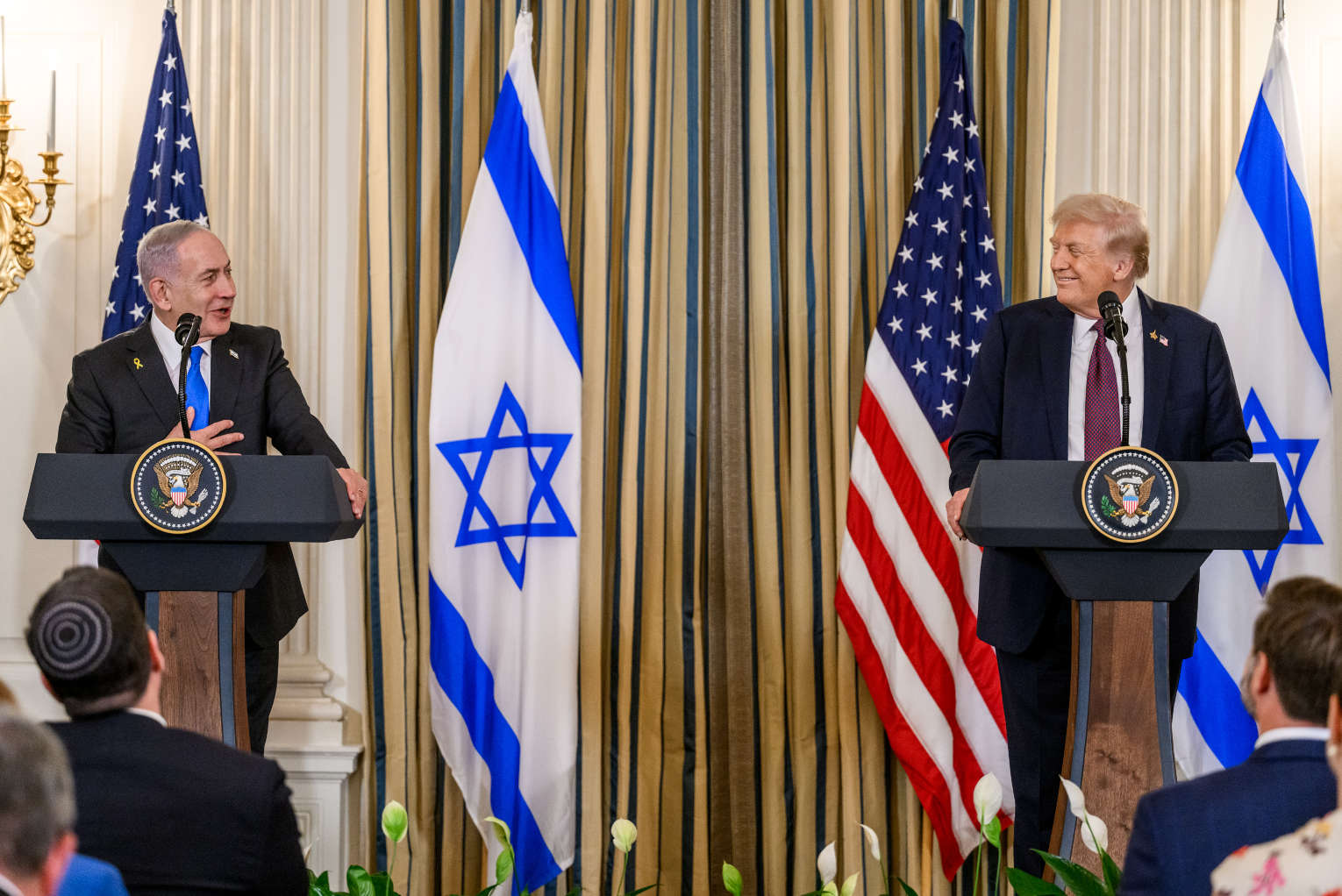
A prominent Orthodox rabbi is making a bold claim about President Donald Trump’s recent posture toward Israel, arguing that it is not simply the result of politics or diplomacy, but part of God’s dealings with Israel in the last days.
According to reporting by Israel365 News, Rabbi Mendel Kessin believes Trump’s apparent shift from one of Israel’s strongest allies to a leader urging restraint against Iran and Hezbollah fulfills a pattern found in the Torah thousands of years ago.
His conclusions have sparked discussion among Jewish audiences because they touch on Israel’s security, Iran and biblical prophecy. For Christians, however, an important question arises: How should we evaluate these prophetic claims while still recognizing Israel’s central place in God’s prophetic plan?
The answer requires both discernment and humility.
A Rabbi’s Explanation for Trump’s Shift
Kessin rejects conventional political explanations for Trump’s recent actions.
Rather than attributing them to advisers, foreign policy calculations or geopolitical pressures, he argues God is allowing Trump to change course because of Israel’s internal spiritual condition.
“It’s shocking,” Kessin said, according to Israel365 News, “because it looks like Trump has changed. But really, God is giving this punishment because of what the Israeli government is doing. They have no idea of the commotion they’re making in heaven.”
Specifically, Kessin argues Israel’s effort to draft ultra-Orthodox yeshiva students into military service represents an attack on Torah study, which he views as the nation’s greatest source of spiritual protection.
Whether Christians agree with that conclusion is another matter.
While we affirm the authority of the Old Testament and God’s covenant promises concerning Israel, our understanding of redemption, prophecy and salvation is centered on Jesus Christ and the New Testament. We do not interpret biblical prophecy through rabbinic tradition or Kabbalistic teaching, but through the whole counsel of Scripture.
Even so, when respected Jewish teachers begin viewing current events through a prophetic lens, Christians should at least understand what is being said before weighing it against Scripture.
Order Troy Anderson’s New Book, “Designated Disrupter” on Amazon.com!
“Save Me From My Brother”
The centerpiece of Kessin’s argument comes from Genesis 32:11.
As Jacob prepares to meet Esau after years of separation, he prays:
Save me, I pray, from the hand of my brother Esau, for I am afraid he will come and attack me…
Kessin believes the wording points beyond Jacob’s immediate situation.
“The Torah calls it that Esav, that Jacob prays against Esav, and he says, ‘from the hands of my brother,'” Kessin said.
“Take a look at the beginning of the verse. He’s actually calling Esav his brother and he’s praying to God to save him from Esav as his brother.”
He continued, “There will come a day when Esav will be your brother again in the future, and he will try to do what? Kill you. So you’re going to pray: ‘Please God, change his mind. Save me from that.'”
Kessin applies that interpretation directly to Trump, noting that both Trump and Israeli Prime Minister Benjamin Netanyahu have publicly referred to one another as brothers.
“The Torah refers specifically to Esav, miyad achi, miyad Esav, from the hands of my brother, the hands of Esav, and you have called Trump your brother,” Kessin said.
“It’s amazing when you think about that: a direct reference that you can actually pray for salvation from Esav as your brother. And this is it. Everybody is now praying that Trump reverse himself the way he used to be.”
That interpretation is entirely Kessin’s. Scripture does not identify Donald Trump with Esau, and Christians should be careful not to declare as biblical certainty what Scripture does not explicitly teach.
But the larger question remains worth considering.
If one of Israel’s strongest political allies can become a source of concern almost overnight, what does that remind us about placing our confidence in political leaders?
Iran, Trump and a Different Prophetic Lens
Kessin also argues that Trump has a divinely appointed role in confronting Iran.
“God wants him to remove Iran, and he’s not doing that,” Kessin said. “He’s playing around. It’s ping-pong.”
He sharply criticized negotiations with Tehran, arguing the Iranian regime cannot be trusted to honor agreements.
“The war is not with Iran. It’s with Islam,” Kessin said. “That’s the war.”
Christians should distinguish between Kessin’s interpretation and biblical prophecy.
Many of us have long recognized Persia—modern-day Iran—as one of the nations specifically mentioned in Ezekiel 38 as part of a future coalition that comes against Israel. That does not mean every diplomatic negotiation fulfills prophecy.
It does, however, remind us that Scripture consistently presents Israel as central to God’s prophetic timeline.
The Bible also repeatedly warns against trusting human rulers above God.
Whether presidents change course because of politics, pressure, personal ambition or reasons known only to God, our confidence ultimately rests in the Lord rather than in Washington, Jerusalem or any other capital.
Where Christians Agree—and Where We Don’t
Perhaps the most significant takeaway from Kessin’s lecture is not whether his interpretation proves correct.
It is that many Orthodox Jews increasingly believe the world is entering an extraordinary period of prophetic significance.
We can appreciate that growing expectation while recognizing that our hope rests in Jesus Christ, not in rabbinic interpretations of the Torah.
We also differ from Kessin on foundational doctrines.
We do not believe Torah study is humanity’s highest command or Israel’s greatest defense. We believe Jesus Christ fulfilled the Law and the Prophets and that salvation comes through Him alone.
At the same time, Christians should reject replacement theology and remember that God is not finished with Israel.
Romans 11 warns Gentile believers not to become arrogant toward the natural branches. Genesis 12:3 declares God’s blessing upon those who bless Abraham’s descendants. Zechariah 12 points to Jerusalem becoming a heavy stone for the nations, while Ezekiel 38 and 39 place Israel at the center of future conflict before God powerfully reveals Himself to the world.
Those passages are why Christians should continue to watch the Middle East carefully—because Scripture tells us that Israel will remain central to God’s redemptive plan.
We pray for Israel. We pray for the Jewish people to recognize Jesus as the Messiah. We pray for wisdom for world leaders and for Israel’s leaders as they face extraordinary threats. Above all, we remember that no president, prime minister, peace agreement or military alliance determines the outcome of history.
The God of Abraham, Isaac and Jacob does.
James Lasher, a seasoned writer and editor at Charisma Media, combines faith and storytelling with a journalism background from Otterbein University and ministry experience in Guatemala and at the LA Dream Center. A Marine Corps and Air Force veteran, he is the author of The Revelation of Jesus: A Common Man’s Commentary and a contributor to Charisma magazine. For interviews and media inquiries, please contact [email protected].
