
The Golan Heights is full of prehistoric sites generally missed by tourists. In this article, I want to persuade you that those sites are of great interest to people who love the Bible.
In general, prehistoric sites do not particularly interest Christian tourists. There are several reasons for this. First, there is usually very little to see at these sites, and the discoveries generally consist of a few caves and flint tools. The second reason concerns the specific interests of evangelical tourists. They are usually looking for sites connected to the Bible. Prehistoric sites such as caves inhabited by early humans in the Galilee and Mount Carmel are not directly connected to biblical stories. However, the Golan contains a different type of prehistoric site – one that is extremely mysterious and has a clear biblical connection.
In the Bible, the Golan Heights is called Bashan. Golan was the name of one refuge city located in Bashan (Joshua 20:8; 21:27).
Before the Israelites entered the land of Canaan, they traveled east of the Jordan River from the south, passing through Edom and Moab, in order to enter the Promised Land through the Plains of Moab, opposite Jericho. However, before entering the land, they turned north and fought Sihon, king of the Amorites, and Og, king of Bashan (Numbers 21).
Regarding Og, the Bible says, “For only Og king of Bashan was left of the remnant of the Rephaim. Behold, his bed was a bed of iron; it is in Rabbah of the sons of Ammon. Its length was nine cubits, and its width four cubits by the usual cubit” (Deuteronomy 3:11-NASB).
According to this verse, Og was the last remnant of a race of giants called the Rephaim, who lived in Bashan. However strange this description may sound, and even though many people claim it is an exaggeration, the Golan contains numerous discoveries that appear to confirm the existence of an ancient race of giants that disappeared completely by the time the Israelites entered Canaan.
What are these archaeological discoveries?

Order Dinesh D’Souza’s New Book, “The Stones Cry Out” on Amazon.com!
Dolmens of the Golan
Throughout the Golan Heights, one can find megalithic stone structures that generally resemble tables: two or three upright stones with a horizontal stone placed on top. These structures are called dolmens, and they can be found in other parts of the world as well. However, the Golan Heights and Transjordan are probably the region with the highest concentration of dolmens in the world.
And what is the connection to giants?
These dolmens are constructed from enormous stones weighing several tons. Ordinary human beings cannot lift stones of this size. Even 100 people would be unable to lift a stone weighing 10 tons. To lift a stone weighing several tons and place it on top of two or three other stones of similar weight standing vertically would require advanced technology.
When archaeologists surveyed the enormous dolmens of the Golan, they couldn’t find any other remains of the culture of the people who lived there and built those dolmens. Nothing of that culture has survived – not houses, not written documents, and not even pottery. This raises a great question: If such a civilization was advanced enough to lift extremely heavy stones using sophisticated cranes or other mechanisms, how is it that nothing remains of that culture apart from these megalithic structures?
If we compare them with the people who lived in Egypt during the same period and built the pyramids, the difference is striking. The ancient Egyptians left behind abundant evidence of their cultural wealth, as well as evidence of a hierarchical governing structure that made it possible to mobilize large numbers of people and use sophisticated tools. We can, therefore, reasonably assume that the ancient Egyptians knew how to lift enormous stones and build the pyramids.
However, we cannot say the same about the culture of the people who built the dolmens. How, then, were the inhabitants of this region able to lift so many stones of such enormous weight? There are about 5,000 dolmens in the Golan Heights. How could they have done this without advanced technological knowledge and a developed culture?
Is it possible that they were of a race of giants possessing far greater physical strength than modern human beings?
We have no proof that giants built the dolmens. Yet we also have no more convincing explanation about the identity of the people who lifted stones weighing several tons. The largest stone discovered to date in a dolmen weighs approximately 50 tons!
No skeletons of these people have been discovered. In some dolmens, the remains of ordinary human bones have been found. However, even this is not conclusive evidence, since these may very well represent secondary burials that took place hundreds or even thousands of years after the dolmens were originally constructed.
Gilgal Rephaim
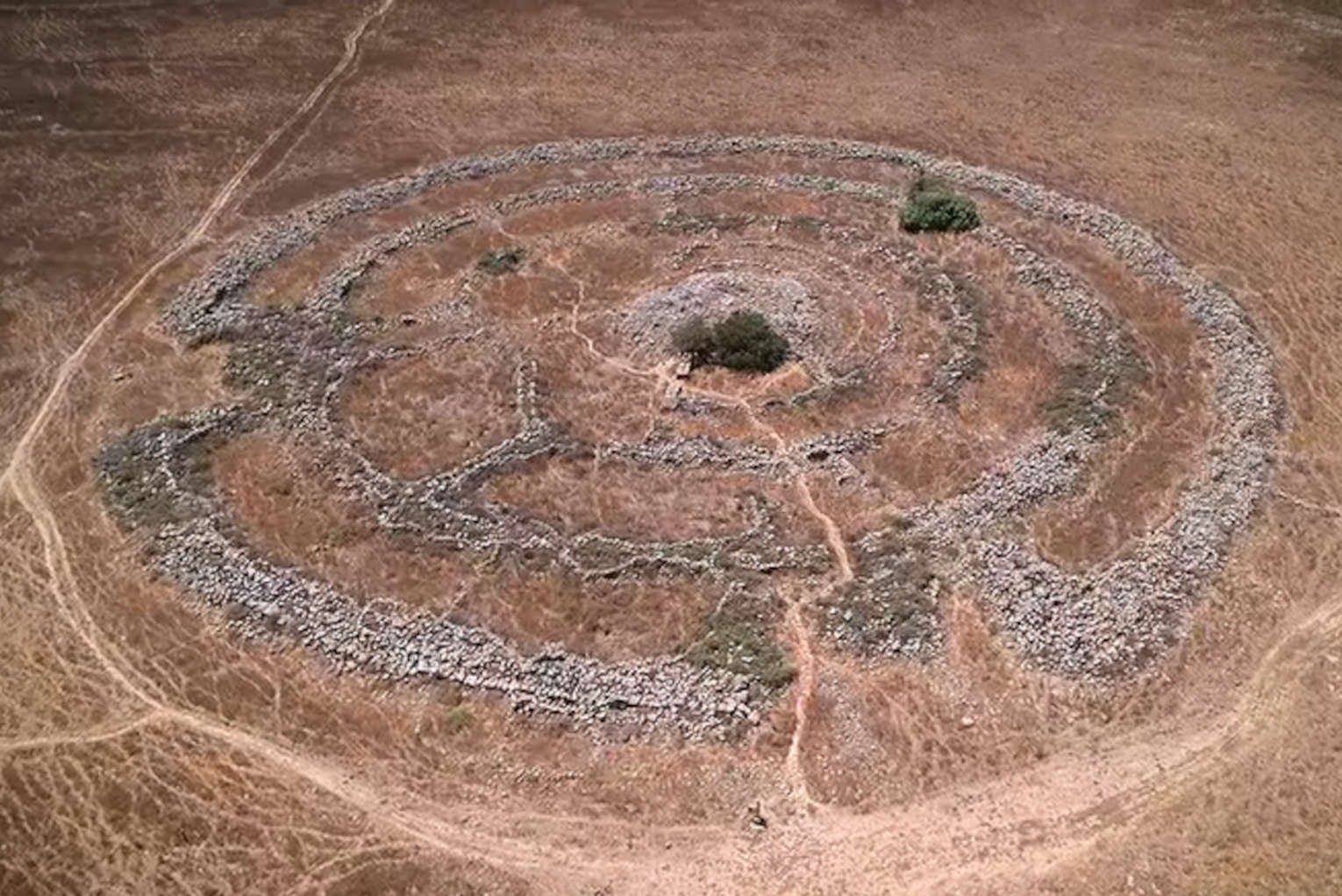
In addition to the dolmens, there is another prehistoric discovery in the Golan, probably belonging to the same culture as the dolmen builders. This is a massive stone structure in the center of the Golan Heights known as Gilgal Rephaim.
This structure is even more mysterious than the dolmens. It consists of three perfect circles, built one inside the other from enormous piles of stones, with a total diameter of approximately 150 meters. At the center of the circles stands a massive stone mound that appears to be a large dolmen, covered by a pile of stones, reaching a height of six meters.
Researchers estimate that this unique structure contains approximately 42,000 basalt stones that weigh about 37,000 tons. How much time did it take to pile those stones together?
Gilgal Rephaim was discovered in the Golan Heights only after Israel captured the region in 1967 during the Six-Day War. The reason is that the Golan is filled with piles of stones, making it impossible to recognize that this particular mound was something special. From above, however, the unique structure becomes apparent.
Gilgal Rephaim is a geoglyph – a structure built by humans that can be properly recognized only from the air.
Who built the site? What was its purpose? We have no answers. There are many theories connecting the structure, as well as the dolmens, with the pagan religious culture of the Amorites who lived in the region. However, we have no way of verifying these theories.
Nevertheless, for evangelical tourists who read the Bible and are interested in biblical sites in the Golan, the dolmens and Gilgal Rephaim may be of particular interest because of the biblical account of a race of giants who lived precisely in this region.
Anyone interested in seeing dolmens in the Golan Heights – and there are many of them – need only ask their tour guide. Reaching Gilgal Rephaim is more difficult, since the route follows rough dirt roads and requires a 4-wheel-drive vehicle capable of traveling through muddy and rocky terrain.
In addition, the site is not particularly impressive when viewed from the ground. Its unique design can truly be appreciated only from above. Nevertheless, some tourists still specifically request to visit the site.
So, there is a lot to see in your next visit to Israel and the Golan Heights!
This article originally appeared on ALL ISRAEL NEWS and is reposted with permission.
