
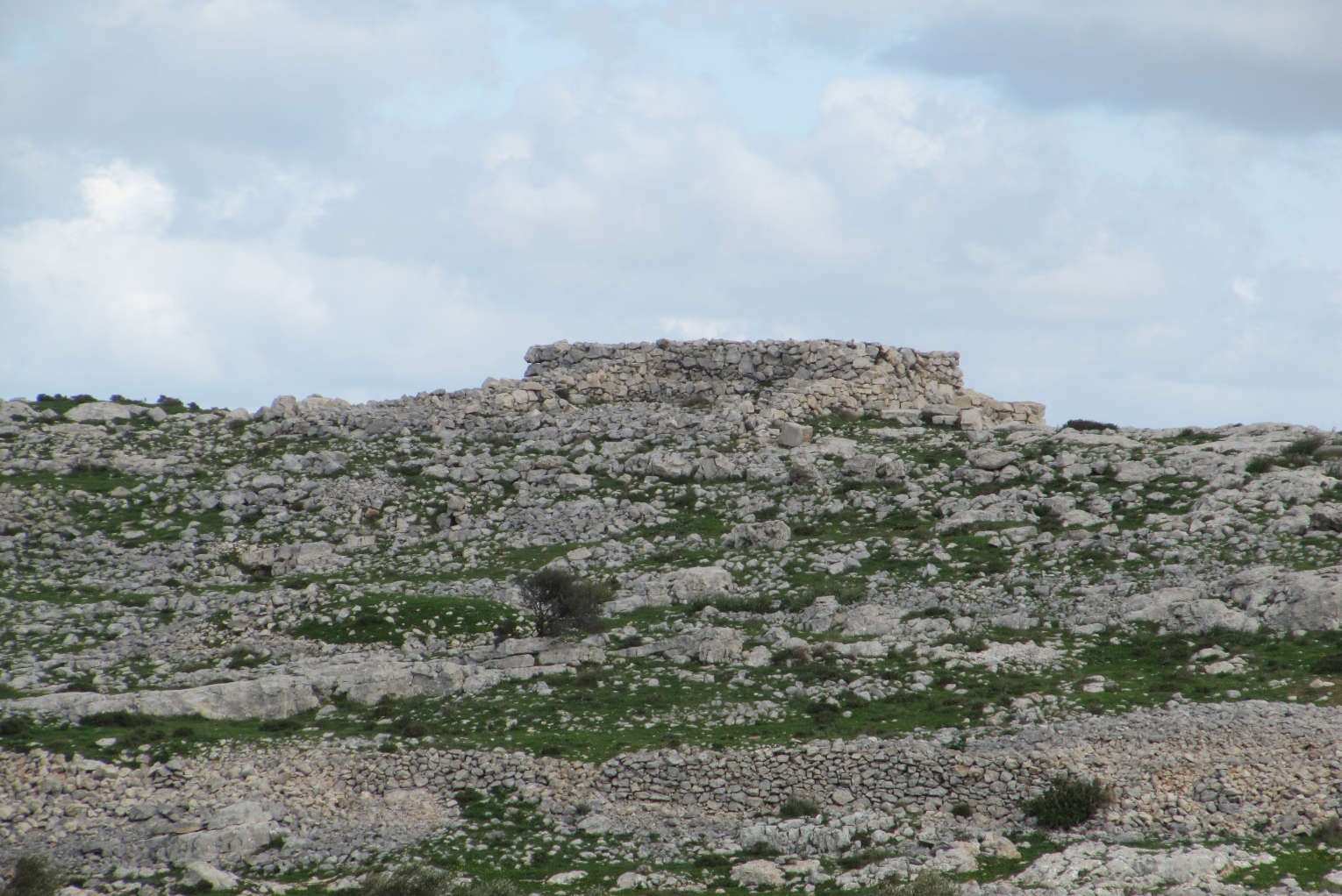
MT. EBAL, Samaria – Here in the heart of biblical Samaria, known to much of the world as the West Bank, there’s a battle going on over an archaeological site believed to be where Joshua built an altar to the Lord when the children of Israel crossed into the Promised Land.
Bible scholar and Joshua’s altar activist Aaron Lipkin said, “And you can see that the Palestinians are building a new village. I mean, look around us. There’s no village in the vicinity. This is a new village, and it’s built intentionally inside the compound of Joshua’s altar.”
Lipkin says Palestinians from the village of Asira al-Shimaliya initially built a new road in the area damaging the wider site. And now want to build a new neighborhood on top of the site, that’s a few miles from where the current village exists.
“The problem is that there’s no supervision over the site. As you can see, it’s in a peripheral area. We have no cameras here. We have no, soldiers here. Nobody’s guarding this site. So theoretically, an Arab building, construction worker can come in with a bulldozer and in 10 minutes destroy the whole site,” Lipkin said.
The altar is in an area under Israeli security control. Palestinians want it as part of a future state. But advocates say the biblical history here needs to be proteced by Israel.
Lipkin said, “There are two reasons for this. One is to prevent visitation of this site by Jews and Christians. And the second reason is to eventually delete or erase the connection of the Jewish people to their land.”

Order Jonathan Cahn’s New Book, “The Altar of Pergamon” on Amazon.com!
Lipkin noted that the process has been happening for several years.
“We’re seeing the Palestinian Authority declaring biblical sites, as Palestinian heritage sites. And Jericho is one example of it, Jericho, that is clearly in the Bible mentioned many times, including in the time of Joshua and has no connection whatsoever to the people that call themselves Palestinians,” he said.
In September 2023, just weeks before October 7th, UNESCO officially declared ancient Jericho as a world heritage site in the State of Palestine.
Lipkin sees that as an act against Israel and the Jewish people.
“The problem… is that this site is in Area B, according to the Oslo Agreements. The only solution to preserving the site of Joshua’s altar for the Judeo-Christian heritage that we all share is by Israel establishing permanent presence here. This place needs to be an international acknowledged heritage site.”
In the books of Deuteronomy and Joshua, the children of Israel are commanded to build an altar to the Lord.
Lipkin says, “Moses commands the Israelites, upon entry to the land, to conduct a huge national ceremony of blessings and curses. And so the first commandment is to build a stone altar on Mount Ebal and to do a ceremony of sacrifices. And then the next stage is to do a ceremony of blessings and curses on Mount Gerizim and on Mount Ebal.”
After centuries of unsuccessful searches for Joshua’s altar on Mount Ebal, Lipkin says archaeologists decided it didn’t exist.
“The problem was that they looked for it in the wrong place. They looked for it on the southern slopes of Mount Ebal, and they couldn’t find it. The new archaeologists that are saying that the Bible is not true, that it’s a fairy tale, that Moses never existed, Joshua never existed, the Exodus never happened.”
This all changed in the 1980s, when young professor Adam Zertal searches for Mount Ebal and after finding an ancient wall surrounding a compound he decides to excavate.
“What he discovers is under this pile of stone is a structure that is made out of field stones. For example, a stone box that is sealed from the top, a ramp going up to it with two secondary ramps on both sides and all around are these circular stone installations that are, are very clear, clearly identified in archaeology as showing a place of worship. “
After researching which culture it could have belonged to, Zertal realizes there’s only one answer.
“We found a huge Israelite altar on Mount Ebal, the biggest of its kind. This has to be Joshua’s altar. And if this is Joshua’s altar, then Joshua existed, Moses existed, and the Exodus happened.”
In July, ten Israeli families started a new community on Mt. Ebal not far from the altar. Lipkin hopes the Israeli government will declare the area a protected site so archaeologists can continue their work and Jews and Christians from around the world can visit this monumental discovery.
Published by agreement with CBN News
Julie Stahl is a correspondent for CBN News in the Middle East. A Hebrew speaker, she has been covering news in Israel fulltime for more than 20 years.
Julie’s life as a journalist has been intertwined with CBN – first as a graduate student in Journalism; then as a journalist with Middle East Television (METV) when it was owned by CBN from 1989-91; and now with the Middle East Bureau of CBN News in Jerusalem since 2009.