
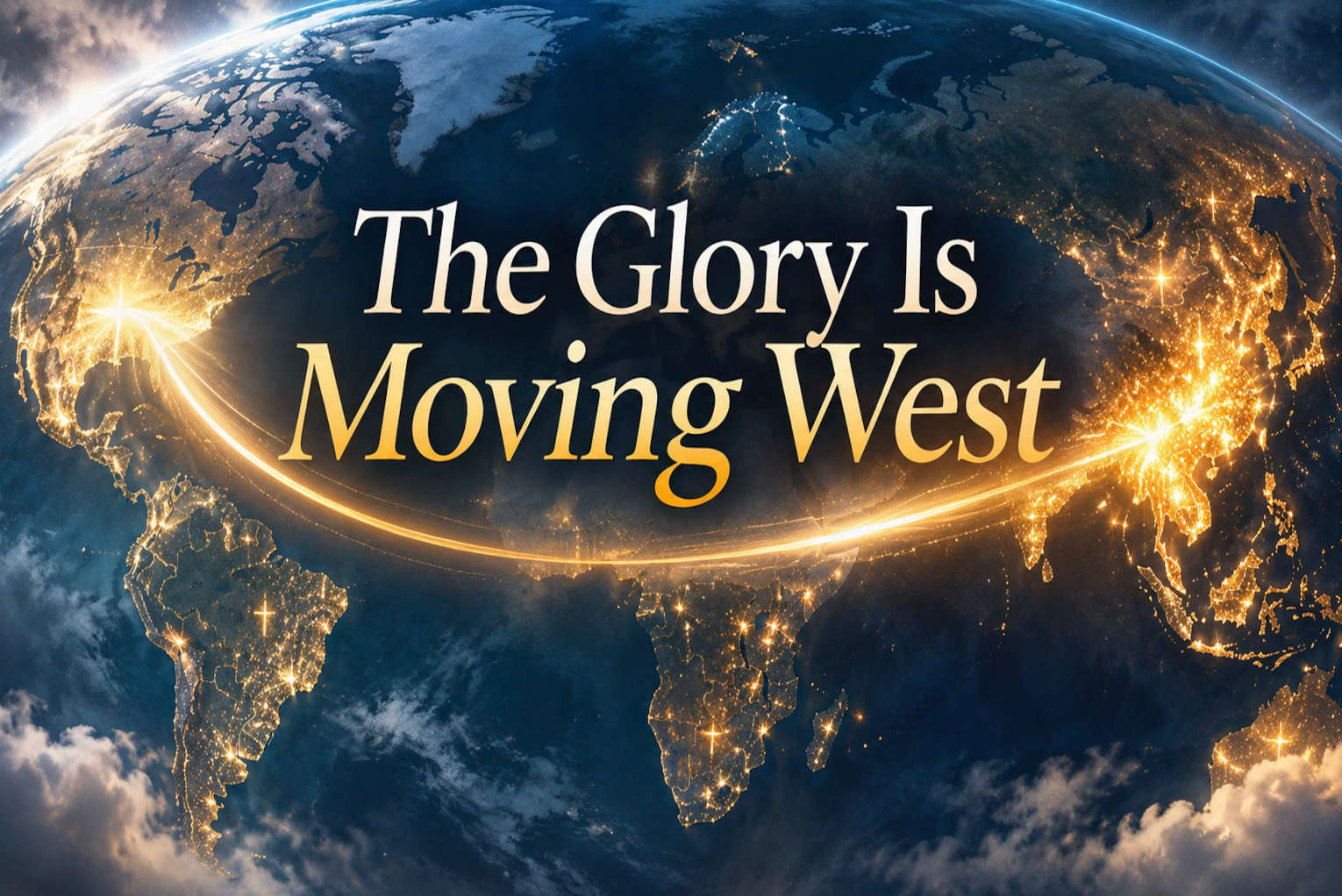
Christianity is shrinking and growing at the same time, in two different parts of the world, and you are almost certainly reading this in one of them. Which one you are in matters more than most believers realize. One side of this shift puts your faith at risk, and the other side is where God’s influence on the earth is now concentrated.
The numbers show the divide plainly. Gordon-Conwell Theological Seminary’s Center for the Study of Global Christianity reports that Christianity across the global North has been shrinking by about four-tenths of one percent a year. In the United States, the share of adults who identify as Christian fell from 78 percent in 2007 to 62 percent in Pew Research Center’s 2023–24 Religious Landscape Study. Meanwhile Christianity in Africa is growing by about 2.6 percent a year and in Asia by more than 1 percent. The country Operation World names as home to the fastest-growing evangelical church on earth is Iran, an Islamic Republic that ranks among the worst persecutors of Christians in the world.
If you live in the West, you are standing on the shrinking side, and it is more dangerous than the numbers suggest. A church in decline does not simply lose members. It loses its voice in government and its protection in law, and before long it begins to lose confidence in its own Bible. The believers who remain come under steady pressure to fall silent or to soften what they believe. That pressure is already here, and it is about to grow.
The growth on the other side is not mainly a matter of numbers. It is a matter of kingdom influence. Iran’s secret church, which had only about five hundred believers from Muslim backgrounds at the time of the 1979 revolution, has carried the gospel across its own borders. According to Operation World, the second-fastest-growing evangelical church in the world is in Afghanistan, where Afghans are being reached in large part by Iranians. Iranian Christian communities are also growing in Britain, Germany, Turkey, Canada and the United States, and the gospel pours back into Iran through satellite television and social media. A church that is not permitted to own a building is shaping nations.
Peter explained why influence follows the persecuted when he wrote to believers who were being hunted across the Roman Empire.
“If you are insulted because of the name of Christ, you are blessed, for the Spirit of glory and of God rests on you.” — 1 Peter 4:14 (NIV)
A church that is not permitted to own a building is shaping nations.
This shift is one of the clearest signs of the hour we are living in, and it is moving toward the West. Persecution is coming to America, and the elections of November 3, 2026, showed how far the nation has already traveled. The good news is that the church will not be here for the Tribulation these things are leading toward. Until Jesus comes for us, the question is which side of the shift you will be standing on, and the answer begins with understanding why He takes His church before the storm.
Order Randy Kay’s New Book, “Heaven Encounters” on Amazon.com!
The Church Leaves Before the Storm
The word rapture comes from Paul’s first letter to the Thessalonians. When he wrote that believers would be “caught up” to meet the Lord in the air, he used the Greek word harpazo, which means to snatch away suddenly and by force. Centuries later the Latin Bible translated it rapiemur, and from that Latin root we get the English word rapture. So when someone tells you the Rapture is not in the Bible, he is arguing with a translation of a word Paul himself wrote.
“For the Lord himself will come down from heaven, with a loud command, with the voice of the archangel and with the trumpet call of God, and the dead in Christ will rise first. After that, we who are still alive and are left will be caught up together with them in the clouds to meet the Lord in the air. And so we will be with the Lord forever.” — 1 Thessalonians 4:16–17 (NIV)
The same letter tells us when this happens in relation to the judgment that falls on the earth. Paul wrote that Jesus “rescues us from the coming wrath” (1 Thessalonians 1:10), and a few chapters later he added, “For God did not appoint us to suffer wrath but to receive salvation through our Lord Jesus Christ” (1 Thessalonians 5:9). The Tribulation is the time of that wrath, the seven years Daniel foresaw and John described from Revelation 6 through 19. Jesus made the same promise to the faithful church in Philadelphia.
“Since you have kept my command to endure patiently, I will also keep you from the hour of trial that is going to come on the whole world to test the inhabitants of the earth.” — Revelation 3:10 (NIV)
Jesus did not promise to keep them through that hour. He promised to keep them from it. Paul also told the Thessalonians that the man of lawlessness cannot be revealed until the one who now holds him back “is taken out of the way” (2 Thessalonians 2:7), and many of us believe that restraining presence is the Holy Spirit working through the church He indwells. From Revelation 4 through 21, the word church does not appear once. When John next sees the saints with Jesus in Revelation 19, they are riding out of heaven behind Him, “dressed in fine linen, white and clean.”
I don’t hold this only from the page. In 2005, when I died and stood in Heaven, I was shown the end of the age in its order. I saw multitudes lifted through openings in the cobalt, glassy floor of the Throne Room, angels guiding them in, their faces wide with amazement. Only after that did I see seven shields lifted from the earth and the destruction Satan had planned pour out. When I came back, I found that same order in Scripture. Something else came before the lifting, and I will return to it, because it bears directly on the shift I described at the start.
Jesus did not promise to keep them through that hour. He promised to keep them from it.
If the church is taken before the Tribulation, then our concern is what we will face in the years leading up to it. Much of that answer is already showing up in our politics.
What the Ballots Revealed
On November 3, 2026, Americans voted in the midterm elections, and the results showed exactly where the push in American religion is now coming from. In Texas, James Talarico, a Presbyterian seminarian who campaigned constantly on his faith, became the first Democrat elected to the U.S. Senate from that state since 1988. In Kansas, Adam Hamilton, senior pastor of the United Methodist Church of the Resurrection, unseated a sitting Republican senator in a state that had not sent a Democrat to the Senate since 1932. Nine pastors, former pastors and seminarians ran for Congress as Democrats this cycle, and two clergywomen in Iowa won House seats alongside Talarico and Hamilton. In Michigan, Abdul El-Sayed became the first Muslim ever elected to the United States Senate.
The push has a name, and it is progressive Christianity. Many believers have heard the term without knowing what it means. Progressive Christianity keeps the name of Jesus and the language of the Bible, but it moves the center of the faith from the cross to a social cause. Many of its teachers reject the truth that Jesus died in our place for our sins. One progressive writer summed up the view by saying Jesus saves us through His life, not His death. Brian McLaren, one of the movement’s best-known voices, has written that many progressives would say no theory of atonement is needed at all, because there is no problem God needs to solve through the death of Jesus. If there is no problem, there is no sin to forgive, and if there is no sin to forgive, there is no need for a Savior. The prophet Isaiah answered that seven centuries before the cross.
“But he was pierced for our transgressions, he was crushed for our iniquities; the punishment that brought us peace was on him, and by his wounds we are healed.” — Isaiah 53:5 (NIV)
Paul called this the gospel itself, the message “of first importance”: “that Christ died for our sins according to the Scriptures” (1 Corinthians 15:3). Remove the cross from the center, and what remains may still use the name of Jesus, but it is no longer the gospel He gave His life to establish. That theology has now won seats in the United States Senate, and you can hear it in what these two senators-elect teach.
James Talarico supports writing Roe v. Wade into federal law. At a CNN town hall on October 14, 2026, he told a Catholic voter, “the Bible is silent on the issue of abortion,” and on another program he said, “Jesus never talks about abortion.” The Bible is not silent. David wrote, “For you created my inmost being; you knit me together in my mother’s womb” (Psalm 139:13). God told Jeremiah, “Before I formed you in the womb I knew you, before you were born I set you apart” (Jeremiah 1:5). When Mary came to visit her relative Elizabeth, Elizabeth told her, “the baby in my womb leaped for joy” (Luke 1:44). And Jesus did speak to it, because when He was asked which commandments lead to life, the first He named was “You shall not murder” (Matthew 19:18).
Talarico has gone further. On Joe Rogan’s podcast he argued that because Mary gave her consent when the angel announced the birth of Jesus, Scripture supports a woman’s right to choose abortion. But Mary consented to receive a life God was giving, not to end one. “I am the Lord’s servant,” she answered. “May your word to me be fulfilled” (Luke 1:38). Turning the moment the Son of God entered the womb into an argument for ending life in the womb is not a reading of Scripture. It is a reversal of it.
Adam Hamilton preached a sermon in 2022 asking who goes to heaven. His answer was that God can apply the saving work of Christ to atheists and to people of other faiths, so that those who never trusted Jesus in this life can still receive His saving grace after death. “I don’t fear that those folks will spend eternity in Hell,” he said. Jesus closed that door when He said, “I am the way and the truth and the life. No one comes to the Father except through me” (John 14:6). The writer of Hebrews gives us the timing.
“People are destined to die once, and after that to face judgment.” — Hebrews 9:27 (NIV)
In His account of the rich man and Lazarus, Jesus said that after death “a great chasm has been set in place” between the two destinies, and no one crosses from one side to the other (Luke 16:26). The day to receive Christ is today. “Now is the time of God’s favor, now is the day of salvation” (2 Corinthians 6:2).
Progressive Christianity keeps the name of Jesus and the language of the Bible, but it moves the center of the faith from the cross to a social cause.
The progressive push is not the only shift the ballots revealed. Set the Michigan result beside the size of the community behind it. Muslims make up about one percent of American adults, according to the Pew Research Center. Yet the Council on American-Islamic Relations counted a record 97 Muslim candidates winning office in this election, up from 82 in 2022, and seven Muslims were elected to Congress, the most in our history. A year earlier, New York City elected Zohran Mamdani, a Muslim and a member of the Democratic Socialists of America, as its mayor, and the Detroit suburbs of Dearborn, Dearborn Heights and Hamtramck all elected Muslim mayors. CAIR’s own leaders describe this as the “growing political strength” of Muslim communities across the nation.
Every American has the right to run for office, and I pray for each of these leaders. My concern is the direction they represent. The DSA describes its goal as an economy owned and run by the public and by workers rather than for private profit, and its intellectual father is Karl Marx, who called religion “the opium of the people.” Marx wanted faith gone because devotion to God competes with devotion to the state. What I see forming now is an unlikely alliance. Marxist secularism supplies the economics, a rising Muslim political movement supplies a growing base, and progressive Christianity gives the whole effort a Christian face. They disagree about nearly everything else, yet they share an interest in edging Bible-believing Christianity out of its place in government and public life.
Persecution Comes West
That brings me to the first answer to the question of what now. Be prepared for more persecution. I am not speaking of the kind that plagues our brothers and sisters in Africa, Iran and China. Open Doors’ 2026 World Watch List counts 388 million Christians facing high levels of persecution for their faith, one in every seven believers on earth. Of the 4,849 Christians it documented as killed for their faith in its reporting year, 3,490 died in Nigeria alone, and North Korea has held the top spot on the list for twenty-four straight years. In those places, following Jesus can cost you your life.
Persecution in the West wears a suit. It arrives through laws, licensing boards, school policies and court orders, and it is carried out by secularists working hand in hand with progressive Christians who assure everyone that Jesus would approve. Britain shows us where this road leads. In October 2024, a British magistrates’ court convicted Adam Smith-Connor, an army veteran, for praying silently near an abortion facility in Bournemouth. He was praying for the son he had lost to abortion twenty-two years earlier. He made no sound and held no sign, and the court still ordered him to pay £9,000 in prosecution costs.
Persecution in the West wears a suit.
None of this should catch a believer off guard. Jesus told His disciples, “If they persecuted me, they will persecute you also” (John 15:20), and Paul passed the same warning on to Timothy.
“In fact, everyone who wants to live a godly life in Christ Jesus will be persecuted.” — 2 Timothy 3:12 (NIV)
Where the Glory Is
Now I can tell you what came before the lifting. Before I saw a single person taken into the Throne Room, I saw the Glory of God poured out on the earth like an orb. It did not appear everywhere at once. It began over the eastern continents and spread toward the western ones, and wherever it moved, people were healed, people walked out of wheelchairs, and countless numbers found new life in Christ.
Set that beside the map of the church today, and you can see why it has stayed with me. The Glory is burning brightest in the East, where following Jesus costs the most, and it is fading in the West, where following Him has cost almost nothing. Here is what I believe that means for us, and I want to be clear that this is my reading of what I saw, not something Jesus told me in words. If the Glory travels westward along the path of persecution, then the persecution now arriving in America is not a sign that God has abandoned the West. It is the road the Glory takes to reach us.
The persecution now arriving in America is not a sign that God has abandoned the West. It is the road the Glory takes to reach us.
This is where the secular planners miscalculate. They expect pressure to shrink the church, yet revival has always burned brightest in the persecuted church. Operation World estimates that Iran’s evangelical church has been growing by close to twenty percent a year. The pressure coming to the West will not put out the fire. It will separate those who carry it from those who only stood near it.
So there is a dichotomy now, and every believer in the West will stand on one side of it. Those who are firmly committed to Christ, in principle and in practice, will gain favor with God even as the culture turns against them. The lukewarm will find themselves either defenseless when the pressure comes or siding with the socialists, the Marxists and the Western Islamists who are applying it. Jesus spoke to that condition directly.
“I know your deeds, that you are neither cold nor hot. I wish you were either one or the other! So, because you are lukewarm—neither hot nor cold—I am about to spit you out of my mouth.” — Revelation 3:15–16 (NIV)
The Great Deception
Persecution is the pressure from outside the church. Deception is the danger from within it, and Jesus named deception first when His disciples asked Him about the end of the age. “Watch out that no one deceives you,” He said (Matthew 24:4). Then He gave a warning we are watching come true.
“For false messiahs and false prophets will appear and perform great signs and wonders to deceive, if possible, even the elect.” — Matthew 24:24 (NIV)
That deception is taking root in America. A growing number of teachers draw large followings by claiming they have toured hell, and some go further and announce exactly why the people they saw were there. Some even say that many of them were believers who trusted in eternal security, led astray by teachers of eternal salvation more than by the teachers of other religions. They speak with great authority, and many find them convincing.
But only God can see into a human heart. “People look at the outward appearance, but the LORD looks at the heart” (1 Samuel 16:7). No visitor to hell, however sincere, can look across a multitude of souls and pronounce what each one believed and why. Anyone who claims to do so is claiming knowledge that belongs to God alone.
Then there is the matter of fruit. A teacher can preach repentance to millions while refusing to repent of his own conduct, and when that happens, the holiness he projects becomes a covering that keeps anyone from looking closely at his life. This is how deception takes root. Jesus gave us the test for exactly this.
“Watch out for false prophets. They come to you in sheep’s clothing, but inwardly they are ferocious wolves. By their fruit you will recognize them.” — Matthew 7:15–16 (NIV)
Only God can see into a human heart.
In the Pulpit
The deception is not confined to social media or to the Senate. Millions are following teachers who stand in prominent pulpits. One mainstream pastor draws world-class speakers to his platform while teaching that the Rapture is not in the Bible. You have already seen that Paul wrote of it, and Jesus described it Himself when He promised His disciples, “I will come back and take you to be with me that you also may be where I am” (John 14:3).
Two Counterfeits
So we have outright persecution in Africa, in the Middle East and in communist nations like North Korea and China, while in the West a false form of Christianity is rising. The false form is more dangerous because it is more appealing, and it comes in two versions.
The first version allows freedom to sin. It keeps the name of Jesus and drops His call to holiness, so that abortion is recast as compassion and sin becomes a matter of personal conscience. Jude warned of people who “pervert the grace of our God into a license for immorality” (Jude 4), and Paul answered that idea before it could spread: “Shall we go on sinning so that grace may increase? By no means!” (Romans 6:1–2).
The second version denies what Jesus Christ accomplished on the cross. It teaches that true salvation is conditional on keeping yourself saved, which turns the gospel into a religion of works. It sounds holier than the first, and it leaves sincere believers lying awake wondering whether they have done enough. Paul would not tolerate it for a moment.
“For it is by grace you have been saved, through faith—and this is not from yourselves, it is the gift of God—not by works, so that no one can boast.” — Ephesians 2:8–9 (NIV)
Paul asked the Galatians, “After beginning by means of the Spirit, are you now trying to finish by means of the flesh?” (Galatians 3:3). And Jesus settled the security of His own when He said, “I give them eternal life, and they shall never perish; no one will snatch them out of my hand” (John 10:28). The grace that saves us also changes us, so obedience follows true faith as its fruit and never as its purchase price.
The Church That Is Growing
Both counterfeits are growing, but neither is growing fastest. The fastest growth in the world belongs to the persecuted church and to the believers who have not denied the power of the Holy Spirit. Paul described the last days as a time when people would keep the outward shell of religion and throw away the very thing that makes it live.
“Having a form of godliness but denying its power. Have nothing to do with such people.” — 2 Timothy 3:5 (NIV)
The church that embraces that power is the one expanding. According to Gordon-Conwell Theological Seminary’s Center for the Study of Global Christianity, Pentecostal and charismatic Christians numbered about 58 million worldwide in 1970, and today they number more than 670 million. Peter announced this outpouring on the day of Pentecost when he quoted the prophet Joel: “In the last days, God says, I will pour out my Spirit on all people” (Acts 2:17). The Spirit was given for a purpose. “You will receive power when the Holy Spirit comes on you; and you will be my witnesses” (Acts 1:8).
These believers are preparing the Body of Christ for the outpouring of God’s Glory, the same Glory I saw moving across the earth from east to west before the Rapture. They are evangelizing and discipling with urgency because they understand the hour we are living in.
The fastest growth in the world belongs to the persecuted church and to the believers who have not denied the power of the Holy Spirit.
What Now
This is the end-times battle, and it is intensifying. Persecution is rising abroad and arriving in the West, deception is spreading through pulpits, podcasts and the halls of Congress, and the Glory of God is gathering where the cost of following Jesus is highest, moving toward us along the same road the persecution is traveling. Here is how I believe we are to answer it.
First, settle your expectations. Persecution in the West is coming, and when it reaches your workplace, your child’s school or your church, do not be shaken by it. Peter wrote, “Dear friends, do not be surprised at the fiery ordeal that has come on you to test you, as though something strange were happening to you” (1 Peter 4:12).
Second, test every teacher. Measure what they say against Scripture, and measure how they live against what they preach. A teacher who frightens you about your salvation while excusing his own conduct has already told you what you need to know.
Third, refuse to be lukewarm. Commit to Christ in principle and in practice, and ask the Holy Spirit for the power He promised every believer. You were saved to be His witness, and the world needs to see the difference He makes in you.
Fourth, share Jesus with urgency, and disciple those who receive Him. The door is open today, and the Glory that is coming will draw multitudes who need someone to walk with them.
Then lift up your head. Jesus told us what to do when we see these things begin: “stand up and lift up your heads, because your redemption is drawing near” (Luke 21:28). The trumpet has not sounded yet. Until it does, our work is to stand firm and to bring as many people home with us as we can.
Randy Kay is the founder of Randy Kay Ministries and the host of Heaven Encounters with Randy Kay and The Last Call with Randy Kay. He is the author of Heaven Encounters: 140 Near-Death Experiences Revealing the Afterlife (Charisma House) and the founder of My Family Worldwide, a fellowship spanning more than 100 nations. He has trained thousands and led human development for some of the world’s most successful companies. His four courses, Designed to Thrive, Encountering God, The Healer and Grieving With Hope, are available at randykay.org.