In the latter days of Abraham’s life, according to the Bible, fire and brimstone rained down on the cities of Sodom and Gomorrah, destroying them completely. From a vantage point in Hebron, a long distance away, Abraham saw the smoke rising from the conflagration.
The destruction of Sodom and Gomorrah in Genesis 19 is one of the most memorable accounts in the Bible, representing divine wrath and punishment for persistent human sin and wickedness. Thus, they are sometimes called the “sin cities” of the Bible.
While skeptics over at least a couple of centuries have insisted that Sodom and Gomorrah are legendary, and that the Bible is merely giving us a “morality tale,” the Scriptures portray the destruction of the two cities as an historical rather than an allegorical event.
But if Sodom and Gomorrah were incinerated in a fiery conflagration nearly four thousand years ago, the evidence of that destruction might give biblical archeologists the opportunity to locate those two ancient cities. So where are they?

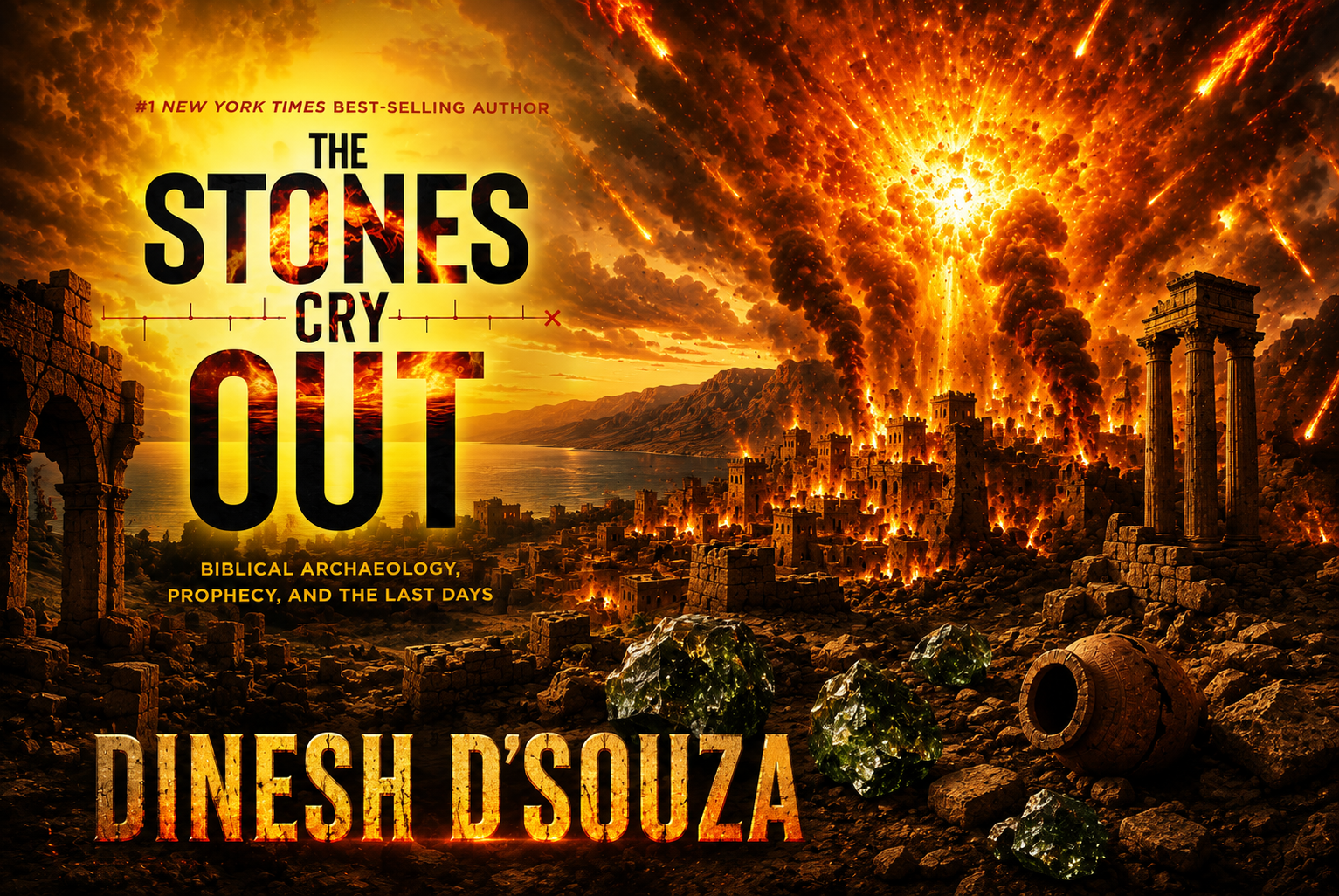
To order Dinesh D’Souza’s new book, The Stones Cry Out, visit Amazon.com.
From various biblical references, it is quite clear that Sodom and Gomorrah are somewhere near the Dead Sea. Since the 1920s, the traditional view of biblical archeologists is that the two cities were quite likely located near the southeastern coast of the Dead Sea.
In subsequent decades, archeologists excavated two promising sites in the region: Bab edh-Dra, which they identified with Sodom, and Numeira, which they identified with Gomorrah. Notice that Numeira even sounds somewhat like Gomorrah, and this is significant because many ancient cities changed their names over the centuries, but in a manner that preserved the echoes of their original names.
We recognize the names Sodom and Gomorrah instantly, but the Bible actually speaks of five “cities of the plain.” The other three are Admah, Zeboiim and Zoar. Four of the five were, according to the biblical account, wiped out. Zoar was spared. In fact, Abraham’s nephew Lot, who lived in Sodom, survived by fleeing to Zoar, where he and his family lived in a nearby cave in the mountains.
One of the great treasures of biblical archeology is called the Madaba Map. It is a mosaic map that was found on the floor of a church in Madaba, Jordan. It has a detailed depiction of Israel—then called Palestine, its Roman name—in the sixth century A.D. The Madaba map, which has enabled archeologists to find many ancient locations subsequently lost to history, appears to place Zoar on the southeast shore of the Dead Sea, in the vicinity of Bab edh-Dra and Numeira.
Both Bab edh-Dra and Numeira were destroyed by fire. Archeologists have found charcoal, broken and fallen bricks, and large areas of ash at Bab edh-Dra. The fire seems to have incinerated and collapsed the city walls. Stones and boulders from walled structures were scattered along the slopes of Bab edh-Dra.
Numeira was also burned. Archeologists found evidence of earthquakes that might have produced the fires or occurred in conjunction with the fires. Eventually, both sites were permanently abandoned.
So far, the evidence seems compelling, but the problems are with the dates of these events. Radiocarbon dating puts the destruction of Bab edh-Dra and Numeira centuries earlier than Abraham’s time. Some results even say that Bab edh-Dra and Numeira were not destroyed at the same time, which would pose a serious problem if we are trying to corroborate the biblical account. The Bible is emphatic that these sin cities were destroyed simultaneously.
Archeologist Stephen Collins has caused quite a stir in the scholarly community by advancing a rival location for biblical Sodom. He places Sodom at the northeastern end of the Dead Sea. In a way his thesis is not original. Many biblical scholars through the centuries thought Sodom must be roughly where Collins said it was. But their views were entirely based on the biblical account; they lacked archeological support. That’s where Collins came in.
Collins was initially convinced that Sodom was Bab edh-Dra and Gomorrah was Numeira. But he also recognized the problems with those identifications, so in a classic illustration of how biblical archeology works, he went back to the biblical text. There he found a problem even more serious than any radiocarbon dating mismatch. He found a mismatch between the two locations and the text itself.
The Bible says in Genesis 13:8-12 that when friction developed between Abraham and his nephew Lot, on account of their large herds grazing the same lands in the region of Bethel and Ai, Abraham proposed that he and Lot take their herds different ways. Lot, we read, “saw that the whole plain of the Jordan toward Zoar was well watered, like the garden of the Lord,” and so he went east, in that direction, “as far as Sodom.”
Collins realized that from Abraham and Lot’s vantage point, the only visible plain was at the northern end of the Dead Sea—that is the plain that is fertile and “well-watered,” then as it is today—and if Lot went east in that direction, it must mean that Sodom was located at the northeastern end of the Sea, not the southeastern coast, as the traditional view held. Collins excavated at a site called Tall el-Hammam, where he believes he has found biblical Sodom.
In Tall el-Hammam, Collins found thick layers of destruction, with collapsed walls, burned debris, and even skeletal remains, all inside a three-foot-thick layer of ash. Quite clearly this ancient city was thoroughly incinerated, and other adjacent cities around it have a similar archeological profile, showing that they too endured a similar fate.
Soon, however, Collins and his team encountered a serious problem. They found pottery in the ruins that was covered or glazed with a greenish, glass-like surface. Collins was dismayed. As a pottery expert, he knew right away that glazing techniques did not exist in 2,000 BC, and that glazed pottery largely begins with the Islamic period, which is around the seventh century AD.
Finding glazed pottery among 4,000-year-old charred ruins is similar to finding human bones among the skeletons of the dinosaurs. If evolution is correct, those human bones could not have existed when dinosaurs roamed the earth. So too with the glazed pottery. This is the type of anomaly that overturns the whole theory. Collins considered that perhaps his thesis had been refuted.
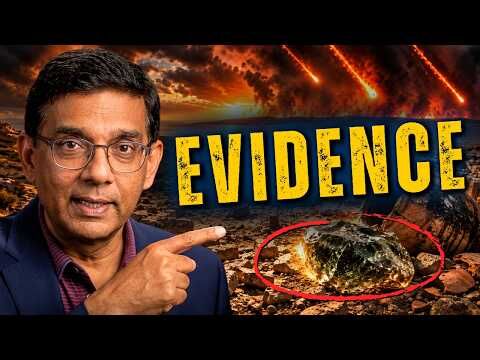
Just to be sure, Collins sent pottery fragments or shards to be tested at the U.S. Geological Survey lab in New Mexico. He was astounded to hear from the geochemists there that what they were testing was not glazed pottery at all. Rather, it was a substance called “trinitite.” Trinitite is not the name for a glaze applied to pottery; rather, it is the name for the pottery itself when it is subjected to extreme heat—the type of heat that occurs in a meteoric or nuclear explosion.
Scientists in New Mexico first encountered trinitite in the aftermath of the nuclear tests in the desert in the 1940s. Robert Oppenheimer, director of the Los Alamos Lab, gave the first nuclear test the code name Trinity, and the heat from that blast was so intense that it melted the sand, turning it into green glass. Trinitite!
Collins now realized that what happened over Tall el-Hammam was a meteor or asteroid explosion. The explosion was not the result of impact with the Earth, but had occurred in the sky within the Earth’s atmosphere, generating heat that is estimated to be the equivalent of a thousand Hiroshima bombs. That is what wiped out a thriving city and that is what created the trinitite. Notice how closely this scenario matches the biblical account of fire and brimstone “raining” on Sodom and Gomorrah.
I would like to leave it there, but as with so many persuasive theories, there is a hitch. Once again, it has to do with the date. Radiocarbon testing by Collins and others dates the destruction of this ancient city and its surroundings to 1750 to 1650 B.C. This is obviously a mismatch if Abraham lived in 2000 B.C.
But we do know for sure that Abraham lived in 2000 B.C.? Actually, we do not. Biblical chronologies are open to dispute, even among scholars who completely accept the reliability of the Bible. Collins thinks that maybe Abraham and the patriarchs lived later than previously thought, but he acknowledges the mismatch of dates between the destruction debris at Tall el-Hamman and the generally accepted dates for the biblical destruction of Sodom and Gomorrah.
What we learn from this dispute over alternate locations for Sodom and Gomorrah is that biblical archeology is not always an exact science. Facts are objective; interpretations, less so. Sometimes things can be known tentatively, not definitively. Science as we know it gives us probability rather than certainty.
There are good scholars on both sides of the Sodom and Gomorrah debate. I expect that at some point in the future, we’ll have further evidence that will settle the issue. Biblical Sodom and Gomorrah are still somewhat elusive, but I believe the time is not too distant in which they will come fully into view.
This content is from Dinesh D’Souza’s Substack, which you can read here.
Born in Mumbai, India, Dinesh D’Souza came to the United States as an exchange student in 1978. After graduating from Dartmouth College, he served as a policy analyst in the Reagan White House and a scholar in two prominent think tanks, the American Enterprise Institute and the Hoover Institution at Stanford University. He is a New York Times best-selling author who has written books on politics, religion, culture, and economics— including Illiberal Education, The End of Racism, What’s So Great About America, and United States of Socialism—and three books on Christian apologetics: What’s So Great About Christianity, Life After Death, and Godforsaken. D’Souza has made eight political documentary films and produces a daily podcast called The Dinesh D’Souza Podcast, which is seen and heard by about 100,000 people daily.