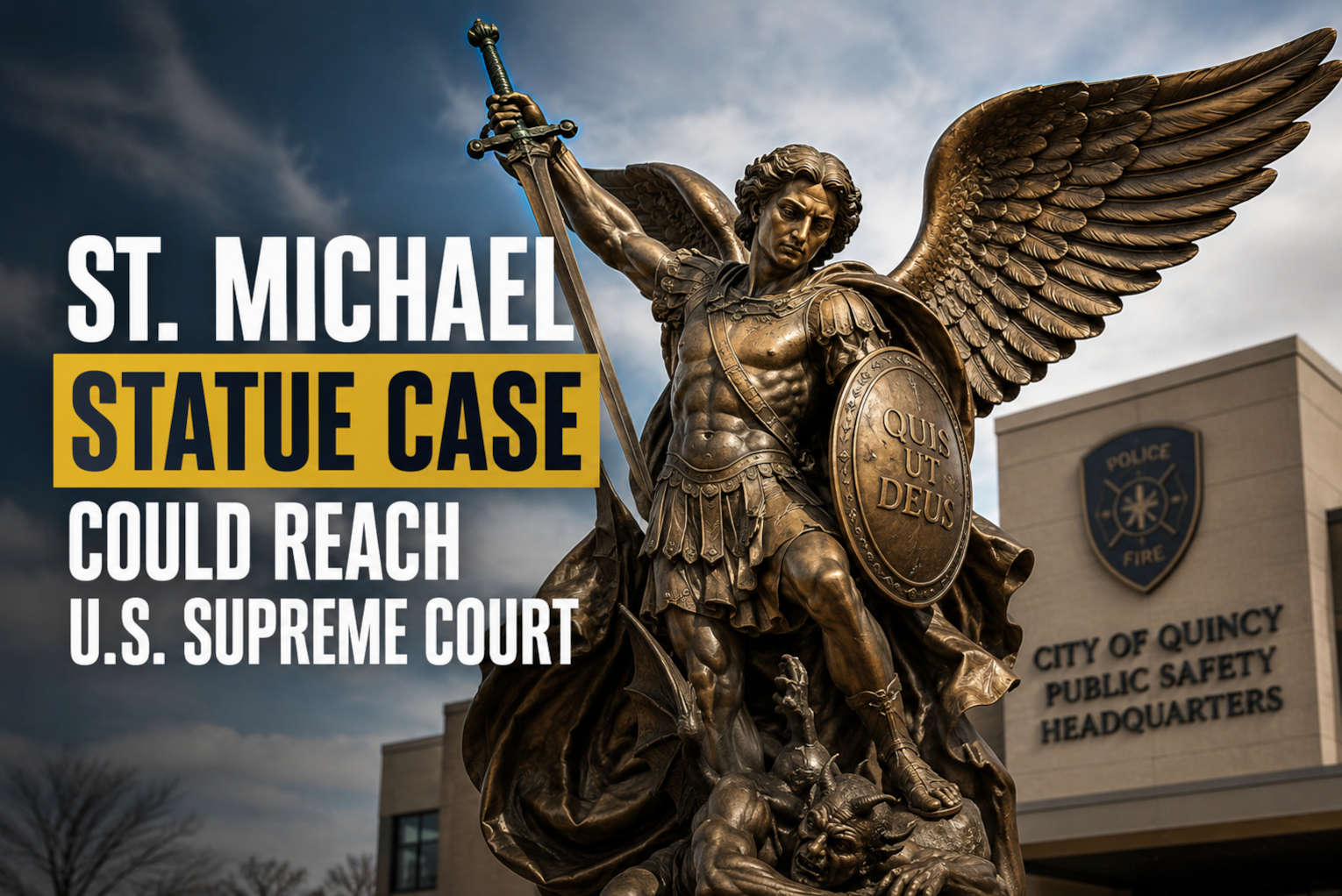
A legal battle over two statues outside a Massachusetts public safety headquarters is shaping up to become another major test of religious liberty in America, with attorneys on both sides acknowledging the dispute could ultimately reach the U.S. Supreme Court.
At the center of the case is the City of Quincy’s plan to install 10-foot bronze statues of St. Michael the Archangel and St. Florian outside its new public safety headquarters. Supporters say the display honors the courage and sacrifice of first responders and reflects America’s longstanding tradition of recognizing faith in the public square. Opponents argue it crosses a constitutional line by advancing religion.
City Defends Historic Symbols
According to previous reporting by the New York Post, Mayor Thomas Koch selected the statues to “honor, inspire, and encourage our First Responders,” “boost morale,” and “ensure [first responders’] lifesaving work would remain maximally effective.”
Order Jonathan Cahn’s New Book, “The Altar of Pergamon” on Amazon.com!
The Becket Fund for Religious Liberty, which represents Quincy, argues that public acknowledgment of religious history and symbolism does not violate the law.
“The ACLU’s position is anti-art and anti-history and we’re confident the justices will reject it,” Becket senior counsel Joseph Davis told Fox News Digital.
“We don’t hide away beautiful civic art just because it might make someone think of religion, and nothing in Massachusetts law says otherwise. Quincy has every right to honor its first responders with symbols that have inspired courage and sacrifice for generations,” Davis added.
For many religious liberty advocates, the case reflects a broader debate over whether the Constitution protects Americans’ free exercise of religion while also allowing the nation’s religious heritage to remain visible in public life.
ACLU Challenges the Display
The lawsuit, filed by Quincy residents and represented by the ACLU of Massachusetts and other organizations, argues the statues violate the Massachusetts Constitution because they would be the only permanent adornments outside the government building.
“The statues, whose imagery is drawn directly from Catholic iconography, lack a predominantly secular purpose,” the ACLU of Massachusetts argued in its court brief. It added that installing “two new, oversized, overtly religious statues as the sole adornments on the City’s public safety building is to advance religion.”
Jessie Rossman, legal director for the ACLU of Massachusetts, said, “The Massachusetts Declaration of Rights demands that our government remain neutral in matters of religion.”
The Massachusetts Supreme Judicial Court is expected to rule soon. Whatever the outcome, the decision is likely to become another closely watched case in the ongoing national debate over religious liberty and the place of faith in America’s public square.
James Lasher, a seasoned writer and editor at Charisma Media, combines faith and storytelling with a journalism background from Otterbein University and ministry experience in Guatemala and at the LA Dream Center. A Marine Corps and Air Force veteran, he is the author of The Revelation of Jesus: A Common Man’s Commentary and a contributor to Charisma magazine. For interviews and media inquiries, please contact [email protected].