
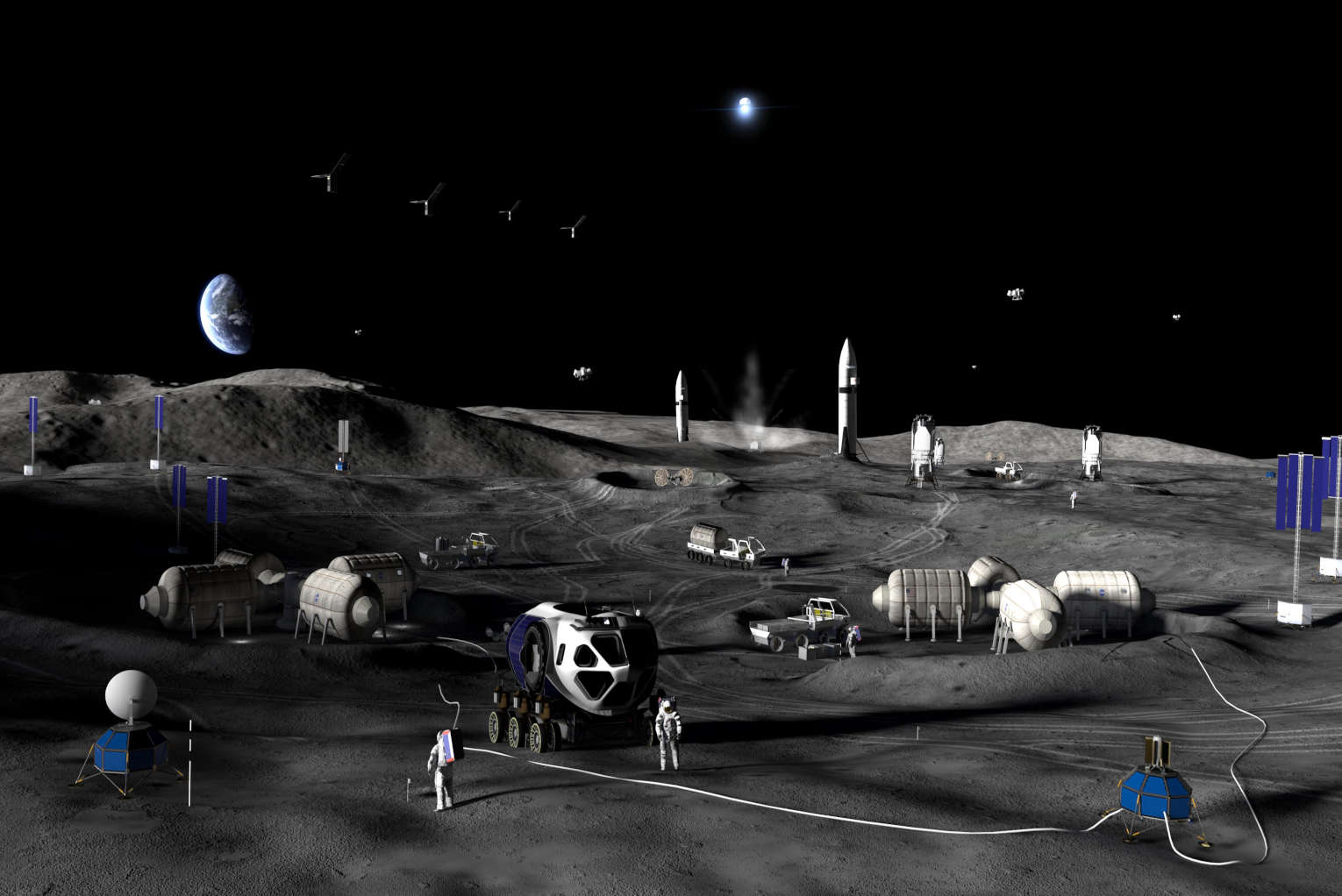
NASA is no longer planning brief visits to the Moon. A permanent presence is now the objective, marking a turning point in humanity’s reach beyond Earth and stirring a renewed sense of wonder about the vast universe God created.
As announced by NASA Administrator Jared Isaacman and reinforced by the White House, the mission is clear and unambiguous: “The goal is not just to reach the Moon, but to stay.”
A Permanent Presence on the Moon
NASA is moving forward with plans to establish a sustained human foothold through its Moon base initiative, laying the groundwork for long-term habitation and continuous operations on the lunar surface.
To build a sustained human presence on the Moon, we are building @NASAMoonBase, prioritizing surface operations and scalable infrastructure.
— NASA Administrator Jared Isaacman (@NASAAdmin) March 24, 2026
– Frequent robotic landings and mobility testing including MoonFall drones
– Starting in 2027 nearly monthly cadence of equipment and… pic.twitter.com/3T00Y450kO
The agency is preparing for a steady rhythm of activity, with nearly monthly deliveries of equipment, rovers and scientific payloads beginning in 2027. Investments in power, communications and surface mobility are designed to support scalable infrastructure that can grow alongside human presence.
Frequent robotic landings and mobility testing, including advanced drone systems, will pave the way for astronauts to live and work on the Moon in a way never before achieved.
“The goal is not just to reach the Moon, but to stay,” the White House stated, underscoring a decisive shift from symbolic missions to permanent occupation.
The goal is not just to reach the Moon, but to stay. 🌘 https://t.co/b24OqEEQb9 pic.twitter.com/5WPHYRNmeO
— The White House (@WhiteHouse) March 24, 2026
That commitment is matched by a firm national stance: “America will never give up the Moon again.”
A New Space Race and a Renewed Purpose
NASA is restructuring its approach to mirror the urgency and execution that defined the Apollo era, focusing on speed, coordination and sustained progress.
The agency is standardizing rocket architecture, embedding its expertise across private industry and increasing launch cadence to support continuous lunar missions. Plans are already in motion to ensure at least two providers can deliver astronauts to the Moon every six months, extending human presence well beyond the Artemis program.
At the center of this effort is a broader national vision that brings together government, industry and international partners with a shared objective.
“We will win the second space race,” Isaacman declared.
This renewed push reflects more than technological advancement. It captures a deeper human drive to explore, to discover and to step into the unknown, echoing a sense of awe that has long accompanied humanity’s gaze toward the heavens.

Order Troy Anderson’s New Book, “Designated Disrupter” on Amazon.com!
From the Moon to Mars
The Moon is not the final destination. It is the proving ground for what comes next.
NASA is developing SR-1 Freedom, a nuclear electric propulsion spacecraft designed to carry humanity farther than ever before, with a targeted launch to Mars in 2028.
“NASA is building SR-1 Freedom, a nuclear electric propulsion spacecraft, launching to Mars in 2028,” Isaacman announced.
The spacecraft will deploy the “Skyfall” payload, delivering Ingenuity-class helicopters to explore the Martian surface and expand scientific discovery on the Red Planet.
“Nuclear power and propulsion will be the key to undertaking crewed missions to Mars and exploring the outer solar system,” Isaacman said.
This breakthrough positions nuclear technology at the center of deep space exploration, unlocking the speed and efficiency required to reach distant worlds.
A Future That Calls Us Forward
With a permanent Moon base taking shape and Mars on the horizon, NASA’s strategy marks a defining moment in modern exploration.
We are stepping into an era that blends innovation with wonder, building pathways beyond Earth while rediscovering the vastness that surrounds us. As these missions unfold, they carry a renewed sense of purpose, inviting us to look upward once again and press forward into the unknown.
James Lasher, a seasoned writer and editor at Charisma Media, combines faith and storytelling with a background in journalism from Otterbein University and ministry experience in Guatemala and the LA Dream Center. A Marine Corps and Air Force veteran, he is the author of The Revelation of Jesus: A Common Man’s Commentary and a contributor to Charisma magazine. For interviews and media inquiries, please contact [email protected].