
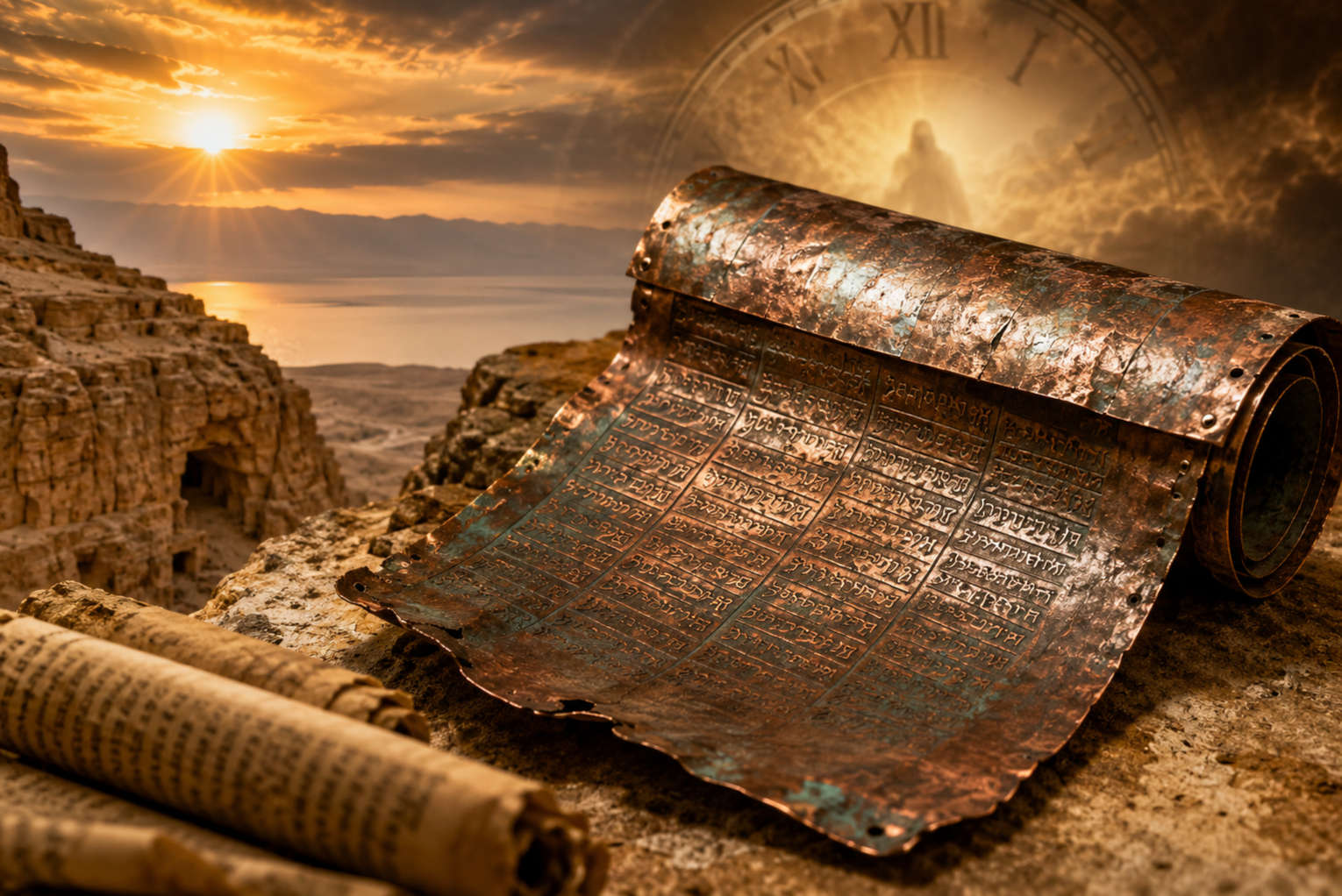
A strange copper document hidden for nearly 2,000 years inside a cave overlooking the Dead Sea is once again igniting fascination over ancient treasure, messianic expectation and the spiritual atmosphere surrounding what many in Judea believed were the biblical “End of Days.”
Unlike the other Dead Sea Scrolls Discovery, the mysterious Copper Scroll was not written on parchment or papyrus. It was engraved into sheets of metal, a decision that continues to puzzle archaeologists and biblical scholars alike.
Now, a bold new interpretation is breathing fresh life into one of history’s most enigmatic discoveries.
According to the Daily Mail, archaeologist Shimon Gibson believes the Copper Scroll may not have been a treasure map at all, but instead a secret financial record connected to the Bar Kokhba revolt, one of the bloodiest uprisings against the Roman Empire.
Gibson argued the valuables listed in the scroll “may have been funds or contributions secretly gathered to support the rebellion.”
That theory carries enormous spiritual and historical implications.
The Copper Scroll was discovered in 1952 inside Cave 3Q near Qumran overlooking the Dead Sea. Researchers immediately recognized it as something entirely different from the broader collection of Dead Sea Scrolls, which included biblical manuscripts, religious commentary and apocalyptic writings.
Order Dinesh D’Souza’s New Book, “The End of Time” on Amazon.com!
Instead, the Copper Scroll contained 64 cryptic entries describing hidden riches buried throughout the land.
One translated entry reads: “At Khorrebeh, situated in the valley of Achor below the steps leading to the east, [dig] forty cubits: a coffer [full] of money, the sum of which is the weight of seventeen talents.”
Another declares: “In the funerary monument of Ben Rabbah, of Beit Shalisha: 100 ingots of gold.”
For decades, scholars debated whether the document described real treasure hidden before Rome destroyed Jerusalem and the Second Temple in 70 AD, or whether the text carried symbolic or ceremonial meaning.
Now the focus is shifting toward another explosive chapter in Jewish history.
The revolt led by Simon bar Kokhba erupted decades after Jerusalem’s destruction and was fueled by fierce resistance to Roman oppression. Many Jews viewed Bar Kokhba as a possible messianic deliverer who would overthrow Rome and restore Jewish rule to Jerusalem.
That era became saturated with apocalyptic expectation, divine longing and hopes for final redemption.
The Daily Mail noted that the violent period “has long been associated with apocalyptic thinking and expectations of divine intervention.”
That reality should not surprise Bible readers.
The pages of Scripture repeatedly reveal humanity’s longing for deliverance in times of chaos, oppression and uncertainty. The prophet Daniel wrote extensively about kingdoms rising and falling before God ultimately establishes His eternal Kingdom. Jesus Himself warned in Matthew 24 that history would move toward increasing turmoil before His return.
And yet amid all the upheaval, Christ gave us reassurance that transcends every earthly kingdom and every failed human savior.
Jesus declared in John 16:33, “In the world you will have tribulation. But be of good cheer. I have overcome the world.”
That truth matters more than ever as archaeologists continue uncovering stunning discoveries connected to the biblical world.
It almost feels impossible to keep track of the avalanche of ancient findings emerging year after year. From the City of David excavations to evidence connected to ancient Judea, the Dead Sea Scrolls and now renewed debate surrounding the Copper Scroll, discovery after discovery continues pulling modern eyes back toward the land, history and spiritual tensions woven throughout Scripture.
Even the mystery surrounding the Copper Scroll itself deepens the intrigue.
Gibson believes the document was never intended for ordinary reading because the copper would crack if repeatedly unrolled. Instead, he said it may have been created as a permanent hidden record meant only for select individuals.
That detail transforms the scroll from a simple artifact into something almost cinematic: a sealed message from an era consumed by war, prophecy, rebellion and longing for redemption.
Ancient Judaism expert Yonatan Adler called Gibson’s theory “intriguing,” adding that discoveries like the Copper Scroll force researchers to think “outside of the box.”
More than 70 years after its discovery, the Copper Scroll remains one of archaeology’s greatest mysteries. Hidden treasure, secret rebellion funds, messianic expectation and apocalyptic belief now swirl together around a single metal document buried in the caves of Qumran nearly two millennia ago.
Yet while ancient Judea searched desperately for political deliverers and earthly victory over Rome, we know the true Messiah has already come.
No buried gold could save humanity. No rebellion could establish eternal peace.
That victory belongs to Jesus Christ alone.
James Lasher, a seasoned writer and editor at Charisma Media, combines faith and storytelling with a journalism background from Otterbein University and ministry experience in Guatemala and at the LA Dream Center. A Marine Corps and Air Force veteran, he is the author of The Revelation of Jesus: A Common Man’s Commentary and a contributor to Charisma magazine. For interviews and media inquiries, please contact [email protected].
