
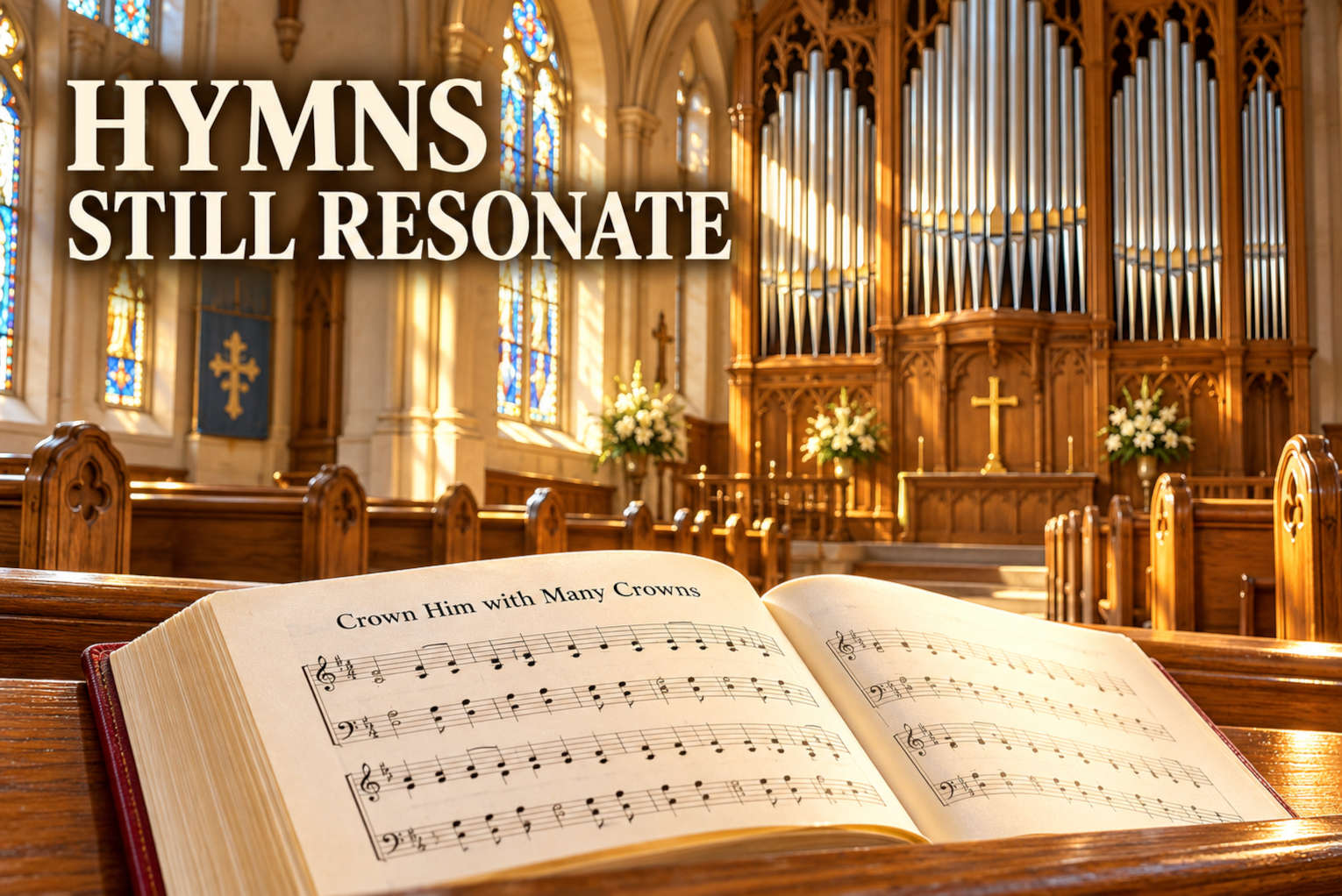
A German concert organist stopped in Douglas, Georgia, and asked a small church if it wanted to sing. He then got a room full of adults and children belting an old hymn.
Paul Fey posted the clip from a concert at St. Andrew’s. The hymn was “Crown Him with Many Crowns.”
In the description, Fey said the congregation asked to sing a couple of hymns with the organ, and that he was especially amazed by how many children and young people were there.
“It was wonderful to see such a lively congregation,” he wrote.
Fey is 28. He was born near Leipzig in 1998, found the pipe organ at 15, and trained in the orbit of the Thomaskirche, the church where Johann Sebastian Bach worked.
His YouTube channel draws a large monthly audience.
What he flagged was the singing.
Not a soloist. Not a band. A congregation, including kids, belting out a song about the Lamb upon the throne.
Order Abby Trivett’s New Book, “The Power of Suddenly” on Amazon.com!
The parish’s own page describes worship rooted in the Anglican tradition and Scripture, with Sunday Holy Communion, Sunday school, and a youth gathering.
This clip of Fey is worth sending around. A touring organist who spends his life in cathedrals walks into a small Georgia church and is struck by the children.
Churches that have spent 20 years chasing contemporary music in an attempt to draw young people might notice who showed up for the old tunes.
“Crown Him with Many Crowns” has lasted because it was built to be sung by a room, not performed by a single person.
Matthew Bridges wrote the original stanzas in 1851. The melody sits where untrained voices can find it. The words are about Christ, not the singer’s feelings. Men, women, and children can all push on the same line, and that is what Fey caught on the recording.
Contemporary worship music often misses the mark in two major ways: theological depth and congregational participation.
Beyond the shallowness of many modern lyrics, the songs are often structured for a stage performer and a microphone, which drowns out the congregation and leaves them miming along. Children especially become passive onlookers instead of active singers.
The solution isn’t to ban modern songs, but to look at what just happened in Douglas.
A renowned organist was blown away because a small church community and its children still knew a hymn by heart.
This is not a case of sentimental nostalgia. It is a vivid picture of a congregation doing what corporate worship was designed to do: exalting the Lamb upon the throne.
This article originally appeared on The Western Journal and is reposted with permission.
