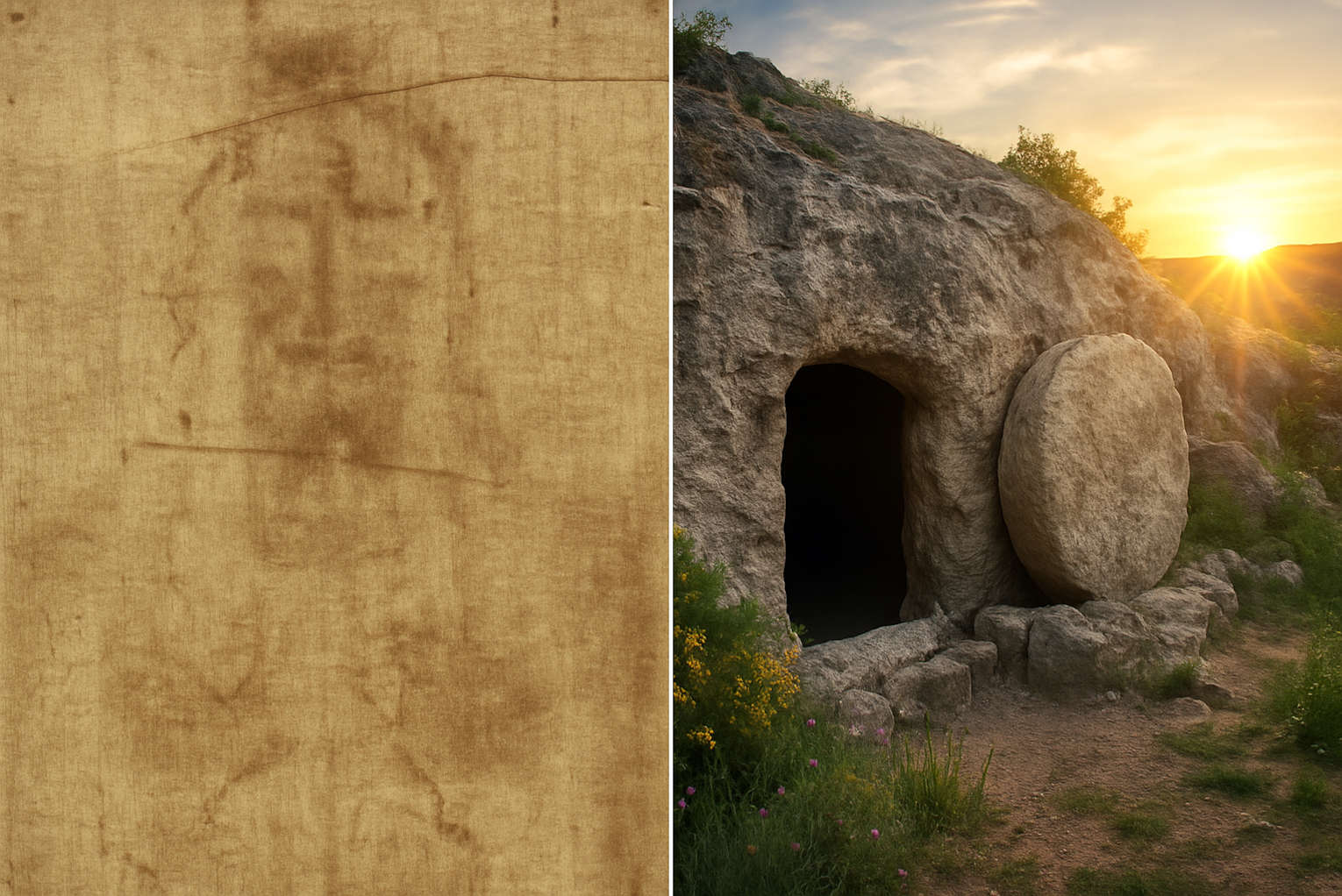

For centuries, the Shroud of Turin has captivated believers and skeptics alike. To the naked eye, it appears as a faint linen cloth with the outline of a man. But under scientific scrutiny, the Shroud reveals forensic details of crucifixion so precise, and an image so mysterious, that no known technology, ancient or modern, can fully explain how it was formed. Could it be what some call “God’s calling card,” evidence of the resurrection of Jesus Christ?
On a recent episode of Prophecy Watchers, host Gary Stearman sat down with author and researcher L.A. Marzulli to discuss Marzulli’s new film, Holy Shroud, Holy Fire. Together they explored not only the scientific anomalies surrounding the Shroud, but also its deep theological significance. “The Shroud, I think, is the most studied artifact on the planet,” Marzulli said. “It is not a painting. It’s not produced by the hand of man. So what is it?”
Breaking News. Spirit-Filled Stories. Subscribe to Charisma on YouTube now!
Marzulli pointed out that the Shroud was first photographed in 1898 by Secondo Pia. The resulting image shocked the world. “When you look at the Shroud it’s a negative image, and when you photograph it, it becomes a positive image. That is astounding,” Marzulli explained. “How would a 15th century forger know that photography would be invented hundreds of years later?”
The debate over the Shroud’s authenticity intensified after carbon-14 dating in the 1980s suggested it came from the Middle Ages. But Marzulli noted that those tests sampled a repaired section of cloth. Later research by Ray Rogers revealed that the fibers from the tested corner contained cotton from a medieval patch rather than the original linen. “That’s what skewed the carbon-14 dating,” Marzulli said. New studies, including work by researcher Giulio Fanti, suggest the cloth truly dates back about 2,000 years.
Pre-order Jonathan Cahn’s Newest Book, “The Avatar” on Amazon.com!
What makes the Shroud so compelling, Marzulli stressed, are the forensic details. “Every inch of his body, front and back, is scourged, open wounds. He’s in shock. And finally, when he’s pinned, it’s not in the palm of the hand—it goes at a slight angle and comes out the back of the wrist. And that’s precisely what the Shroud shows.” Even the mixture of blood and water at the spear wound matches the Gospel account. “Forensically, it is 110% accurate on every single level,” Marzulli emphasized.
Adding weight to the case is the Sudarium of Oviedo, a head cloth mentioned in John 20. This separate relic has been in Spain since at least the 7th century. When overlaid with the Shroud’s facial image, researchers have found “120 points of congruency,” Marzulli noted. “That means the Sudarium was on the same man who is in the Shroud. And of course, we believe it’s Jesus.”
Marzulli also connected the mysterious image to the ancient tradition of the Holy Fire in Jerusalem. For over 1,700 years, believers have witnessed a blue flame appear each Easter at the Church of the Holy Sepulchre, said to be the tomb of Christ. The flame lights candles without burning for several minutes. “We believe that the Holy Fire created this. It doesn’t burn, it just scorches. And that’s what the image is,” Marzulli explained, linking the phenomenon to the Shroud’s formation.
To both Stearman and Marzulli, the evidence points beyond historical artifact and into the realm of divine witness. “It’s forensic evidence of the greatest event in the history of the world,” Marzulli said. “The resurrection of the fully God, fully man, Jesus the Messiah.” Stearman reflected that perhaps in “these last of the last days, the Lord is revealing things to us” as reminders of Christ’s victory over death.
Join Charisma Magazine Online to follow everything the Holy Spirit is doing around the world!
Whether viewed through science, history, or faith, the Shroud of Turin continues to provoke the deepest questions of all: Who was the man in the Shroud? And if it truly is Jesus of Nazareth, what does that mean for the world today?
James Lasher is staff writer for Charisma Media.