
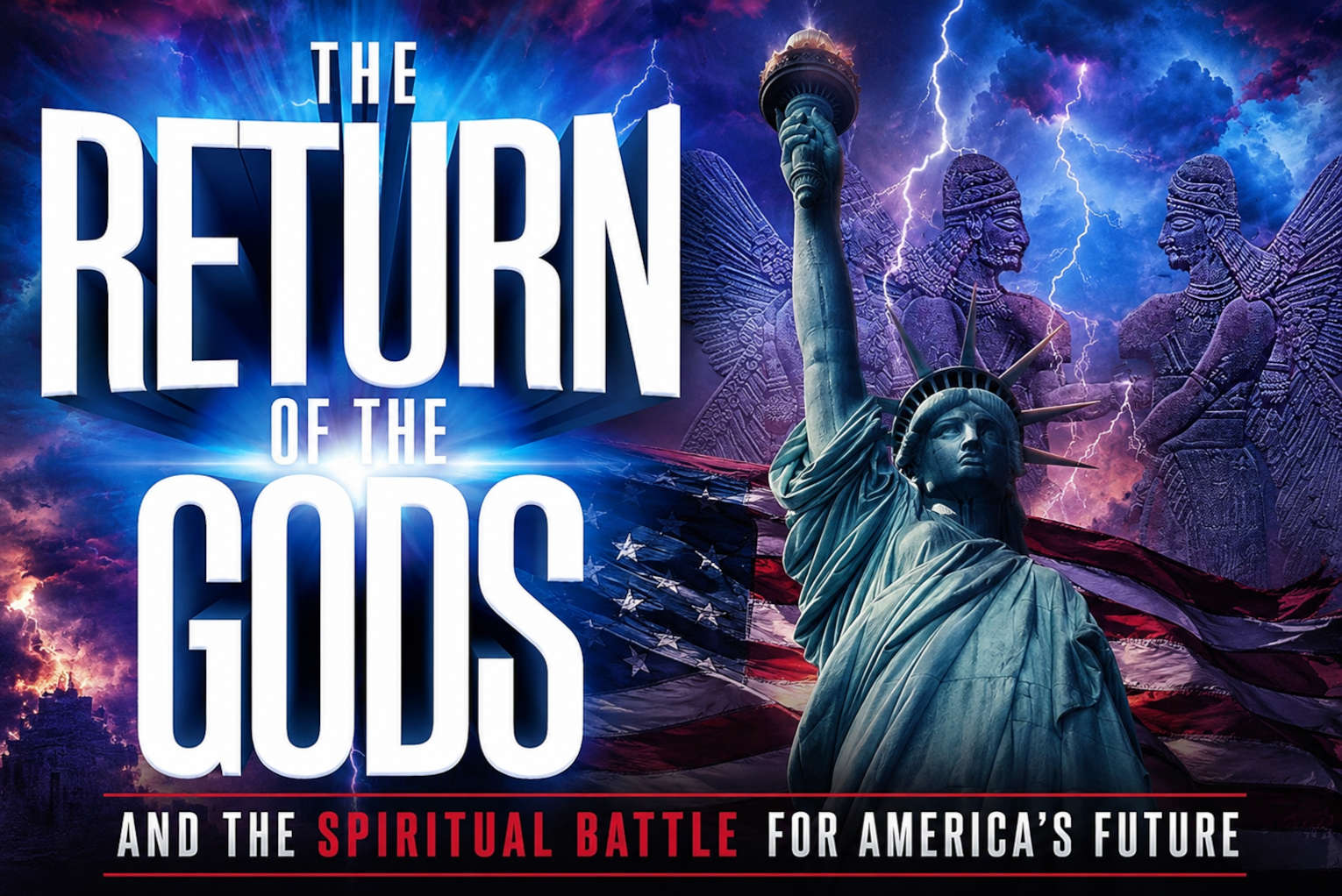
When Jonathan Cahn released the New York Times Bestselling book, The Return of the Gods, he presented a sobering question: What if the greatest forces shaping modern civilization aren’t merely political, social or cultural—but spiritual?
It is a question rooted in Scripture rather than mythology. The Bible makes clear that the false gods worshiped by ancient civilizations were not simply lifeless idols. Behind them operated real spiritual powers seeking humanity’s devotion. Cahn argues that those same powers never disappeared. Instead, they have returned to influence a culture that has steadily turned away from God.
Cahn’s central warning remains impossible to ignore: America’s greatest crisis is not ultimately economic, political or even moral. It is spiritual.
Ancient Mystery Revealed
When most people think of the gods of Babylon, Canaan or ancient Mesopotamia, they picture myths, legends and fictional characters. Cahn argues that Scripture presents a far more sobering reality.
“The Bible reveals that behind the ancient gods and idols were entities known in Hebrew as the shedim or spirits, and in the New Testament as the daimonia. It’s from that word that we get the word demons.”
That biblical foundation appears throughout Scripture. Psalm 106:37-38 says, “Indeed, they sacrificed their sons and their daughters to demons, and shed innocent blood, the blood of their sons and daughters, whom they sacrificed to the idols of Canaan. The land was polluted with blood.” (MEV)
Likewise, the apostle Paul warned the Corinthian church that “the things which the Gentiles sacrifice, they sacrifice to demons and not to God. And I do not want you to have fellowship with demons.”
Cahn’s argument begins there. Idols themselves possess no power. The danger has always been the spiritual rebellion operating behind them. Ancient civilizations gave those powers names and images, but the unseen forces remained the same.
If that is true, Cahn asks, what happens when a nation that once knew God abandons Him?
America’s Departure From God
One of the book’s central themes is that spiritual vacuums never remain empty.
Cahn points to Jesus’ parable of the unclean spirit in Matthew 12. After leaving a person, the spirit later returns to find the house “empty, swept and put in order.” It then returns with seven spirits more wicked than itself.
“The keys to the return of the gods are found in an ancient parable given by Jesus,” Cahn writes. “When one applies it to the modern world, it reveals an ominous warning.”
He argues that the principle extends beyond individuals to entire cultures.
“If those nations and cultures that have known God should ever turn away from God, away from the Gospel, from the Word and from Christianity, they will open up the door to the spirits, to the return of the gods.”
Over the past several decades, America has witnessed dramatic shifts in its moral landscape. Prayer and Bible reading disappeared from public schools. Biblical morality increasingly gave way to moral relativism. Christianity moved from occupying a central place in American culture to becoming one worldview among many.
These developments are not isolated events. They represent the opening of a spiritual door.

Order Jonathan Cahn’s Bestselling Book, “Return of the Gods,” on Amazon.com!
The Possessor: The Paganization of a Nation
Cahn identifies the first member of what he calls a “dark trinity” as the Possessor.
“In ancient times he had warred with the God of Israel. So he would do so again—in America and the West.”
According to Cahn, this spirit’s purpose is not simply to make society less religious but to transform it into something fundamentally pagan.
“Since pagan gods rule over pagan cultures and nations, the Possessor would set out to transform America from a Christian nation into a pagan one.”
Cahn describes this as a long cultural metamorphosis rather than a single event.
He argues that the gradual rejection of objective truth, the normalization of moral relativism, the elevation of self above God and the increasing hostility toward biblical Christianity all reflect this larger spiritual shift.
“The book will reveal how this ancient mystery and this ancient god actually lie behind wokism, political correctness, cancel culture, the modern computer, the genetic merging of man and animal, modern morality, Hollywood and much more.”
Cahn’s broader warning is that civilizations do not drift into spiritual neutrality. They move toward either God or idolatry.
The Enchantress and the Sexual Revolution
The second figure Cahn examines is the Enchantress.
“The next deity of the dark trinity was the Enchantress… She was the goddess of sexuality and, specifically, of sexual immorality.”
He argues that America’s sexual revolution did not emerge in isolation but followed the nation’s broader rejection of biblical authority.
“America’s turning from God in the 1960s was followed by what would be called ‘the sexual revolution.’ Behind it all lay the spirit of the ancient goddess.”
Cahn also connects the explosion of pornography, radical sexual ethics and even the modern resurgence of occult practices to this same spiritual influence.
“The goddess was the caster of spells and enchantments. So at the same time that the sexual revolution was in full swing, there was a revival in the practice of the occult.”
That observation is difficult to ignore in light of today’s culture. Astrology, tarot cards, witchcraft, crystal healing and other occult practices have become increasingly mainstream, particularly among younger generations. Entertainment frequently glamorizes magic and sorcery, while social media platforms host millions of posts celebrating practices Scripture repeatedly condemns.
These are not unrelated cultural trends. They are evidence that ancient spiritual deceptions continue to adapt themselves to every generation.
The Destroyer and the Culture of Death
The third figure Cahn examines is the Destroyer.
“As the Possessor had led to the Enchantress, so the Enchantress had led to the third god, the Destroyer. He was the god of human sacrifice and particularly the god of child sacrifice.”
Cahn draws one of the book’s strongest parallels between the child sacrifices practiced by ancient pagan civilizations and modern abortion.
“Upon the return of the gods to the modern world, the sexual revolution of the goddess would lead to the killing of children in the legalizing of abortion. Behind abortion was the Destroyer.”
He continues:
“As America and the West turned away from God and Christianity, they began taking up the ancient pagan practice of child sacrifice and offered up millions in abortion.”
Whether discussing ancient Israel or modern America, Scripture consistently presents innocent life as sacred because every human being bears the image of God. That biblical truth makes the modern culture’s treatment of unborn children one of the clearest indicators that the battle is fundamentally spiritual rather than merely political.
The Transformer and the War Over Identity
Perhaps no section of The Return of the Gods has generated more discussion than Cahn’s examination of the Transformer.
“The principality known as the Transformer possessed the powers of metamorphosis.”
Drawing from ancient writings, Cahn notes that one hymn celebrated the deity’s ability to “turn a man into a woman and a woman into a man.”
He argues that today’s confusion surrounding identity, gender and the rejection of God’s created order reflects the reappearance of the same ancient rebellion.
“When we watch what is happening in our culture, the defeminization and the masculinization of woman, the goddess is behind it. So too she is the mystery behind something else we are now witnessing—the emasculating and feminization of men.”
He also points to ancient priests who dressed as the opposite sex and underwent physical alterations, comparing those practices with modern cultural developments.
“So it is no accident that we are now witnessing an explosion in transgenderism—men being surgically altered to appear as women and women surgically altered to appear as men.”
Regardless of where the cultural conversation goes from here, Cahn insists the deeper issue is whether humanity will accept God’s design or attempt to redefine it.
The Mystery of the Rainbow
One of the most memorable arguments in Cahn’s book concerns the rainbow.
The rainbow first appears in Genesis as God’s covenant with Noah—a sign of His mercy and promise never again to destroy the earth with a flood.
Cahn argues that the modern cultural use of the rainbow represents something very different.
“A strange thing has happened to America and Western civilization. It has become saturated with the sign of the rainbow.”
He believes that ancient Mesopotamian writings reveal a symbolic connection between the rainbow and the goddess discussed throughout the book.
“It goes back to the tablets of ancient Sumer and Babylon. It has to do with the goddess. What it actually means is very different from what most people believe it does.”
Whether readers agree with every historical connection, Cahn’s broader concern remains consistent throughout the book: symbols matter because they communicate spiritual realities, and cultures often adopt them without understanding their origins or implications.
More Than Politics—A Spiritual War
One of Cahn’s greatest contributions is reminding believers not to reduce spiritual issues to political debates.
The apostle Paul wrote that “we do not wrestle against flesh and blood, but against principalities, against powers, against the rulers of the darkness of this world, against spiritual forces of evil in the heavenly places.”
If that is true, then elections alone cannot solve America’s deepest problems.
Neither can legislation.
Neither can court rulings.
Only spiritual renewal can confront a spiritual crisis.
That means prayer matters.
Repentance matters.
Holiness matters.
The proclamation of the Gospel matters.
The Church’s greatest weapon has never been political influence but the power of the Holy Spirit working through faithful believers.
What Lies Ahead—and How Christians Should Respond
Cahn concludes The Return of the Gods by warning that the battle is far from over.
“The last section of the book is called The War of the Gods. It reveals where it is all heading. It exposes the plan and end-game of the gods… and a coming persecution of believers.”
Yet his message ultimately is not one of fear.
“It reveals what we must all know in order to stand strong—against the gods, and how to overcome in the days ahead.”
That has always been the heart of Jonathan Cahn’s ministry. His books do more than identify darkness. They call God’s people back to repentance, revival and unwavering faithfulness.
The answer to spiritual deception is not panic but discernment.
The answer to cultural darkness is not despair but the light of Christ.
And the answer to ancient spiritual rebellion remains the same today as it was in the first century: a Church that refuses to compromise, boldly proclaims the Gospel and stands firm on the unchanging truth of God’s Word.
Prepared by Charisma Media Staff.
