

L.A. Marzulli remembers a garden where every flower had a song.
Before that came a desolate landscape, a casino filled with figures whose appearances turned nightmarish and a beautiful mansion with no one inside. He says two luminous beings carried him from place to place while his body lay in a hospital bed with a dangerously high fever.
Then came the garden, a waterfall and a valley stretching into the distance. The colors seemed unlike anything he had seen on earth. He sensed that people were nearby and coming toward him.
“Every flower is singing its own individual song,” Marzulli recalled in an interview with Charisma Media.
His next memory was of waking in the hospital and seeing a red-haired nurse dressed in white.
“Are you an angel?” he asked her.
Decades later, the experience has found its way into “The Waiting Room,” a novel that draws on his life to explore eternity, grief and the spiritual consequences of refusing to forgive.
Marzulli’s descriptions of another realm supply some of the book’s imagery. The struggle to release the people who hurt him supplies its central conflict.
“Forgiveness is the key to everything,” he said.
A Fever of 106 Degrees
Around 1969, Marzulli was living in the woods in a makeshift tepee. He described himself at the time as a hippie. He bathed in a nearby stream and drank its water, unaware, he said, that cattle were pastured upstream.
Then he became seriously ill.
His fever climbed, and friends contacted his parents, who came to get him. In the hospital, he underwent a spinal tap. As his temperature continued rising, he was placed on an ice blanket.
When the fever reached 106 degrees, he lost consciousness.
What followed, he says, was the near-death experience he still remembers in vivid detail.
Two beings of light came for him, and he found himself being carried upward. They first left him in a barren place covered with yellow sand. In the distance, indistinct, bloblike forms began approaching.
He ran. The beings returned and carried him away.
The next scene looked inviting. He was at a craps table in a casino, holding a drink, rolling dice and receiving enthusiastic encouragement from the people around him. He had not been a gambler, yet there he was, surrounded by apparent admirers.
Then he looked at them from the corners of his eyes. Their appearances changed. He described green skin, visible skulls and figures that looked like phantoms.
He fled, calling for help.
Again, the beings took him elsewhere. This time he arrived at an immaculate mansion with beautiful landscaping, flowers and richly decorated rooms. He explored the house and gardens before realizing that he was completely alone.
“There was nobody there,” he said.
The beauty could not overcome the isolation. He wanted to leave.
Finally, the beings brought him to the garden. A stream led to a waterfall near where he stood. Beyond it lay an expansive green valley. The flowers sang, and he sensed the presence of others.
“And I had a feeling that people were coming for me,” he said.
Then the scene ended. He described a sensation of falling and blacking out before awakening in the hospital. The nurse told him he had been unconscious for three days.
The experience occurred before he became a Christian. His search for God would continue for years, through questions that had begun with another encounter with death.
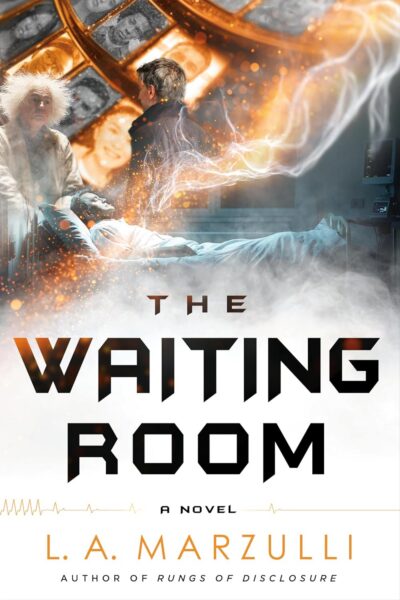
Order L.A. Marzulli’s Book, “The Waiting Room” on Amazon.com!
The Loss That Sent Him Searching
Marzulli was 16 when he met Michelle Mintzer, a 14-year-old working alongside him at a YMCA day camp. She became his first real girlfriend.
Dating her included visits with her father, who would question him before allowing the couple to go out. The relationship continued for two years.
Then, when Marzulli was 18, his father entered his room with devastating news. Michelle had been struck by a car and killed.
“And this shocked me to the core,” Marzulli said.
Death had taken someone he knew intimately and loved. The loss sent him searching for answers about God, suffering and the meaning of life.
“If there is a God, how can I know Him?” he recalled asking.
About 12 years after Michelle’s death, he gave his life to Jesus. In the interview, he described that surrender as the point when everything changed.
“The Waiting Room” is dedicated to Michelle and to Jesus, whom Marzulli calls “the keeper of my soul” in the dedication.
That history gives the novel’s treatment of grief a personal weight. Its characters carry losses they cannot repair, memories they have tried to bury and anger that has survived long after the original wound.
Marzulli said some characters combine incidents involving several people into one fictional person. The book draws from his life without reproducing it as an autobiography. Its emotional struggles reach back to experiences he has had to confront himself.
The Faces We Have Never Forgiven
The idea for the novel came while Marzulli and his wife, Peggy, were driving to dinner on a Los Angeles freeway.
He described receiving the overarching concept suddenly and believing the Lord had given it to him. He told Peggy immediately. The book took about six months to write and marked his first novel in more than 20 years.
The protagonist, Bob Frisbee, is a former commercial airline pilot whose heart stops while he is hospitalized. In the novel’s opening, he watches events unfold from above his bed, then finds himself transported to an unfamiliar room.
There he meets Mr. Olam, known as Mr. O, a mysterious guide with a file containing the details of Bob’s life.
Bob expects answers about where he is. Mr. O begins directing his attention toward people he has never forgiven.
A golden wheel appears, with Bob’s portrait at its center and faces at the ends of its spokes. Some spokes shine. Others remain dark, marking relationships still burdened by resentment.
One of the first faces belongs to a childhood bully. Bob remembers winning their fight and sees little reason to revisit it. Mr. O presses him to recognize the ill will he has carried ever since.
The assignment is to bless the boy who hurt him.
Bob resists. When he finally extends a sincere blessing, the spoke lights up, and the angry face becomes a smile.
The scene establishes a pattern that becomes increasingly difficult as Bob confronts deeper betrayals. Childhood humiliation leads into wounds involving marriage, family and devastating loss. His explanations sound reasonable to him. He was wronged. The pain was real. Years have passed.
Yet the anger remains available whenever a memory summons it.
Marzulli also lets Bob see the histories of people he has judged. A harsh coach was once a wounded child. An unpleasant neighbor endured horrors Bob never imagined. Those discoveries force him to reckon with both their suffering and his own behavior.
The novel gives forgiveness a visible form. Each illuminated spoke marks a person Bob has stopped holding in the grip of an old offense.
Its imagined setting also allows Marzulli to explore worship, spiritual warfare and restoration. A forest fills with music. Moments of humor interrupt painful confrontations. Scenes of reunion give expression to the longing to see loved ones again.
The singing creation echoes the garden in his own account. The wounds that surface in Bob’s conversations echo experiences much closer to everyday life.
Marzulli identifies the book as fiction in his author’s note and describes it as a teaching tool. Its conversations and journeys are his imaginative means of bringing those struggles into view.
When the Wound Comes From the Church
One of Marzulli’s most consequential lessons in forgiveness came after a painful rupture with a congregation.
He said he was forced out of a church and became deeply angry with the people involved. His anger extended to God.
In the book’s explanatory section, he writes that he had been a worship leader there. The expulsion left him feeling abandoned by people who had become like family. He carried that bitterness for two years.
Then, while driving one day, he sensed the Holy Spirit confronting him with Jesus’ teaching about forgiveness.
“And it was like a wakeup call,” Marzulli told Charisma Media.
He points to Matthew 6:14-15, where Jesus teaches that our willingness to forgive others bears directly on receiving the Father’s forgiveness. Marzulli identifies that passage as the foundation of “The Waiting Room.”
The teaching confronted his response to an injury he believed was unjust. He had reasons for being hurt. He still had to forgive.
That distinction runs through the interview. Marzulli acknowledges the seriousness of what people do to one another and insists that forgiveness remains necessary even when the offense is heinous.
“We don’t excuse what’s been done,” he said.
He looks to Jesus on the cross as the model. Even while suffering at the hands of those who had brutalized Him, Jesus asked the Father to forgive them.
In the novel, Bob repeatedly encounters that same demand. His resistance exposes how easily a person can defend an old grievance while overlooking what it has become inside him.
Marzulli had to face that in his own relationship with the church. Remembering the offense kept returning him to his anger. Forgiveness required him to release people whose actions had left him feeling rejected and alone.
Learning to Bless Again
Writing those conversations required Marzulli to examine his heart again.
Asked whether working on the book had been therapeutic, he answered plainly: “It absolutely was therapy.”
He had taught and practiced forgiveness for years. Following Bob through the story brought another layer of unresolved hurts to his attention.
Marzulli described people who had treated him badly over the course of his life. His response now is to bless them in Jesus’ name and ask for God’s goodness toward them.
The blessing gives him something concrete to do when resentment surfaces. He can bring the person before the Lord and seek that person’s good, even while remembering the hurt.
“Because what that does is that frees me up,” he said.
He connects that freedom with joy. When he releases the grievance, he no longer carries the same festering burden in his heart.
He also acknowledged that old attitudes can return. A person may forgive, then find himself picking up the offense again. Marzulli described the Holy Spirit checking him when that happens and prompting him to return to the work of blessing.
Forgiveness, in his account, involves repeated obedience. The memory may reappear, and the decision to release it must be made again.
That is why his invitation is specific: Ask the Lord to bring to mind the people toward whom bitterness remains. Then begin forgiving and blessing them.
The novel’s scenes give that examination a recognizable shape. A childhood bully may still provoke anger. A former friend’s betrayal may feel recent after decades. A church conflict may have ended publicly while continuing privately in the person who was wounded.
Marzulli wants those hidden grievances brought before God. The book’s emphasis on mercy and second chances carries an immediate appeal to respond to the Lord while there is opportunity.
“I’m praying that people that read this book will make that right choice,” he said.
The garden remains vivid in his memory. So does the moment the Holy Spirit confronted the bitterness he had allowed to grow. He has learned to ask God to expose resentment and to bless the person whose name comes to mind.
“Forgive everybody everything,” Marzulli said.
Prepared by Charisma Media Staff.
