

Humanity is gaining power at a breathtaking pace. But are we gaining the character necessary to carry it?
That is the question at the heart of a recent message from Glenn Beck, who drew a provocative connection between artificial intelligence, the mysterious events surrounding Genesis 6, and an ancient Jewish text describing knowledge being handed to humanity before mankind was prepared for what it could unleash.
“We are living right now through the fastest handoff of power in human history,” Beck says, arguing that technological capability is increasingly being placed into ordinary people’s hands without the years or generations of formation that once accompanied such power.
To illustrate the danger, Beck reaches back thousands of years to one of Scripture’s most mysterious passages.
Genesis 6 briefly describes the “sons of God,” the “daughters of men,” and the Nephilim before the account of Noah and the flood. Beck then turns to a much more detailed version of the tradition preserved in 1 Enoch, which describes beings commonly called Watchers descending and introducing humanity to various forms of knowledge.
An important distinction must be made here: The Book of Enoch should not be viewed in the same light as Scripture or treated as carrying the authority of the biblical canon. As an ancient historical document, however, it provides fascinating insight into how some ancient Jewish readers understood the cryptic events surrounding Genesis 6.
And it is precisely that ancient picture that Beck believes carries an eerie warning for the technological age.
“The crime was the calendar,” Beck says. “It arrived early. It arrived unearned.”
In other words, Beck’s argument isn’t that knowledge itself was inherently evil. It was that enormous capability arrived without the character, relationships and responsibility necessary to wield it.
Sound familiar?
Are We Building Babel Again?
The warning becomes even sharper when Beck turns from the Watchers to the Tower of Babel.
Babel represented humanity’s attempt to consolidate itself around one language, one project and an ambition to reach the heavens. Beck contrasts that picture with another ancient account of a unified city, arguing that one achieved unity through righteousness while the other attempted to engineer it through human capability.
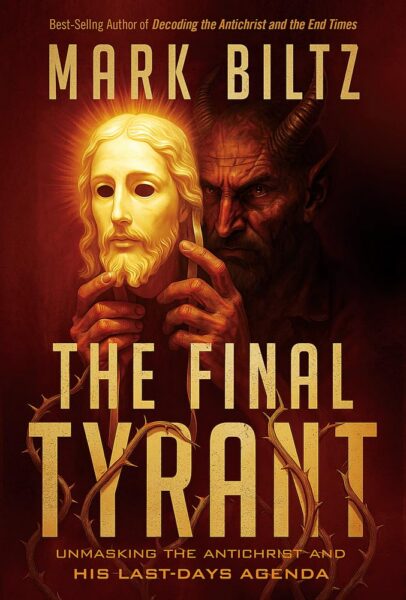
To order Mark Biltz’s new book, The Final Tyrant, visit Amazon.com.
Then comes the line that brings the entire ancient discussion crashing into the 21st century:
“We’re being sold the Tower of Babel. A merged intelligence, a unified mind. Every problem solved by consolidation,” Beck says.
That is where this stops being merely an intriguing discussion about ancient texts.
AI is advancing at extraordinary speed. Beck argues that the better question isn’t simply whether AI is “good” or “bad.” Instead, humanity should be asking whether we possess the character necessary to handle the capabilities now being placed before us.
“Do we have the character to hold something this powerful?” Beck asks.
His warning grows even more urgent when discussing artificial general intelligence and artificial superintelligence. Unlike previous technologies, Beck argues, the next technological leap may not give humanity the luxury of discovering the consequences and simply turning back.
The Biblical Answer May Be Closer to Home
Yet Beck’s conclusion isn’t to smash computers, shutter laboratories or try to stop technological progress.
Instead, he turns to Malachi.
The final verses of the Old Testament speak of turning “the hearts of the fathers to the children, and the hearts of the children to their fathers” before the great and dreadful day of the Lord. Beck sees something profound in that warning: Perhaps the answer to extraordinary capability is not merely greater regulation, but restored relationship, responsibility and generational formation.
Technology can hand a child tremendous power. It cannot teach that child why some power should remain unused.
Beck points out that these systems are being trained on us, our words, our judgments, our desires, our arguments and our values. At the same time, a generation of children is increasingly being formed in a world saturated with machines.
The question, then, isn’t merely what artificial intelligence will become.
The deeper question may be what kind of people we will become as we create it.
Power without formation doesn’t necessarily produce progress.
Sometimes, it produces giants.
Abby Trivett is a writer and editor for Charisma Media and has a passion for sharing the gospel through the written word. She holds two degrees from Regent University, a B.A. in Communication with a concentration in Journalism and a Master of Arts in Journalism. She is the author of the newly released book, The Power of Suddenly: Discover How God Can Change Everything in a Moment. For interviews and media inquiries, please contact [email protected].
