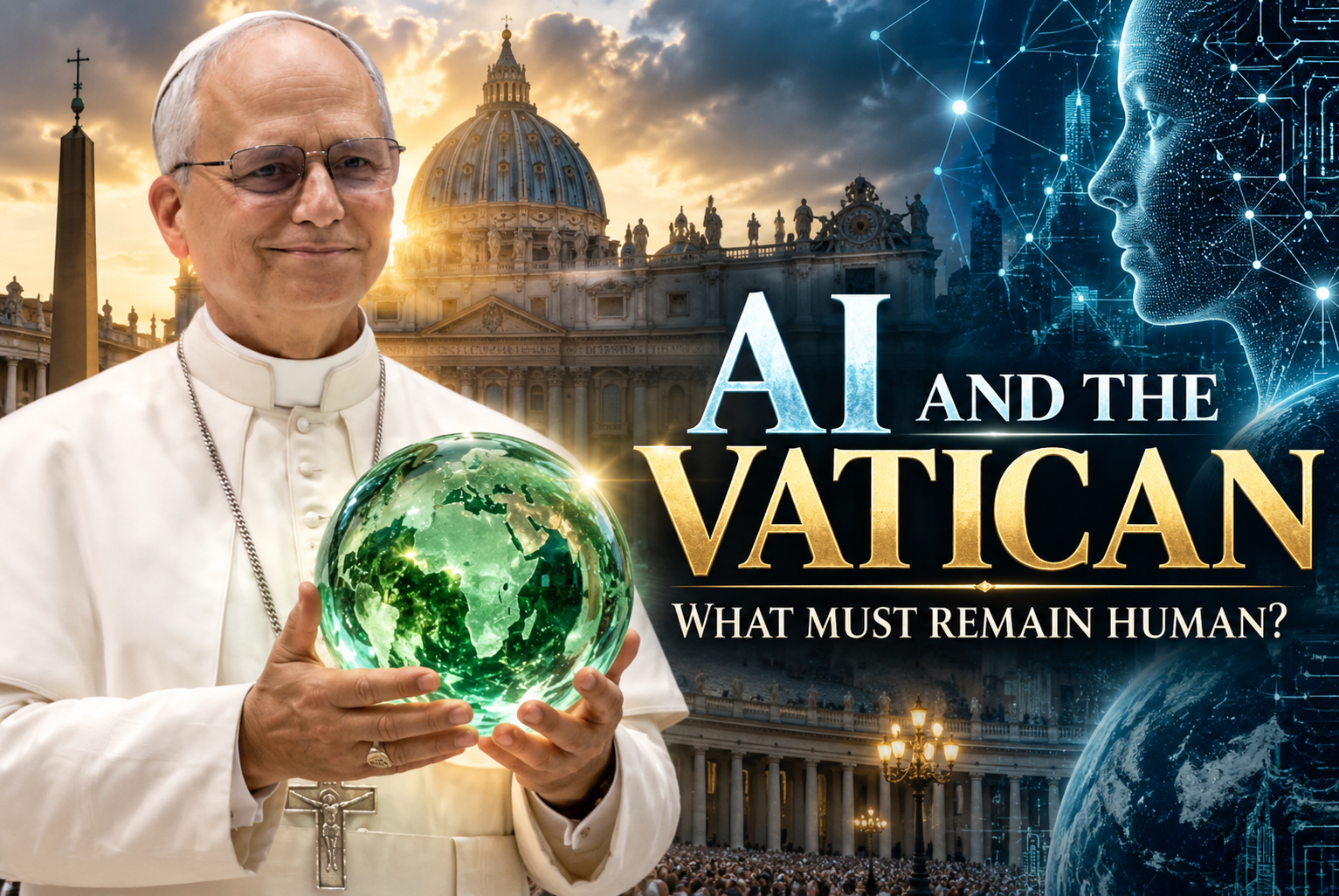
A green glass sphere placed into the hands of Pope Leo XIV may look like little more than a symbolic gift. But behind it lies a much larger question now confronting the church, governments and technology leaders alike: As artificial intelligence grows more powerful, who decides where technology ends and humanity begins?
According to Fox News Digital, Pope Leo received the “Sphere of Humanity” during his Sept. 2 General Audience at the Vatican. Crafted from Murano glass, the symbolic piece incorporates handwritten selections from his first encyclical, Magnifica Humanitas, reflecting on subjects ranging from conscience and human dignity to the challenges emerging alongside AI.
Yet the sphere is only the beginning.
Fox News reported that Saint Peter for Humanity, the nonprofit presenting the gift, is bringing together about 70 figures from the worlds of science, technology, philanthropy, culture and academia in New York City. Their task? Begin shaping the “Codex Humanitatis,” an initiative aimed at confronting some of the most pressing questions surrounding the AI revolution.
To order Katie Souza’s new book, Star Gods, visit Amazon.com.
Expected issues in the conversation include responsibility for AI systems, keeping humans involved in critical decisions, safeguarding reliable information, protecting children and families and determining how an increasingly automated world could reshape work.
Behind all of those discussions sits one enormous question: What must remain human?
Pope Leo has already raised concerns that technology is advancing faster than society can establish meaningful safeguards around it. As Fox News noted, Magnifica Humanitas stresses the importance of identifying who remains accountable throughout the creation and use of artificial intelligence, particularly when AI influences consequential decisions.
However, the question goes deeper than regulation.
Scripture does not measure humanity by intelligence, productivity or technological capability. Genesis tells us mankind was created in the image of God.
As AI becomes increasingly embedded in everyday life, the sphere handed to Pope Leo points toward a defining question of this technological age: Humanity may build increasingly intelligent machines, but technological progress cannot redefine what God created human beings to be.
Abby Trivett is a writer and editor for Charisma Media and has a passion for sharing the gospel through the written word. She holds two degrees from Regent University, a B.A. in Communication with a concentration in Journalism and a Master of Arts in Journalism. She is the author of the newly released book, The Power of Suddenly: Discover How God Can Change Everything in a Moment. For interviews and media inquiries, please contact [email protected].