
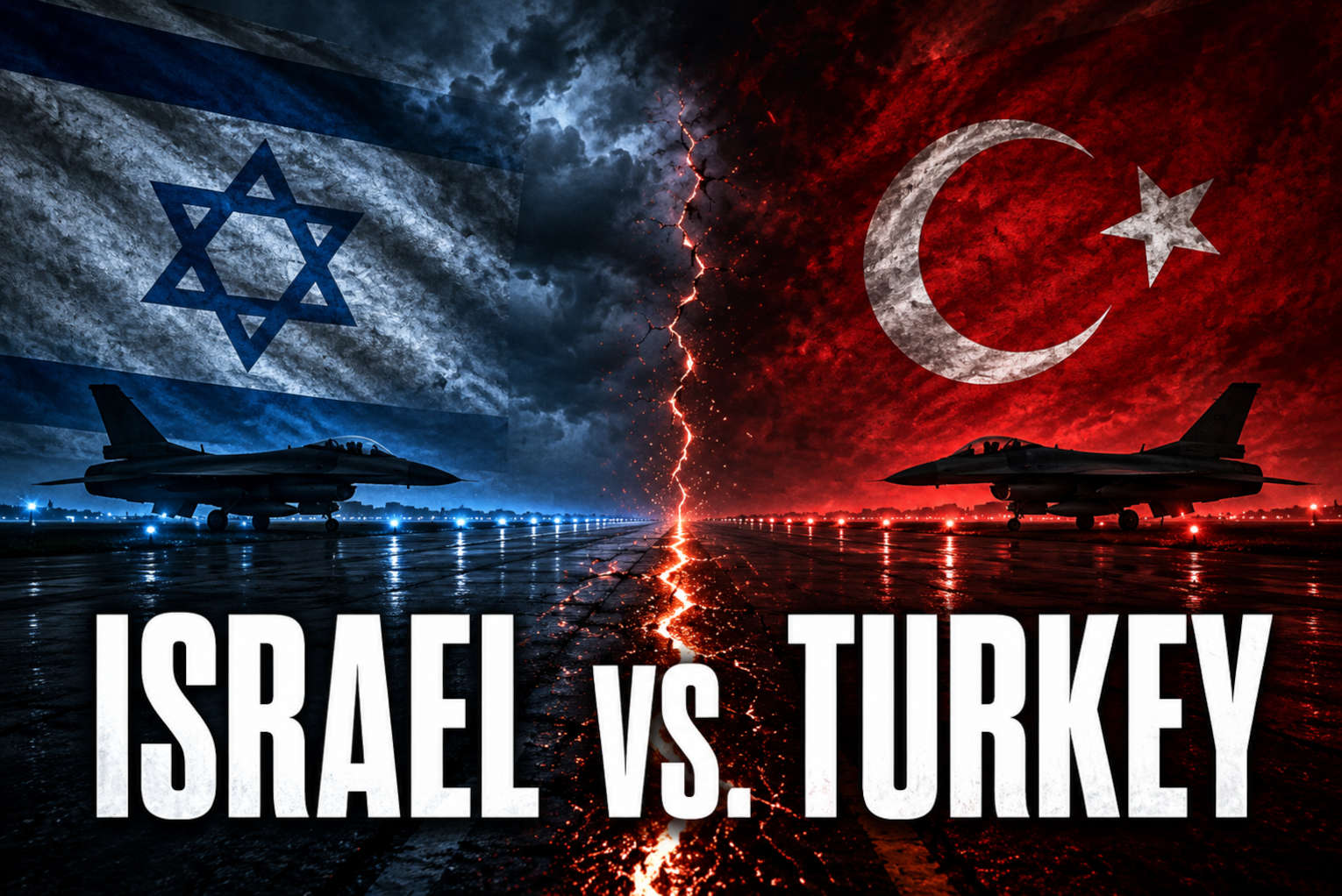
Israel’s leadership doubled down on threatening Turkey not to advance its military toward Israel on Wednesday, after claiming responsibility for strikes on a northern Syrian airport to render it unusable ahead of the allegedly planned takeover by Turkish troops.
Meanwhile, several regional countries slammed Israel’s actions as Turkey and Syria denied there was any Turkish intention to establish a base at Abu al-Duhur airport.
Prime Minister Benjamin Netanyahu declared Israel would not tolerate the Turkish military entrenching itself in Syria, in a short clip from an interview he posted via his official channels.
“We will not tolerate a Turkish military presence that advances south because it threatens us. We made this clear in a general way. Now we saw that there is a Turkish intention to entrench itself at an airport south of its border, near Aleppo, and we sent a message.”

Order Jonathan Cahn’s New Book, “The Altar of Pergamon” on Amazon.com!
“How do I define the message? Don’t. The message was sent, but apparently, they didn’t hear it clearly enough, so we made sure they understood it better,” Netanyahu added.
On Thursday, Defense Minister Israel Katz doubled down on this message, directly addressing Turkish President Recep Tayyip Erdogan, who he said is “dragging Turkey into dangerous adventures in Syria.”
Writing on 𝕏, Katz continued, “Israel will not allow anyone to threaten its security. It would be better for Erdogan to continue delivering his empty, fantastical speeches against Israel in the Turkish parliament and not put Israel’s determination to defend itself to the test.”
IDF Chief of Staff, Lt.-Gen. Eyal Zamir on Wednesday toured the Israeli-held buffer zone on Syrian territory, telling the troops that “challenges are constantly changing and developing” on their front.
“We see what is happening and are monitoring the changes on the Syrian front – we must prepare for them accordingly. We will not allow hostile forces to establish themselves on our borders, and we will know how to use our operational capabilities precisely where and when needed. We must prevent the development of terrorist threats, while also preventing the formation of a significant military threat on our borders,” Zamir said.
Meanwhile, a battle of narratives has developed between Ankara and Jerusalem, as Turkish officials claim that there was no Turkish presence at the attacked airport whatsoever.
“Israel is inventing pretexts to bomb neighboring countries and destabilize the region,” a Turkish official told the news outlet Axios.
The Turkish defense ministry stated Thursday that “there was no Turkish military delegation present at Abu al-Duhur Airport before or during the Israeli strike” but added it would “continue to support Syria and its efforts to develop its military capabilities and infrastructure.”
Meanwhile, these claims were somewhat contradicted by Syria’s Foreign Minsiter Asaad al-Shaibani, who told Axios that “there was no Turkish military build-up at the base in any sense that would justify such an interpretation,” but acknowledged that Turkish officers visited the base several days ago.
This, Shaibani said, was part of “ongoing military cooperation in the areas of training and the exchange of expertise,” arguing that the country is “working to rebuild its military and civilian institutions and develop their capabilities… [and] benefits from cooperation and training programmes with a number of countries, not Turkey alone. Similar cooperation has taken place and continues with Saudi Arabia, Jordan, Qatar and Russia.”
The work at the airport was “limited to rehabilitating the airfield and its facilities that were damaged during the war,” Shaibani added.
Further contradicting claims that Turkey and Syria were caught off guard by the Israeli strikes, Reuters reported that the head of Israel’s Mossad intelligence agency, Roman Gofman, called Shaibani last week to discuss Turkey’s military presence in Syria.
This would mark the highest-level contacts yet between Israel and the new Syrian government.
In addition, Ceng Sagnic, U.S. director at the Jerusalem Center for Security and Foreign Affairs, shared a video on 𝕏 showing “a purportedly Turkish soldier, with an unusual jihadist beard, deployed in Syria,” who stated that the airport was in fact a Turkish base being rehabilitated before starting full operations.
“This is in full violation of the pledges made by the Syrian government in Paris, and in defiance of the statements made by both the Damascus and Ankara governments regarding the Israeli operation,” Sagnic said.
Meanwhile, criticism for the Israeli actions continued from the U.S. and several countries in the region, as well as from Israeli opposition leaders.
Speaking to Axios, U.S. officials affirmed criticism made by U.S. Ambassador to Turkey, Tom Barrack, arguing that the Syrian government hadn’t made hostile moves against Israel.
Pointing to ongoing tensions and Israeli strikes in and around the Israeli-occupied security zone on the Golan Heights frontier, an official said that “at a certain point, the Syrian government started changing its attitude and thinking it needs to defend itself against Israeli aggression.”
Egypt, Saudi Arabia and several other countries also condemned the strikes, blaming Israel for fueling tensions. In Israel, the issue quickly became absorbed by the party campaigns that are ramping up ahead of the October elections.
The chairman of the far-left Democrats Party, former deputy IDF chief Yair Golan, also condemned the move as “provocative and dangerous,” warning it “brings us closer to a confrontation with Turkey and deepens the rift with our allies, foremost among them the United States. Once again, military force is being used for political considerations, and once again Israel is paying the security price.”
The Likud Party hit back by noting that “It is hardly surprising that Yair Golan, who calls for the establishment of a Palestinian terrorist state in the heart of Israel, is willing to allow Turkey to establish a military presence in Syria, which Prime Minister Netanyahu is firmly pushing back against. Yair Golan is the man slated to become defense minister in an Eisenkot, Lieberman, and Mansour Abbas government.”
This article originally appeared on ALL ISRAEL NEWS and is reposted with permission.
