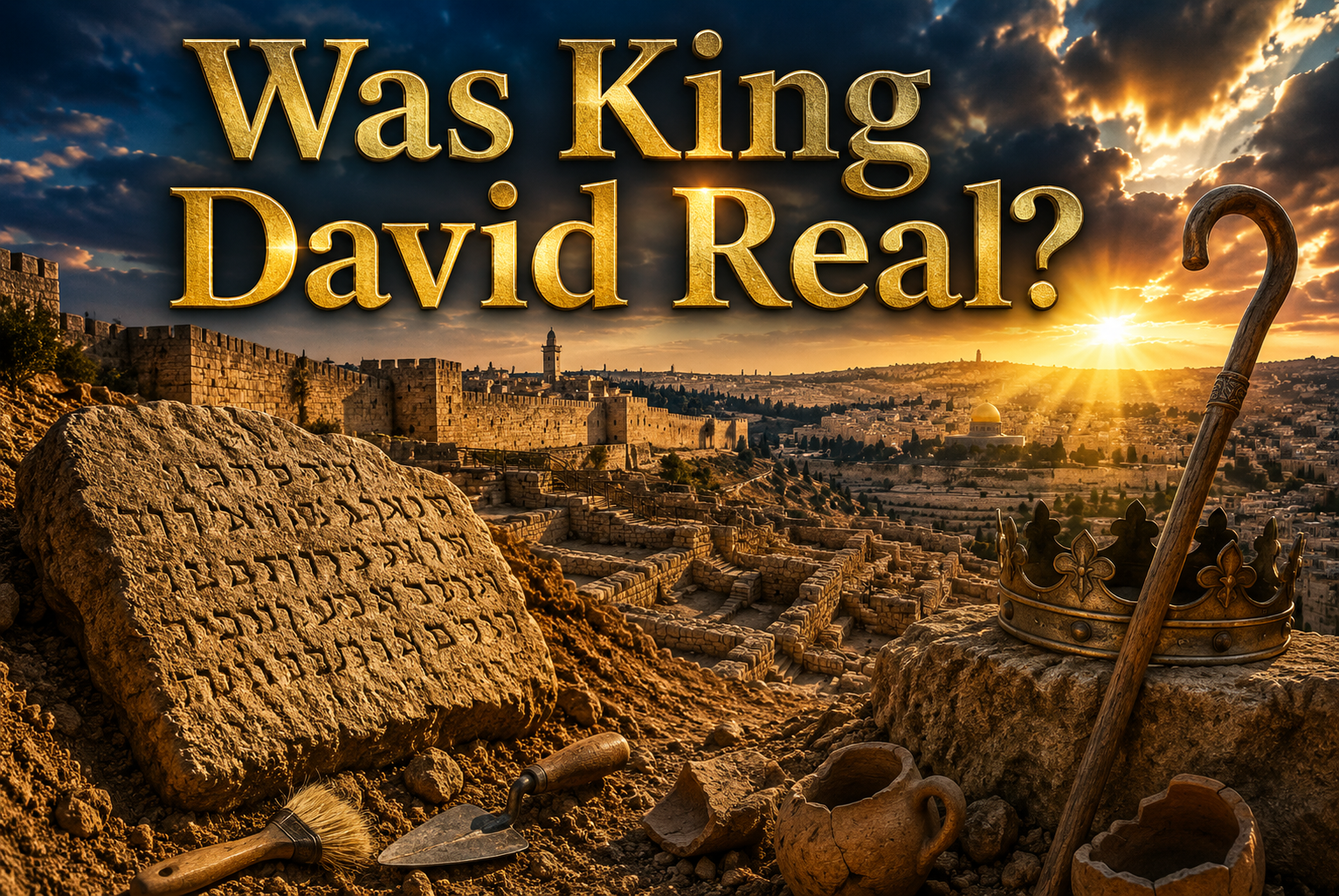
For decades, skeptics insisted King David belonged more to Sunday school than to history. But the dirt has a remarkable way of telling the truth.
Across Israel, archaeologists continue uncovering discoveries that are reigniting one of the biggest debates in biblical history. Ancient inscriptions, fortified cities and carbon-dated artifacts are leading many researchers to conclude that David was far more than legend—and for Christians, the implications reach all the way to Jesus Christ.
A recent episode of TBN Biblical Archaeology explores the growing body of evidence surrounding Israel’s most famous king, taking viewers from the City of David in Jerusalem to the ancient fortress of Khirbet Qeiyafa. Along the way, archaeologists and biblical scholars argue that discoveries unearthed over the past several decades continue to align with the biblical account of David’s reign.
Among the most significant discoveries highlighted is the Tel Dan Stele, an Aramaic inscription discovered in 1993 that contains the phrase “House of David.” Archaeologist Prof. Yosef Garfinkel explains that the inscription marked a turning point in the debate over David’s existence because it provided extra-biblical evidence that a Davidic dynasty was recognized in the ancient world.
“The big revolution was in 1993,” Garfinkel says in the documentary, referring to the discovery of the inscription mentioning the “House of David.”
For many years afterward, the debate shifted. Rather than denying David existed altogether, some scholars suggested he was little more than a local tribal chief whose influence had been exaggerated by Scripture.
Garfinkel believes the archaeological evidence tells a different story.
Excavations at Khirbet Qeiyafa, which began in 2007, uncovered a heavily fortified city complete with massive walls, gates, administrative planning, pottery, inscriptions and olive pits that Oxford University radiocarbon testing dated to approximately 1000 B.C.—the period traditionally associated with David’s reign. According to Garfinkel, the findings point to an organized kingdom in Judah rather than scattered villages governed by a minor local leader.
The documentary also takes viewers through Jerusalem’s City of David, where more than 150 years of excavation have uncovered evidence many researchers associate with biblical Jerusalem. Guides explain how the site corresponds with numerous events recorded in Scripture, including David’s conquest of the Jebusite stronghold and his establishment of Jerusalem as Israel’s capital.
To order Dinesh D’Souza’s new book, The Stones Cry Out, visit Amazon.com.
For believers, however, the significance of these discoveries extends far beyond settling historical debates.
If David was merely a mythical figure, questions naturally arise about the biblical promises tied to his lineage. Scripture repeatedly declares that the Messiah would come through the house of David, making his place in history foundational to the larger redemptive story told throughout the Old and New Testaments.
That connection is explored by Dr. Seth Postell, dean of Israel College of the Bible, who describes David as more than Israel’s greatest king. He points to David’s role as shepherd, prophet and ruler as a foreshadowing of Jesus Christ, the promised Son of David. Postell also highlights Psalm 51 as one of Scripture’s clearest pictures of genuine repentance and God’s abundant grace following David’s sin with Bathsheba.
The documentary closes by examining another part of David’s enduring legacy—his worship. Israeli musician Yaron Cherniak explains how David’s Psalms transformed deeply personal encounters with God into songs that have united believers across nations and generations for thousands of years.
Discoveries like the Tel Dan Stele, Khirbet Qeiyafa and the City of David continue to provide historical context that many researchers believe aligns with the biblical record. They remind us that the Bible unfolds in real places among real people whose stories continue to emerge from the ground thousands of years later.
Perhaps that’s why discoveries like these continue to capture the world’s attention. Christianity has always been rooted in history, not mythology. The gospel didn’t unfold in an imaginary kingdom or through fictional people—it entered a world of real kings, real cities and real covenants.
Every stone uncovered beneath the soil of Israel serves as another reminder that God’s Word has never feared investigation. If anything, history has a remarkable way of catching up with what Scripture has declared all along.
Abby Trivett is a writer and editor for Charisma Media and has a passion for sharing the gospel through the written word. She holds two degrees from Regent University, a B.A. in Communication with a concentration in Journalism and a Master of Arts in Journalism. She is the author of the newly released book, The Power of Suddenly: Discover How God Can Change Everything in a Moment. For interviews and media inquiries, please contact [email protected].