
I grew up in a time when the King James Version was the primary translation used throughout the English-speaking world—the 1950s through the 1970s. In our home, Scripture was not a casual presence; it was central to the rhythm of life. From as early as I can remember, my parents gathered the entire family into the living room every Saturday morning after breakfast and before the weekly chores began. This was our appointed time for family devotions, and it carried a quiet seriousness that shaped us all.
We began by passing around hymnals and selecting songs to sing together. Then came the reading of Scripture. A chapter from the King James Version would be read aloud, one verse at a time, moving from person to person around the circle. Each of us participated. I began taking my turn when I was five years old. I can still recall the hesitation I felt, the difficulty of sounding out unfamiliar words, and the patient voices that would gently supply the correct pronunciation when I stumbled.
In that setting, I was not only learning to read—I was being formed by the cadence and authority of Scripture, shaped in a home where the Word of God was honored and faithfully taught. We concluded family devotions on our knees, each of us praying in turn—out loud!
In 1970, by the time I was twelve, only three of us ten children were still living at home. I was the youngest. One day, my father gave my two brothers and me brand-new leather-bound King James Version New Testaments. There was no command attached to this gift; we were not instructed to read them. Yet something within me responded. I began, on my own initiative, to read a chapter each night before going to bed. What started as a simple decision soon became a consistent habit—one that quietly deepened my relationship with Scripture.
I also remember seeing in our home a unique volume titled Good News for Modern Man. Its simplified language and illustrations did not appeal to me, but the small subtitle—“In Modern English”—was unforgettable.
In 1973, during my sophomore year at Mountain View High School in Mountain View, California, I encountered a more contemporary expression of Scripture in the “Reach Out” edition of the Living Bible New Testament. I carried it with me each day to school. Its language felt immediate and accessible, and it quickly became a useful tool when I was encouraged by fellow students and a faculty sponsor to lead the high school Bible study each morning before classes began. For that purpose, it served well. It sounded contemporary and was easier for others to grasp. Yet despite its usefulness, it never replaced the King James Version in my life. There remained something enduring about the KJV—its weight, its authority, and its unmistakable sense of sacredness.
In the mid-1970s, as I began my college years at Southern California College (now Vanguard University of Southern California), I first heard about a new work described in its original preface as a paraphrase—the New International Version (NIV). At the time, I struggled to understand the need for it. There was already a paraphrase in circulation, and the King James Version remained the dominant and trusted translation of the Church. I purchased a Thompson Chain Reference King James Version, which I still possess today. Only later did terms such as “dynamic equivalence” and “functional equivalence” emerge, offering a framework for classifying the NIV as a translation. To me, those terms seemed less like discoveries and more like attempts to redefine what had previously been clear.
After I entered Fuller Theological Seminary in Pasadena, California, in 1979, I began memorizing Scripture from the King James Version, internalizing its distinctive language and rhythm. Although I did not identify as “KJV-only”—a term I did not encounter until college—it is undeniable that the King James Version shaped my theological thinking and devotional life in profound ways, forming convictions that would later guide my work in ways I did not yet understand. I would soon begin preaching using a modern translation as my text; yet when I quoted Scripture from memory, I did so from the King James Version—and still do.
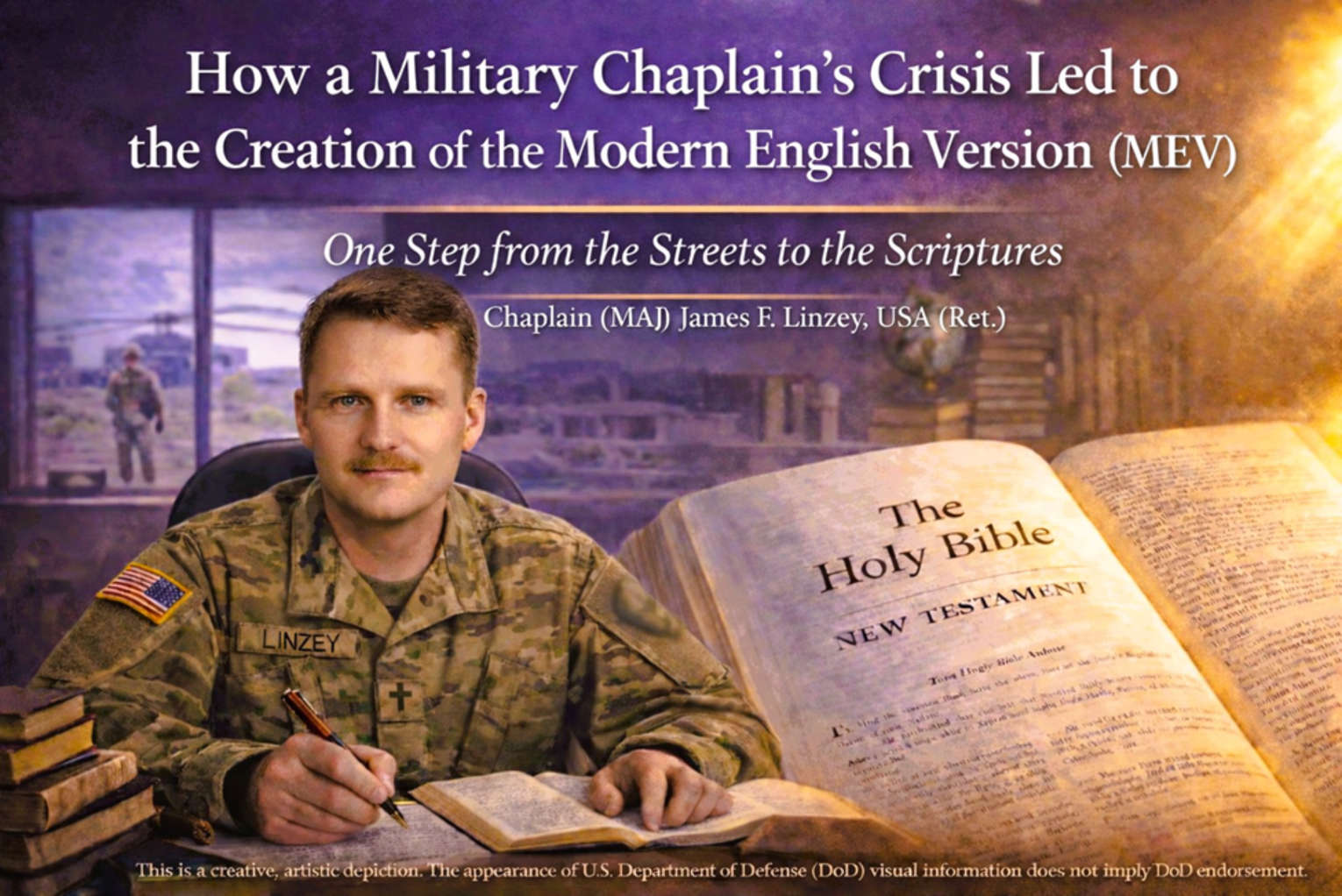
In 2005, during my twentieth year as a military chaplain, I found myself in a situation of extraordinary difficulty. Serving in the Army Reserves, I was on the verge of financial collapse—so close, in fact, that I was one step away from living on the streets. The pressure I faced was not merely circumstantial; it was deeply personal. Because of my stand for Jesus Christ, I experienced what I can only describe as personal persecution from members of my own family, including slander and efforts to undermine my faith, career, ministry, and even my ability to maintain steady employment. Some who maintained outward appearances of faith were, in reality, living double lives that stood in stark contrast to what they professed.
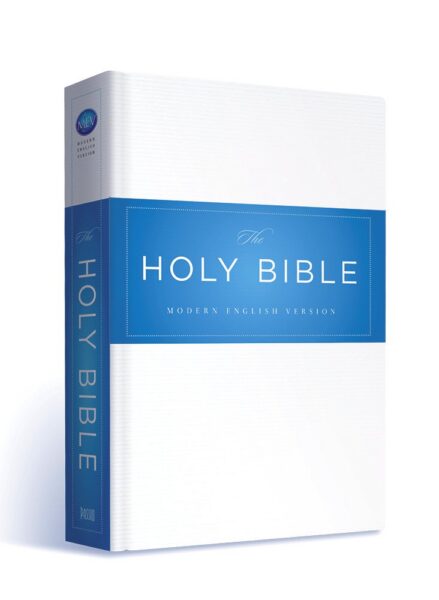
Order Your Copy of the Modern English Version Bible on Amazon.com Today!
In the midst of that turmoil, my mother allowed me to rent a room in her office complex. It was a place of necessity, a place where I struggled to sustain both my livelihood and my ministry. During that time, I began considering how to raise funds to print a military Bible bearing the logo of my ministry—Operation Freedom. I chose to use the NIV because it seemed more accessible to soldiers, though it was costly.
Then, on June 5, 2005, an event occurred that I cannot attribute to anything other than divine intervention. I was seated at a small table in my upstairs bedroom, working on my monthly newsletter. My mind was fatigued, and I paused to rest. Looking out the window, I gazed at the clear blue sky. As I sat there in stillness, it was as though something was placed directly into my mind—like a slide inserted into a projector, fully formed and unmistakable. Along with it came a powerful and undeniable conviction from the Holy Spirit: I was to update the King James Version. It was, in the clearest sense, a moment in which God spoke.
There was no uncertainty in that moment. I knew that God had spoken to me. Without hesitation, I began the work. Initially, I recruited fellow military chaplains who were proficient in Greek, with the goal of completing the New Testament. However, it soon became evident that more expertise was required. I began reaching out to Bible scholars from seminaries and universities across the United States and the United Kingdom, assembling a team capable of carrying the project forward.
At the same time, I was placed back on active duty tours by the Army. This was when I became the first full time chaplain for the Leader’s Training Course (now Cadet Summer Training) under the United States Army Cadet Command at Fort Knox, Kentucky; commissioned to write the official institutional United States Army Cadet Command Prayer; and became the editor of the U.S. Army Cadet Command edition of The Leader’s Bible.
This unexpected provision enabled me to fund the project and compensate qualified scholars for their work. My intention remained limited: to produce a translation for military Bibles that I would personally finance and distribute through my ministry. I had no interest in seeking out publishers. In fact, I deliberately avoided the idea. What I did not yet understand was that this work was not ultimately for me—it was for a far greater purpose.
In September 2011, two years after my retirement from the Army, my senior New Testament editor, Dr. Edward W. Watson, and I were completing the final stages of editing. That same week—if I recall correctly, on a Thursday—I received an unexpected phone call that would alter the course of the entire project. A publisher had just acquired a book I had endorsed in 2004, Psalm 93: God’s Shield of Protection by Peggy Joyce Ruth, originally self-published. That publisher was Charisma Media. A staff member, Jason McMullen, had located my contact information and called to ask how the book might be distributed to military chaplains.
I offered suggestions and provided contacts. The conversation was straightforward and seemed to be coming to a close. Yet as it did, I felt a persistent internal prompting—one that I recognized as the leading of the Holy Spirit—urging me to mention the translation project we were on the verge of completing. I wanted to resist that prompting. I had invested years of effort and significant financial resources into the work, and I was reluctant to invite outside involvement. Nevertheless, as the conversation concluded, I mentioned it almost in passing and asked, “Are you interested?”
The moment that followed was filled with tension. I felt it physically, as if pressing my foot hard on the brakes of a car. I found myself hoping for a negative response. Instead, the answer came immediately and without hesitation: “Yes.” Jason requested a day to consult with leadership and promised to call me back the following day.
After the call ended, I sought counsel from Dr. Watson, other scholars on the committee, and even a marketing professor at California Baptist University in Riverside, California. Without exception, each advised me to be open to the opportunity and see where it might lead. As I considered their counsel, my initial resistance began to give way to a growing sense of clarity and anticipation.
When Jason called back the following day, he expressed strong interest but presented one condition: the Old Testament would need to be completed within a year and a half. Recognizing the magnitude of that requirement, I asked for the weekend to make inquiries. I contacted enough Old Testament scholars to determine whether such a timeline was feasible. One by one, they agreed to contribute.
The following Monday, I gave my answer in the affirmative. In the weeks that followed, a publishing contract was prepared. Meanwhile, Jason and I continued to brainstorm a name for the translation. Then, at the least expected moment, a name came to me. While traveling through central California to a Business Men’s Fellowship USA monthly prayer breakfast in Oakland, my mother, Dr. Verna Hall Linzey, and I stopped at a gas station.
My father, Captain Stanford E. Linzey, Jr., CHC, USN (Ret.), had passed away in 2010, and I was chauffeuring my mother on the trip. While purchasing cashews and orange juice for her, the name came to me suddenly. I recalled that obscure yet unforgettable subtitle in small black print—“In Modern English.” The thought formed instantly: “Why not make a name out of it? Modern English Version.” I knew immediately it was right. I called Jason from the gas station and asked what he thought. He liked it.
The significance of that initial phone call cannot be overstated. In an industry where only a small fraction of those who seek publishing contracts ever obtain one, I had not sought a publisher at all. On the contrary, I had actively avoided doing so. Yet a publisher came to me—unexpectedly, uninvited, and at precisely the moment the New Testament work was reaching completion.
This, I believe, is compelling evidence of the providence of God in the development of what became the Modern English Version. The sense of divine orchestration became even more evident when I later learned that the publisher had been praying for a Bible translation—one they could publish and steward. They had no prior knowledge of my work. Yet when they contacted me regarding an entirely unrelated book, they unknowingly stepped into the answer to their own prayer.
Had it not been for that endorsement of Peggy’s book, I would not have been contacted by the publisher of what became the MEV.
What began in obscurity, under conditions of personal hardship and uncertainty, had become something far greater than I could have anticipated. It was never merely a personal project. It was, from the beginning, part of a larger purpose—one that extended beyond my own life and into a work shaped by those who came before me and meant to serve those who would come after.
James F. Linzey, M.Div., D.D. (Hon.), is a retired U.S. Army chaplain who served 24 years in both the U.S. Air Force and the U.S. Army. He served as Command Chaplain for several missions, including the largest mobilization and demobilization mission in the continental United States that was based at Fort Bliss, Texas, in 2003-2004. A graduate of Vanguard University of Southern California and Fuller Theological Seminary, he is a Southern Baptist minister and ethicist, and the author of Moral Leadership. He portrayed a military chaplain in the feature film Iniquity and wrote two devotionals for the film Indivisible. He is the author of the U.S. Space Force Hymn, “Creator of the Universe,” and the U.S. Army Cadet Command Prayer—one of the few official institutional military prayers in American history. Chaplain Linzey currently serves as pastor of Global Worship Center in Coffeyville, Kansas, and as Chief of Chaplains of the United States National Defense Corps, with the rank of Colonel.
