
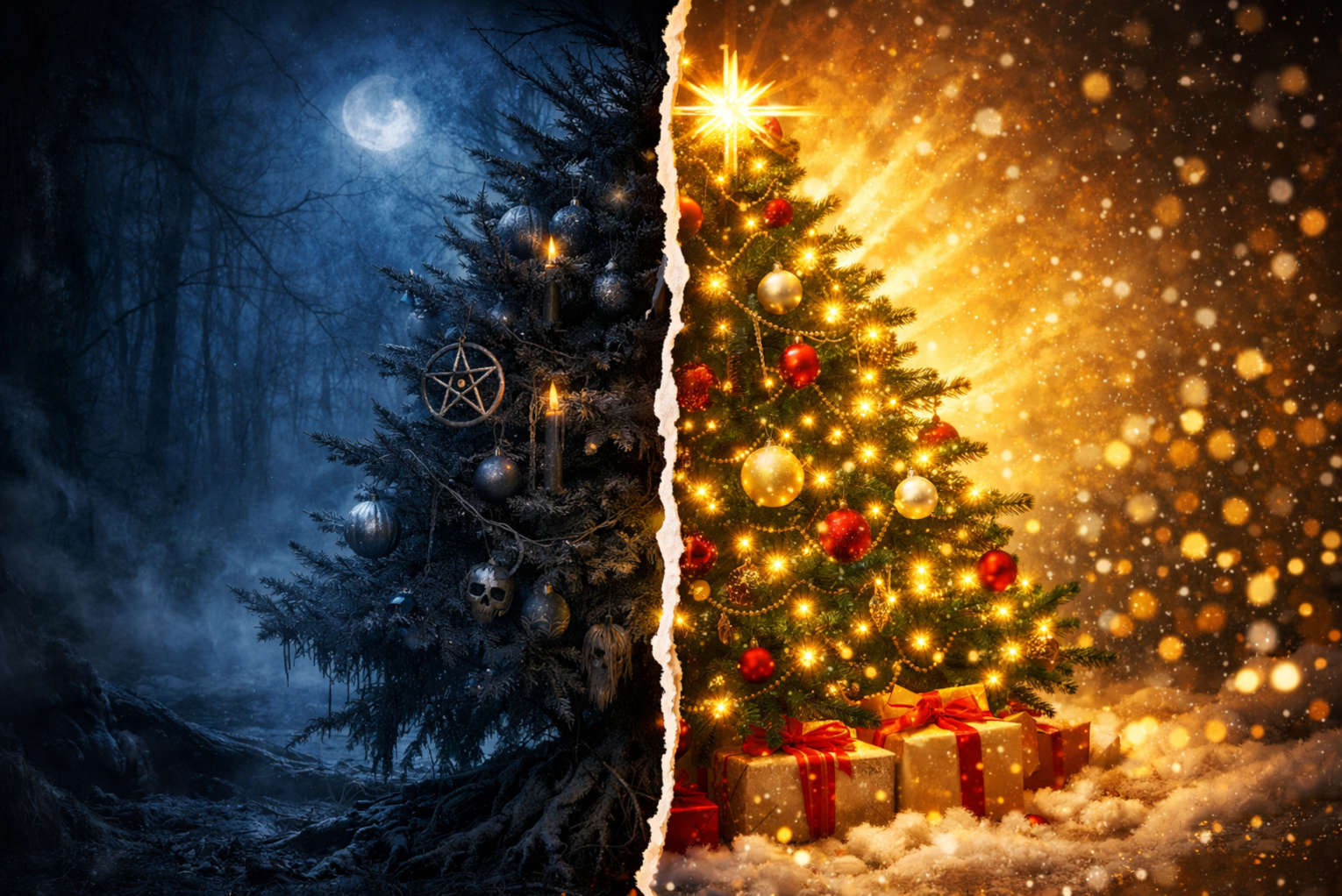
Is Christmas a holiday with pagan origins? Is it wrong to celebrate the birth of Jesus on December 25th? And what about putting up a Christmas tree? Is that a direct violation of Jeremiah 10?
As a Jewish follower of Jesus (commonly called a “Messianic Jew”), I do not relate to the Christmas season the way many Christians do, especially those who were raised in a home where Christmas was celebrated. Yet I do not have a problem with the Christian celebration of Christmas as long as the spirit of the celebration is right. If Jesus is being adored and his birth is being commemorated, the date of that commemoration is not a concern to me.
There is indeed no biblical holiday that marks the birth of Jesus, nor is there a command given to celebrate it at a later time. But that doesn’t mean it was wrong for the later Church to develop the Christmas tradition.
To be sure, some traditions are harmful and destructive, going against the Scriptures and even making the Bible’s teachings void. And Jesus actively opposed such traditions. But other traditions are neutral, while still others can be positive. If, over time, Christians felt it necessary to remember the birth of the Messiah along with his death and resurrection, what harm is there in doing so?
The evidence indeed appears to be against Jesus being born on December 25th, although some early Church leaders believed he was born at that time.
More importantly, December 25th was a pagan holiday, and many believe that the Church adopted this day to celebrate Christmas as a capitulation to paganism. While this is certainly possible (as a Messianic Jew, I don’t relate to Church history the way many Christians do), it’s also possible that this was not the case at all.
As theologian R. C. Sproul explained, “It just so happens that on the 25th of December in the Roman Empire, there was a pagan holiday that was linked to mystery religions; the pagans celebrated their festival on December 25. The Christians didn’t want to participate in that, and so they said, ‘While everybody else is celebrating this pagan thing, we’re going to have our own celebration. We’re going to celebrate the thing that’s most important in our lives, the incarnation of God, the birth of Jesus Christ. So this is going to be a time of joyous festivities, of celebration and worship of our God and King.’”
The whole gospel story is a story of redemption, and since God owns every day of the year, why not redeem a day set apart for pagan worship and use it instead to glorify the Lord?
Regardless of why this date was chosen, since it is the date on which hundreds of millions of Christians mark the Messiah’s birth, it’s as good a day as any to celebrate it, should you be so inclined to do so.
Order Jonathan Cahn’s Newest Book, “The Avatar” on Amazon.com!
Many Messianic Jews celebrate the birth of Jesus (whom they call Yeshua, using his original Hebrew name) during the Feast of Tabernacles (Sukkot), which takes place in September or October. They believe an argument can be made that he was born at this time of the year; they point out that this is already a time set apart on the biblical calendar as holy to the Lord, and they point to John 1:14, which states that “the Word” (speaking of Jesus) tabernacled among us.
Personally, I think that’s wonderful as well. But I also believe it’s fine not to celebrate the birth of Jesus on any particular holiday. Let every day be a celebration of his birth!
At the same time, since the gospels take considerable time to describe these important events (historically, in Matthew 1-2 and Luke 1-2, and theologically in John 1), it’s fine to mark this with a special, annual celebration where these texts are reread and familiar hymns, like “Joy to the World” are sung. Hope remains alive because God sent his Son into the world.
I’m aware, of course, that there’s no evidence that the earliest disciples specially marked the day of his birth, and I’m aware that in early American history, the celebration of Christmas was actually banned, primarily through Puritan influence. But once again, I believe the spirit of the event is what matters most, not the questions of date or timing.
What about erecting a Christmas tree? Does this have anything to do with the birth of Jesus? Obviously not. Does it have pagan origins? There are arguments for or against such origins. Let each one decide for himself or herself.
Is it a violation of Jeremiah 10:2-4? Certainly not.
The text in Jeremiah reads, “Learn not the way of the nations, nor be dismayed at the signs of the heavens because the nations are dismayed at them, for the customs of the peoples are vanity. A tree from the forest is cut down and worked with an axe by the hands of a craftsman. They decorate it with silver and gold; they fasten it with hammer and nails so that it cannot move.”
This is about making an idol and worshiping it, and nothing more. It is not referring to putting up a Christmas tree in your home!
As noted on the CARM website, “If people were praying to their Christmas trees or worshiping them as deities, these passages would certainly apply. But that is not, nor has it ever been, how Christmas trees are used. Christmas trees were never appealed to for blessings nor incorporated into religious rituals or acts of worship. While the exact origin of Christmas trees is unknown and highly disputed, the tradition seems to have come into existence as late as the 16th century during the Protestant Reformation in Germany. There is no evidence that Christians ever used them as anything other than home decorations for the holidays. There is nothing in this tradition that is innately idolatrous or in any way contrary to the biblical prohibitions against carving trees into false gods.”
My personal perspective on Christmas trees is this. If it’s just a fun family tradition that has no religious significance, there’s nothing wrong with that in itself. And if the tree is decorated in a way that reminds a family of the birth of Jesus, I see no reason to be critical.
On the other hand, if the tree is the center of a hyper-materialistic, greed-driven celebration, it’s best to separate this from the miracle of the incarnation (the Son of God becoming flesh), lest we degrade his birth into an excuse for carnality.
Dr. Michael Brown (www.thelineoffire.org/) is the host of the nationally syndicated The Line of Fire radio show. He is the author of over 40 books, including Can You be Gay and Christian?; Our Hands are Stained with Blood; and Seizing the Moment: How to Fuel the Fires of Revival. You can connect with him on Facebook, X or YouTube.
