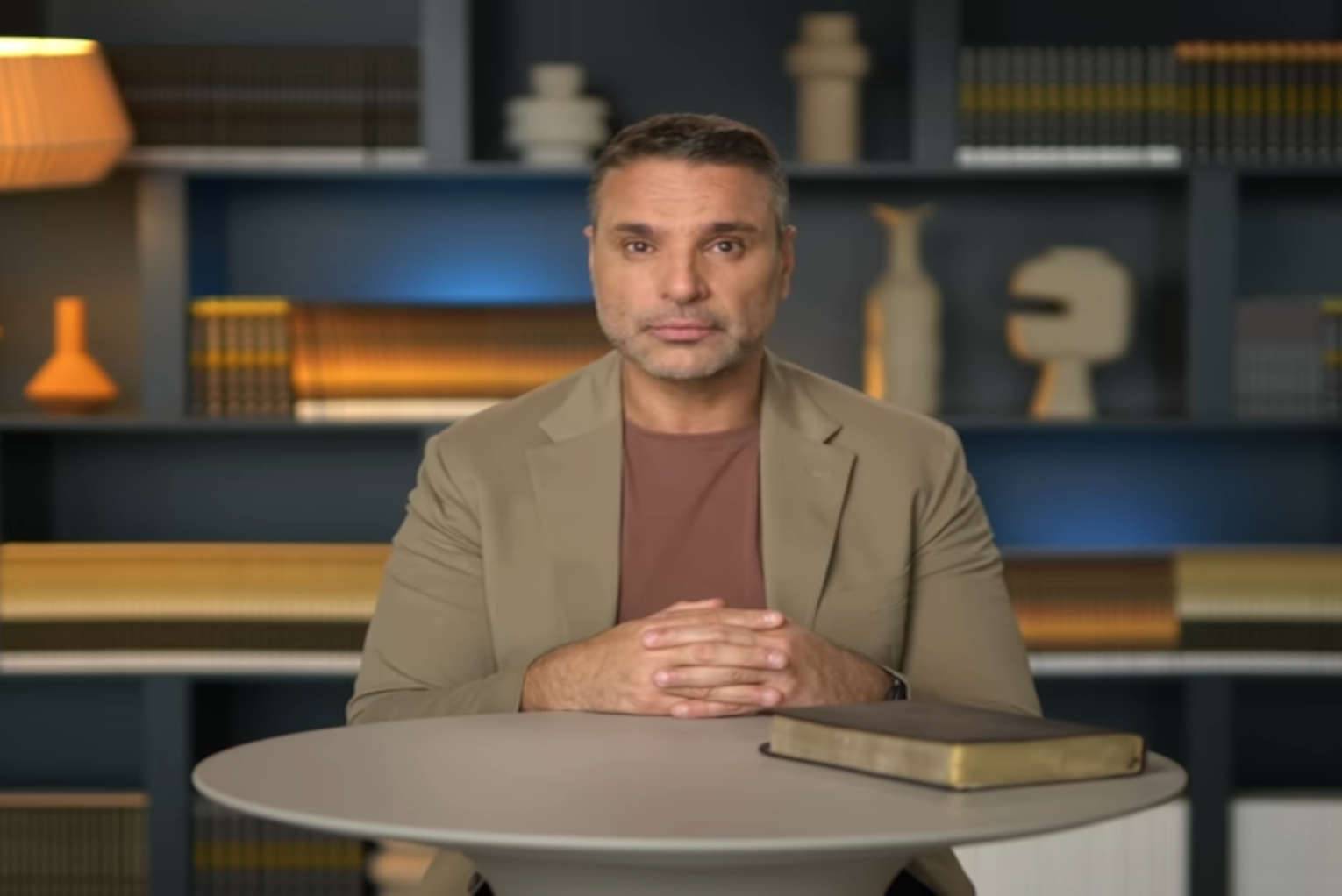

There are threads woven through Scripture that only become visible when you step back far enough to see the full tapestry. Most people encounter the cross and call it history. Some call it theology. But in this extraordinary sermon, Rabbi Jonathan Cahn invites us to see it as something else entirely: a cosmic mystery, seeded at the very beginning of the Bible and blazing in full glory at its very end — with you standing at its center.
Three Holy Days Converge
Cahn opens by grounding his listeners not in abstraction, but in time. The day of the crucifixion was not merely “Good Friday.” It was a convergence of three sacred days: Good Friday, the Passover and the Sabbath — all folding into one singular moment.
The parallel is exact and breathtaking. God labored for six days at creation, then rested on the seventh. Messiah labored for six hours on the cross — and then, as the Sabbath approached, declared what no ordinary man could declare: “It is finished.”
Jesus came, Cahn reminds us, as the Lord of the Sabbath — not merely to observe a day of rest, but to become the source of the rest the human soul cannot find anywhere else. The Hebrew blessings recited over the Sabbath candles, the Passover cup, and the bread were not decorative ritual. They were prophetic reenactments, pointing to the lamb who was about to fulfill all of it at once.
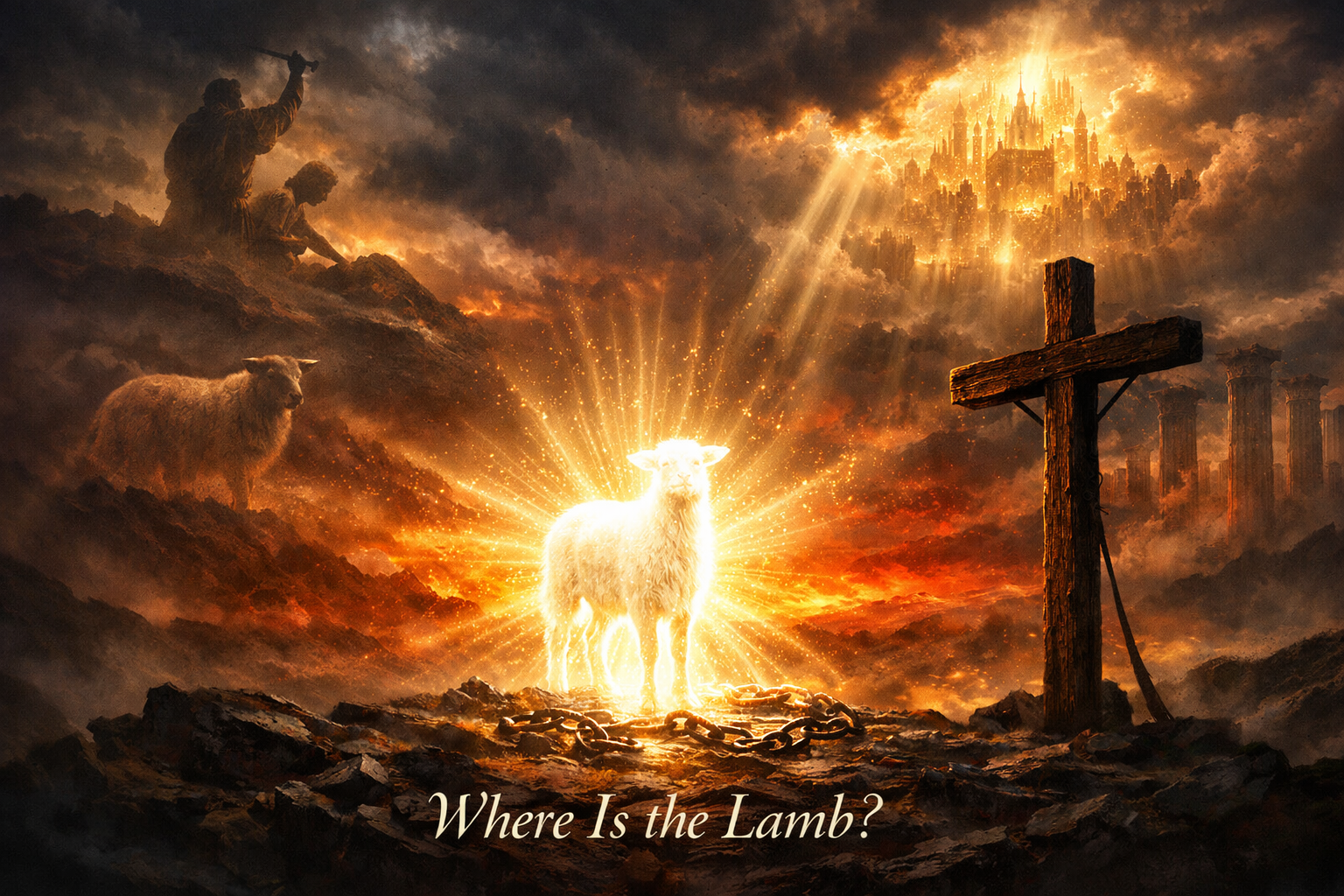
Where Is the Lamb?
The search begins with one deceptively simple question. When you type the Hebrew word for lamb — seh — into a Bible concordance and search for its very first appearance, you do not land in the sacrificial laws of Leviticus. You land in a mountain, with a father and his son.
Isaac said to his father Abraham, “The fire and the wood, but where is the lamb for the burnt offering?” — Genesis 22:7
Abraham’s answer is a prophecy that would not be fulfilled for two thousand years: “Elohim Yireh” — God will provide himself the lamb. A ram was found in the thicket and substituted for Isaac. But as Cahn points out with precision: a ram is not a lamb. The ram saved Isaac. But Abraham’s prophecy — God will provide the lamb — remained open. Unfulfilled. Waiting.
And then, centuries later, Moses writes something remarkable. He doesn’t let the moment pass. He underlines it, names the mountain after it, and tells Israel: something is going to happen here that hasn’t happened yet.
In that mountain, the Lord will be provided — as it is said to this day, on the mountain of the Lord it shall be provided. — Genesis 22:14
The Lamb Grows Larger
The second mention of the word lamb in all of Scripture takes us to Exodus 12 — the birth of a nation, the eve of the Exodus, Passover. Here, the lamb is no longer for one man’s son. It is for an entire household, and then an entire people.
Cahn traces the expanding mystery like concentric circles rippling outward:
- Genesis 22: A lamb for one person— Isaac, Abraham’s son
- Exodus 12: A lamb for a household— the Passover family
- Isaiah 53: A lamb for a nation— Israel’s sin borne by one
- John 1: A lamb for the world— sin of all humanity
- Revelation: A lamb for all eternity— the light of the new creation
The logic of each step is the same: there is bondage, there is a death sentence, and what breaks it is the lamb. Isaac was bound on the altar — the lamb sets him free. Israel was enslaved in Egypt — the Passover lamb purchased their liberation. And you? You too have a bondage. And the same lamb has already paid it.
The Prophet Who Saw It All
The next time the lamb appears in the context of redemption in Scripture is not in the next chapter, or even the next book. It leaps across centuries to the prophet Isaiah — and what he writes is so specific, so impossible to explain by coincidence, that Cahn calls it proof of the divine origin of Scripture by itself.
He was oppressed and he was afflicted, yet he did not open his mouth. Like a lamb that is led to the slaughter, like a sheep that is silent before its shearers, he did not open his mouth. — Isaiah 53:7
The same prophecy contains lines that should stop every reader cold: He was pierced through for our transgressions. By His stripes we are healed. The Lord laid on Him the punishment of us all. And crucially — Isaiah says it explicitly — this suffering servant bears the sin of my people. Israel. Not as a symbol of their suffering, but as a substitute for it.
The mystery was deepening: the lamb was becoming a person.
The Mountain Named After What Hadn’t Happened Yet
Here the sermon reaches one of its most astonishing moments. The name Abraham gave the mountain — Adonai Yireh, “the Lord will provide” — comes from the Hebrew root yireh, which doesn’t only mean “provide.” It also means “to be seen,” “to be manifested,” “to be made visible.”
Moriah, the mountain of Abraham and Isaac, means: the place where God will make the lamb visible.
And where is Mount Moriah? It is Jerusalem. The very city where the Temple was built — where lambs were offered every day for centuries, each one a reminder of a prophecy still waiting. The very city where Daniel said the Messiah would come. The very city where Jesus died.
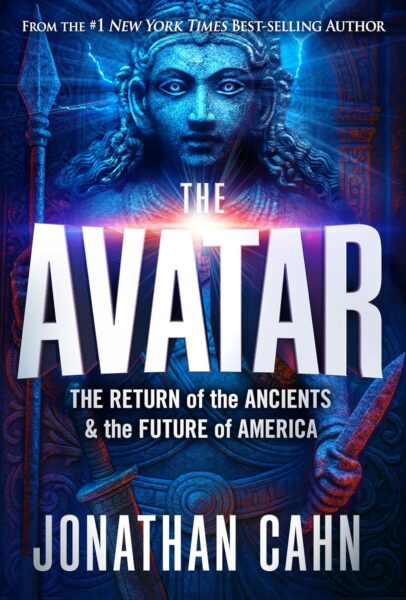
To order Jonathan Cahn’s book, The Avatar, visit Amazon.com.
Where did he die? He died on Golgotha, Calvary. Where is Calvary? On Mount Moriah — the place that says, God will provide the lamb. — Jonathan Cahn
The very first prophecy of the lamb in Scripture contains, encoded within the name of its location, the exact place the prophecy would be fulfilled. Two thousand years before it happened.
“The first two mentions of the lamb give you the time and the place. They come together in Messiah 2,000 years ago on Good Friday,” Cahn stated.
The Priest Who Named the Lamb
In all four Gospels, there is only one place in all the Gospel accounts where the word “lamb” appears. One moment. And it is spoken not by a random bystander, but by a man whose bloodline was the priesthood of Aaron — the very family whose God-given vocation, for generations, was to examine, certify, and present the sacrificial lamb.
John the Baptist — son of a priest, himself a priest by lineage — sees Jesus walking toward him and says the words that collapse the entire thousand-year mystery into a single sentence:
Behold the Lamb of God who takes away the sin of the world. — John 1:29
A priest identifying the lamb. The lamb who is not for a person, not for a household, not for a nation — but for the world. Abraham’s prophecy was always moving in this direction. Moses was pointing here. Isaiah was looking ahead to this. And now a priest, in the tradition of his ancestors, steps forward and certifies: this is the one.
The Lamb That Was Foreknown Before Time
After the Gospels, the apostle Peter turns the mystery entirely personal. You were not redeemed with silver or gold, he writes. You were redeemed with something infinitely more costly: the blood of the lamb, precious and spotless. And then he says something that reshapes everything:
For he was foreknown before the foundation of the world, but he has appeared in these last times for the sake of you.— 1 Peter 1:20
Before the universe existed. Before the first atom. Before time had anywhere to go — the lamb was prepared. For you. Not for humanity in the abstract. Not for a theological category. For you specifically, with your name, your life, your failures, your chains.
Cahn makes the application with the tenderness of a pastor and the precision of a scholar:
If you were the only one, he still would have done it. It was just as personal for you. He died specifically for you.— Jonathan Cahn
The End of the Bible Is the Lamb
The book of Revelation contains more references to the Lamb than any other book in the New Testament — more, in fact, than nearly any book in the entire Bible, save the sacrificial catalogues of Numbers. This is not accidental. The mystery that began with one father and one son on one mountain must end somewhere worthy of its beginning.
In Revelation 5, the veil over heaven is lifted. And what stands at the center of the throne of God, surrounded by every angel and every creature in existence, being praised with a volume of worship that defies description?
Worthy is the Lamb that was slain to receive power and wealth and wisdom and might and honor and glory and blessing. — Revelation 5:12
And it does not end even there. In Revelation 21 — the very last pages of the last book — a new heaven and a new Earth appear. The new Jerusalem descends, radiant. And in this eternal city, there is no temple, and there is no sun. Not because they were forgotten, but because they are no longer necessary:
The city has no need of the sun or the moon to shine upon it, for the glory of God has lit it up, and its lamp is the Lamb. — Revelation 21:23
The mystery that began with a question — Where is the lamb? — ends with the lamb as the light of all eternity. The answer to Abraham’s question is not merely an event in history. It is the permanent, blazing, inexhaustible center of the universe.
God Will Provide
When Abraham spoke those three Hebrew words on the mountain — Elohim Yireh, God will provide — he was not writing a theology textbook. He was speaking into the future, by the Spirit, to every human being who would ever stand on the mountain of their own need, their own bondage, their own insufficiency, and ask the same question Isaac asked:
Where is the lamb?
The answer that has echoed across every century since, the answer that the Temple sacrifices rehearsed for a thousand years, the answer that Isaiah saw from centuries away, that John the Baptist confirmed at the Jordan River, that Peter sealed in his epistle, and that all of heaven will sing forever — is the same answer:
God will provide for you the lamb. The Jesus. The author, the finisher of your faith, your beloved, your best friend, your everything, your redeemer, your salvation. God will provide your Jesus. He’s the lamb.— Jonathan Cahn
Abby Trivett is a writer and editor for Charisma Media and has a passion for sharing the gospel through the written word. She holds two degrees from Regent University, a B.A. in Communication with a concentration in Journalism and a Master of Arts in Journalism. She is the author of the upcoming book, The Power of Suddenly: Discover How God Can Change Everything in a Moment. For interviews and media inquiries, please contact [email protected].