

Money is not a side issue in the Christian life, according to Pastor Jack Hibbs. It is central to worship, stewardship and obedience.
“Money is a big deal, everybody. A very big deal,” Hibbs said in a recent message. “Stop thinking that money is evil.”
Hibbs made clear he rejects prosperity theology. “I am not preaching prosperity, wealth and claim it doctrine. I’m against it,” he said. “However, God blesses obedience. That’s a fact.”
Money Is Amoral
Hibbs repeatedly emphasized that Scripture does not condemn money itself.
“Nowhere in the Bible does it say that money is evil. It’s just not there,” he said. “Money is amoral.”
He pointed to 1 Timothy 6:10, which says the love of money is a root of all kinds of evil.
“You see, money is not evil. Money is amoral. It’s used for good or evil based upon the person who is governing it,” Hibbs said.
To illustrate the point, he compared money to a pen. “This pen is amoral. Money is amoral. It doesn’t have any morality until you put it into practice.”
Money as Worship
Hibbs warned that money can easily become an idol.
“Jesus said, ‘You can either worship God or mammon,’” he said, referencing Christ’s teaching on divided loyalty.
“Money is an altar of worship,” Hibbs added. “It’s the worshipper that makes the object an object of worship.”
He broadened the warning beyond finances. Shopping, hobbies and sports can become idols if they replace dependence on God.
“It’s not the thing, it’s what I make the thing into be,” he said.
The Call to Work
Hibbs connected financial stewardship to the biblical command to work.
Quoting Ecclesiastes 3:12-13, he said enjoying the fruit of one’s labor is “the gift of God.”
“Man works with his own hands, takes what he has crafted and sells it and he makes his own life better,” Hibbs said.
He stressed the importance of teaching young people to work. “Use the hands. Build something,” he said. “There’s a sense of self-worth and meaning by the use of your hands.”
He also cited 2 Thessalonians 3:10. “If anyone will not work, neither shall he eat,” Hibbs said. “If you’re able-bodied, if you can make money and work, if you don’t, you’re not going to get any handouts.”
At the same time, he said caring for those who cannot work is an honor.
Stewardship Over Poverty and Wealth
“There is no virtue in poverty,” Hibbs said, while reiterating his opposition to prosperity preaching.
“If you are obedient in the area of finances, there is a high probability that you are going to be very wise regarding finances and money and the use of money,” he said.
He argued that faithfulness with small amounts matters more than the size of the amount itself.
“In the eyes of God, a million dollars is not more good than a nickel,” Hibbs said. “Somebody else can use a nickel and it winds up in eternity being more honoring to God than a million dollars.”
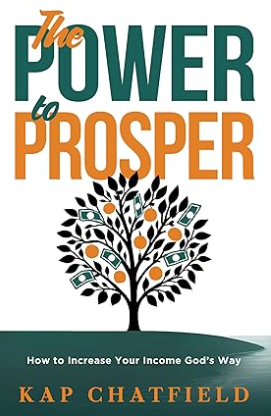
Order Kap Chatfield’s New Book, “The Power to Prosper” on Amazon.com!
Saving and Discipline
Hibbs shared personal testimony about learning to save at age 15.
“If you’re faithful in a little bit, God will give you the honor and the ability to be faithful with a little bit more,” he said.
He encouraged disciplined saving, even in small amounts. “If you’ve got $20 in your hand and you break it up and you take $5 of that and put it in an envelope or put it in a bank account and put it away, forget about it, you won’t spend it.”
Faithfulness, he said, builds over time.
Credit, Debt and Wisdom
Hibbs referenced Proverbs 22:7. “The borrower is servant to the lender.”
While warning against debt, he said credit cards can be used wisely if paid off monthly and never used to carry balances.
“I will only spend on that card what I can pay at the end of 30 days,” he said. “Use the credit card company’s money to your advantage.”
He cautioned that lack of self-control leads to financial bondage. “They are literally banking on you not being a good Christian steward over money.”
Inheritance and Generational Blessing
Quoting Proverbs 13:22, Hibbs said, “A good man leaves an inheritance to his children’s children.”
He argued that believers should aim to bless future generations rather than burden them.
“Don’t become a burden to your children or your children’s children, but rather a blessing,” he said.
Tithing and True Blessing
Hibbs closed by pointing to Malachi 3:10 and the call to bring tithes into the storehouse.
“Bring all the tithes into the storehouse,” he said. “Give to God’s causes, whatever God’s concerned about, and he will return to you blessings.”
But those blessings are not always financial.
“If you think money, you’re thinking wrong,” Hibbs said. “Think bigger.”
He described a broader view of blessing that includes health, strong relationships and influence.
“You can have a billion dollars and you cannot buy health,” he said. “I’d rather have my life favored by the grace of God.”
Hibbs distilled the Christian approach into a simple charge.
“The Christian call is be wise to use money,” he said. “If it’s even a widow’s mite, a little bit, be faithful in that. And God will make you faithful in more.”
James Lasher, a seasoned writer and editor at Charisma Media, combines faith and storytelling with a background in journalism from Otterbein University and ministry experience in Guatemala and the LA Dream Center. A Marine Corps and Air Force veteran, he is the author of The Revelation of Jesus: A Common Man’s Commentary and a contributor to Charisma magazine. For interviews and media inquiries, please contact [email protected].