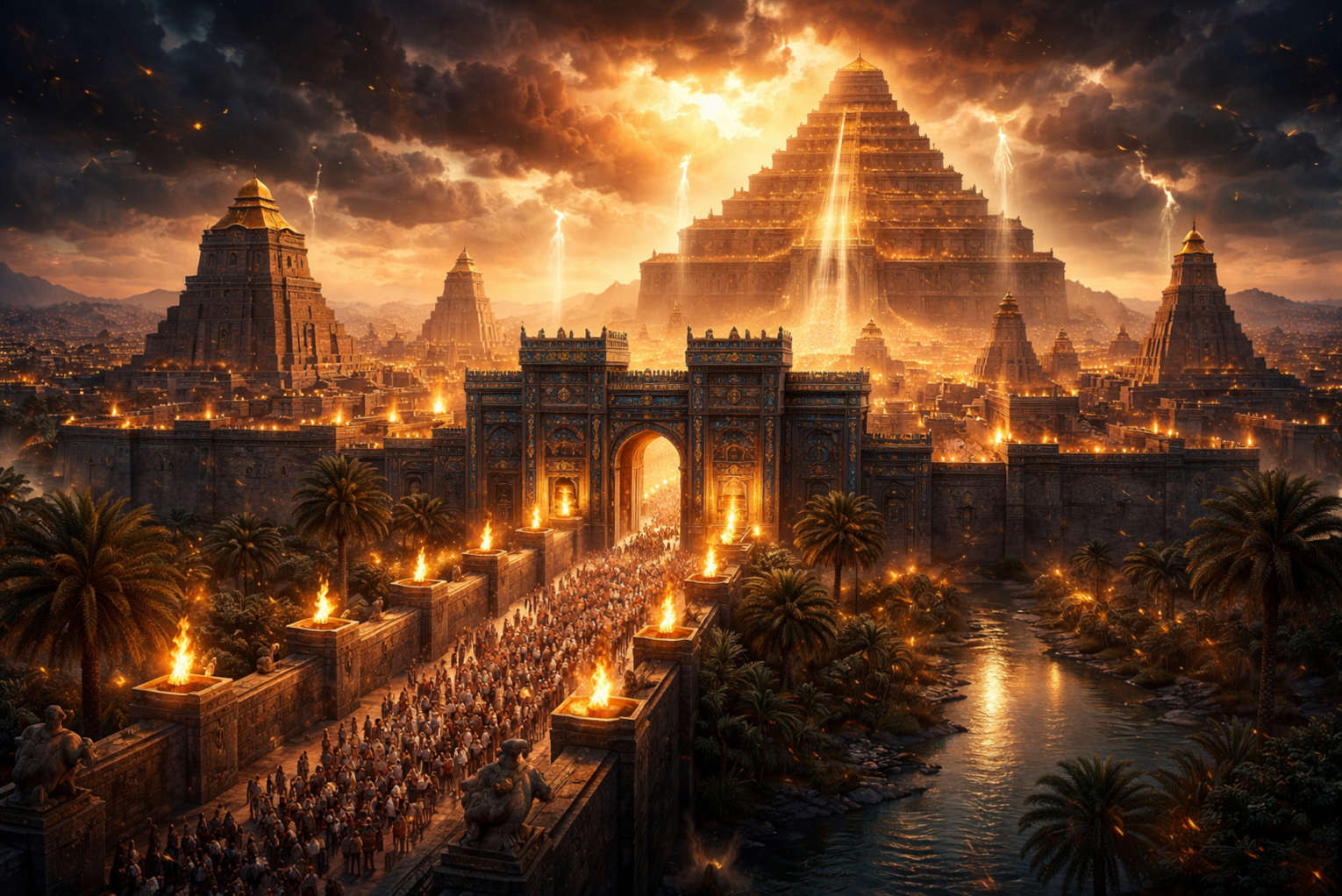

Could one of the most infamous cities in human history rise again as a global center of power, wealth and influence? It is a question many dismiss outright, yet it is one that refuses to disappear as modern headlines increasingly echo ancient warnings.
According to Bible prophecy and current developments in Iraq, the idea of a renewed Babylon is no longer confined to theology classrooms or end-times fiction. It is being debated in real time.
In a recent report, Joel Rosenberg argues that the rebuilding of ancient Babylon is no longer theoretical. “The ancient city of Babylon is being rebuilt right now as we speak before our very eyes,” Rosenberg says, adding that Babylon was once “the capital of the most wicked, most powerful empire on the entire planet,” and is described in Scripture as playing a similar role in the final chapter of human history.
Rosenberg points directly to the book of Revelation, where Babylon is portrayed as the epicenter of global commerce and corruption in the end times. He describes it as “the very home and center of wealth and power of the antichrist,” noting that the Bible’s prophetic language is not vague symbolism but geographically specific.
“The prophecies are very specific in the Old Testament and the New and give a lot of detail about the archaeology and the rivers that are near Babylon,” he says. “They’re talking about literal ancient Babylon from Iraq rising again after thousands of years.”
That claim has long drawn ridicule from skeptics who insist Babylon is merely a metaphor for modern cities such as Rome, New York or London. Rosenberg acknowledges the argument but rejects it.
“Certainly, Babylon is a type,” he says, “but the prophecies are very specific.” He argues that dismissing Babylon as symbolic alone fails to account for the repeated biblical emphasis on its physical location and future prominence.
Order James Lasher’s New Book, “The Revelation of Jesus” on Amazon.com!
What gives Rosenberg’s report weight is not speculation but documentation. He traces the modern rebuilding of Babylon back to Saddam Hussein, who saw himself as a successor to King Nebuchadnezzar and ordered large-scale excavation and reconstruction in the late 20th century. While those efforts stalled during war, they did not end. Since 2003, restoration has accelerated.
Rosenberg cites mainstream reporting to support the claim. A 2006 front-page article in The New York Times reported that Iraqi leaders and United Nations officials were “working assiduously to restore Babylon” and transform it into a cultural center.
UNESCO has since invested millions into preserving the site, and Babylon was officially designated a UNESCO World Heritage Site in 2019. “UNESCO has even printed up a brochure with Babylon listed as the premier destination,” Rosenberg noted, quoting U.N. officials who said cultural tourism could become Iraq’s second-largest industry after oil.
U.S. involvement has also played a role. Rosenberg reported that the State Department under the Obama administration contributed funding toward the “Future of Babylon” project. “The Obama administration was contributing $700,000 towards the Future of Babylon project,” he said, calling it “astonishing,” given that the funding had nothing to do with promoting Bible prophecy.
The momentum has continued. In 2025, Iraq hosted the first International Day of Babylonian Civilization inside the ruins themselves. Iraqi officials said the event aimed to “revive Babylonian heritage” and boost international tourism. Rosenberg views this as further confirmation that Babylon is being positioned once again as a global destination.
For Rosenberg, the implications go far beyond archaeology or tourism. Revelation 18 describes Babylon as “the world’s great commercial hub,” a place where merchants trade gold, silver, jewels and luxury goods, drawing the kings of the earth.
He argues that the rebuilding now underway lays the groundwork for precisely that scenario.
“How could a once great city that hasn’t existed for much of the past 2,000 years once again become a city at all, much less eventually the wealthiest, most powerful and most evil city on the planet?” Rosenberg asks. His answer is direct. “There’s only one way that could happen. If the God of the Bible decrees that it will happen, then it will happen.”
The renewed question of Babylon is not merely academic. Rosenberg frames it as a test of discernment. Governments, global institutions and secular media outlets involved in Babylon’s restoration do not see themselves as fulfilling prophecy.
Yet he argues that prophecy has often advanced through actors who were unaware of its significance. “They’re not doing it because they’re interested in Bible prophecy,” he says. “They’re trying to rebuild their ancient city and bring money and power.”
Whether Babylon ultimately becomes the end-times power center described in Scripture remains to be seen. But the convergence of prophecy, geopolitics, archaeology and global investment is difficult to ignore. The rise of Babylon, even in its early stages, challenges believers to remain watchful without sensationalism and grounded without complacency.
The call, Rosenberg suggests, is not panic but preparedness. Discernment requires recognizing developments as they unfold while remaining anchored in Scripture rather than headlines alone. If Babylon’s revival is part of the prophetic arc, it will not announce itself with fanfare. It will emerge gradually, shaped by human ambition and divine sovereignty alike.
James Lasher, a seasoned writer and editor at Charisma Media, combines faith and storytelling with a background in journalism from Otterbein University and ministry experience in Guatemala and the LA Dream Center. A Marine Corps and Air Force veteran, he is the author of The Revelation of Jesus: A Common Man’s Commentary and a contributor to Charisma magazine.