
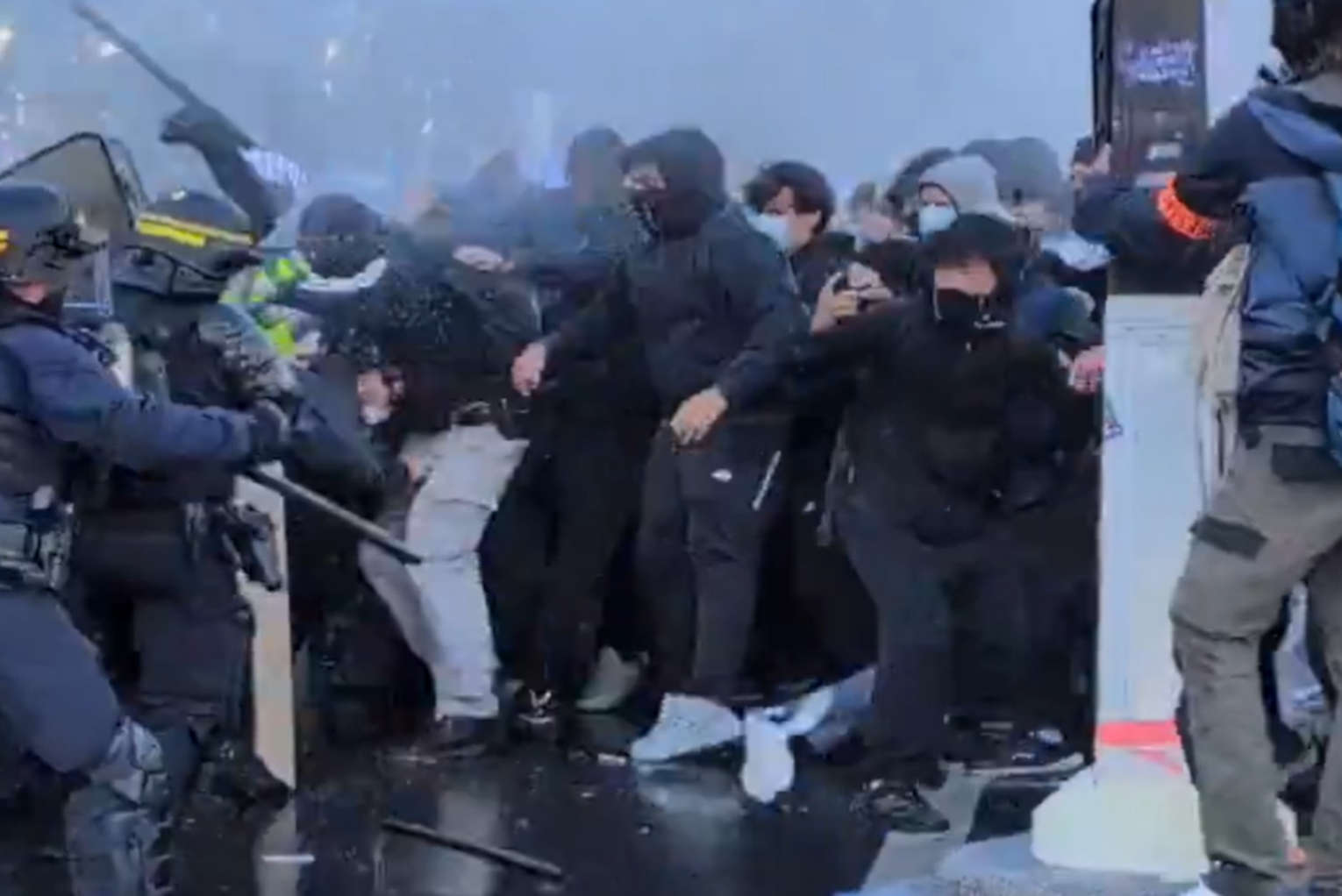
Since the middle of September, French high schools have turned from places of learning into scenes of fire, tear gas and mass arrest. France’s Justice Ministry reports that 5,060 people have been taken into police custody, 4,406 of them minors, and the education minister says 24 schools have been burned or ransacked.
The official explanation is that teenagers are protesting austerity, and on the surface it holds. Prime Minister Sébastien Lecornu’s draft 2027 budget calls for €54 billion in savings, including a wage freeze for public employees. The students’ complaints about absent teachers, crowded classrooms and crumbling buildings are real enough that some principals sympathize with them. But the deeper story is not about one budget. It is about a nation that has spent half a century borrowing against its children’s future, and is now watching those children riot at the first sign that the bill has arrived.
The “cut” that isn’t one
Look at the education line that supposedly lit the match. Under the government’s plan, the national education budget does not shrink. It grows by 1.7 percent, to €65.53 billion. The government admits that increase is below inflation and attributes the gap to falling enrollment. Students point to the elimination of 3,256 teaching posts this year, and that grievance deserves a serious answer. Still, a modest squeeze in a system with fewer pupils is not the dismantling of public education. Anyone who describes it that way is selling a narrative, not reporting a fact.
The numbers that matter are elsewhere. France has not balanced a budget since 1974. Its finance ministry projects public debt at 119.3 percent of GDP this year and 121.7 percent next year, nearly double the 60 percent ceiling the European Union asks members to respect. This year’s deficit is expected to reach 5.4 percent of GDP, against an EU limit of 3 percent, and Paris has spent two years under special EU monitoring. Every French president since Valéry Giscard d’Estaing has chosen the comfortable path of promising more than the country could pay for. The generation now in the streets inherited the consequences without ever being told the truth about them.
Who is pouring the gasoline
Grievances alone do not explain burning schools. The Prime Minister’s office says French intelligence views the blockades as an organized maneuver by La France Insoumise (LFI) and its ultra-left proxies. The party’s conduct has done little to dispel the charge. Jean-Luc Mélenchon, LFI’s presidential candidate, urged party officials and activists to “interpose” themselves wherever they could. Bally Bagayoko, the LFI mayor of Saint-Denis, stood outside a high school and said violence can, at a certain point, be legitimate. Paris’s police chief has warned that professional rioters are exploiting the unrest, and Marine Le Pen says Mélenchon bears significant responsibility for the violence.
Glenn Beck framed the moment by pointing his audience to a scene from Taylor Sheridan’s CIA drama Lioness. He argued it captures what France is living through: a fifty-year war on Western institutions, waged by what he calls the Red-Green alliance of the revolutionary Marxist left and Islamist political movements, with idealistic young people serving as its useful idiots.
You need not accept every element of that thesis to recognize the pattern. Le Monde’s own reporting describes a movement rooted in genuine frustration, and that is exactly the point. Real grievances are the raw material political opportunists harvest. Teenagers make the most convenient shields, because any police response can be filmed and sold as repression.
History repeats in Paris
France has seen this play before. In May 1968, a dispute over university rules at Nanterre spread to the Sorbonne and then across the country. It brought the Fifth Republic to the brink until Charles de Gaulle dissolved the National Assembly and called elections. The radicals of 1968 later became the political and academic establishment that built the modern French state on borrowed money.
In 2005, after two boys died hiding from police in Clichy-sous-Bois, roughly 9,000 cars burned and nearly 3,000 people were arrested before the government declared a state of emergency. In 2023, after police shot 17-year-old Nahel M., the state deployed 45,000 officers to restore order. Each time, Paris bought a temporary peace with promises and public money. Each time, the disorder returned larger than before.
Scripture names the trap plainly: “The rich ruleth over the poor, and the borrower is servant to the lender” (Proverbs 22:7). A nation that lives on credit eventually surrenders its freedom of action to its creditors. A people taught that every benefit is a right will treat the first restraint as an act of violence against them.
The American mirror
Americans who imagine this is a uniquely French sickness should look at their own balance sheet. The national debt has crossed $40 trillion. In fiscal 2025, Washington spent $970 billion on net interest, more than the $917 billion it spent on national defense. We have also watched the same coalition now exploiting French teenagers rehearse its methods here, from the 2024 campus encampments to the occupation of Columbia University’s Hamilton Hall. The lesson from Paris is that fiscal discipline postponed becomes fiscal discipline imposed. When it is finally imposed, the activists who blocked every reform will be waiting with matches.
Conservatives should draw two conclusions and act on both. First, the time to restore fiscal sanity is now, while reform can still be gradual. That means demanding that Congress treat the debt as the national security threat it has become, not a problem for the next generation. Second, the law must apply with equal force to every rioter and every politician who encourages one, however sympathetic the cause looks on camera. France ignored both lessons for fifty years, and its children are paying for it in fire. America can still choose a different ending, but only if we choose it before our own bill comes due.
This article originally appeared on American Faith and is reposted with permission.
Hannah Nelson is the Vice President of American Faith Media. Any opinions or independent views expressed within this article are solely those of the author and do not necessarily reflect the views of any affiliated organizations or publishers.
