
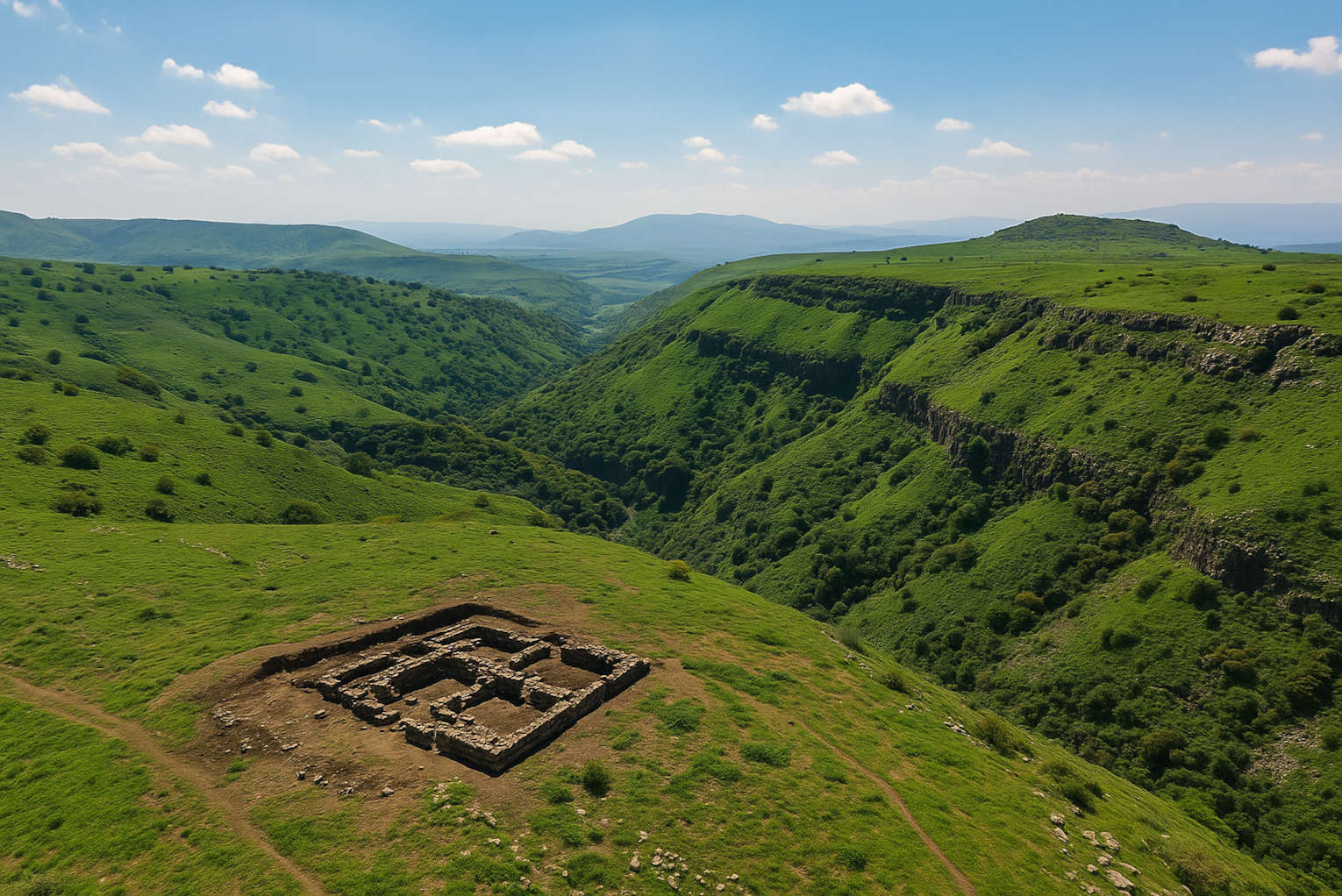

Archaeologists in Israel have uncovered a 1,500-year-old synagogue deep within the Yehudiya Nature Reserve in the Golan Heights, adding yet another layer of proof that Jewish life and worship flourished across this biblically significant region for thousands of years. The discovery, led by researchers from the University of Haifa, the Israel Nature and Parks Authority and Kinneret Academic College, sheds light on a thriving Jewish community that once stood where modern political debate now rages.
The synagogue dates back to the 5th or 6th century CE, standing as a silent witness to the continuous presence of the Jewish people in the heart of what the Bible calls Bashan. Its preservation after 15 centuries serves as a powerful reminder that the connection between the people of Israel and their land runs deeper than modern timelines or geopolitical arguments.
The Golan has a Jewish history;
— Adi 🎗 (@Adi13) October 5, 2025
Archaeologists unearth 1,500-year-old synagogue below abandoned Syrian village in Golan
A team from the University of Haifa and Kinneret College identify an ancient wall facing Jerusalem and some 150 synagogue items, including a stone engraved… pic.twitter.com/4cJ11ll9VH
Breaking News. Spirit-Filled Stories. Subscribe to Charisma on YouTube now!
As reported by Israel365 News, “Already at the start of the excavation, dozens of architectural fragments were uncovered and later, to our surprise, the southern wall of the structure was revealed with three openings facing Jerusalem,” said Dr. Mechael Osband of the University of Haifa. “This was the final confirmation that we had found the ancient synagogue itself.”
Architecture Rooted in Worship
The synagogue, measuring roughly 13 meters wide and 17 meters long, was built in the basilica style common to ancient Jewish houses of worship. It featured two rows of columns, benches along the walls and intricate carvings throughout. Among the artifacts unearthed were decorated lintels, basalt columns and stones engraved with menorah motifs, as well as fragments believed to belong to the Torah ark, a clear indication that Torah study and prayer were central to community life.

Order Jonathan Cahn’s Newest Book, “The Avatar” on Amazon.com!
“The discovery of the ancient synagogue at Yehudiya is clear evidence of Jewish settlement in the Golan as early as 1,500 years ago when Jewish communities flourished here,” explained Dr. Dror Ben-Yosef, archaeologist for the Israel Nature and Parks Authority. “These synagogues were not only houses of prayer but also centers of study and literacy where sages taught Torah and Jewish knowledge to the entire community.”
A magnificent 1,500-year-old shul (synagogue), whose location was previously unknown to experts, has been unearthed in an archaeological excavation within the Yehudiya Nature Reserve in the Golan Heights.
— Shiri_Sabra (@sabra_the) October 5, 2025
The discovery was announced on Sunday morning following an excavation… pic.twitter.com/ba9GkmcEhC
Each engraved stone, menorah carving and Torah fragment uncovered from the volcanic soil stands as both an archaeological and spiritual testimony. These finds speak of a people who lived, worshiped and educated their children in the land they were given centuries before the rise and fall of empires that would later dispute it.
Ancient Roots in the Biblical North
The Golan Heights, biblically known as Bashan, is referenced repeatedly in Scripture as territory conquered by Moses and incorporated into the inheritance of the tribe of Manasseh (Deut. 3:10–11). For generations this rugged region has served as both a strategic high place and a spiritual reminder of God’s faithfulness to His covenant people.
Archaeological surveys across the Golan have uncovered approximately 25 ancient synagogues, each one a fragment of a larger narrative revealing how Jewish life thrived from the 1st century BCE to the 8th century CE. The newly found Yehudiya synagogue joins a long list of sites including Gamla, Katzrin and Ein Nashut that display similar architectural patterns, all oriented toward Jerusalem, symbolizing unity of faith and direction of worship.
Standing Stones of Promise
Within the remains of a now-abandoned modern village, the excavation team identified two layers of the synagogue’s southern wall still standing after 15 centuries with three entrances perfectly aligned toward Jerusalem. These details reveal not just architectural precision but spiritual intentionality, each entrance a doorway of prayer, each stone a marker of promise.
Join Charisma Magazine Online to follow everything the Holy Spirit is doing around the world!
“We intend to complete the excavation of the magnificent synagogue at Yehudiya and make it accessible to everyone who visits the reserve,” said Dr. Ben-Yosef. Once completed, visitors will be able to walk through the same thresholds where ancient worshipers once gathered to hear the Word of God read aloud.
The discovery of this synagogue is more than an academic triumph. It is a divine echo through the dust of time. It confirms what Scripture and history have always testified: that the Jewish people’s connection to the Golan and to the broader Land of Israel is not recent or temporary but rooted in covenant and carved into the very stones of the earth.
James Lasher, a seasoned writer and editor at Charisma Media, combines faith and storytelling with a background in journalism from Otterbein University and ministry experience in Guatemala and the LA Dream Center. A Marine Corps and Air Force veteran, he is the author of The Revelation of Jesus: A Common Man’s Commentary and a contributor to Charisma magazine.