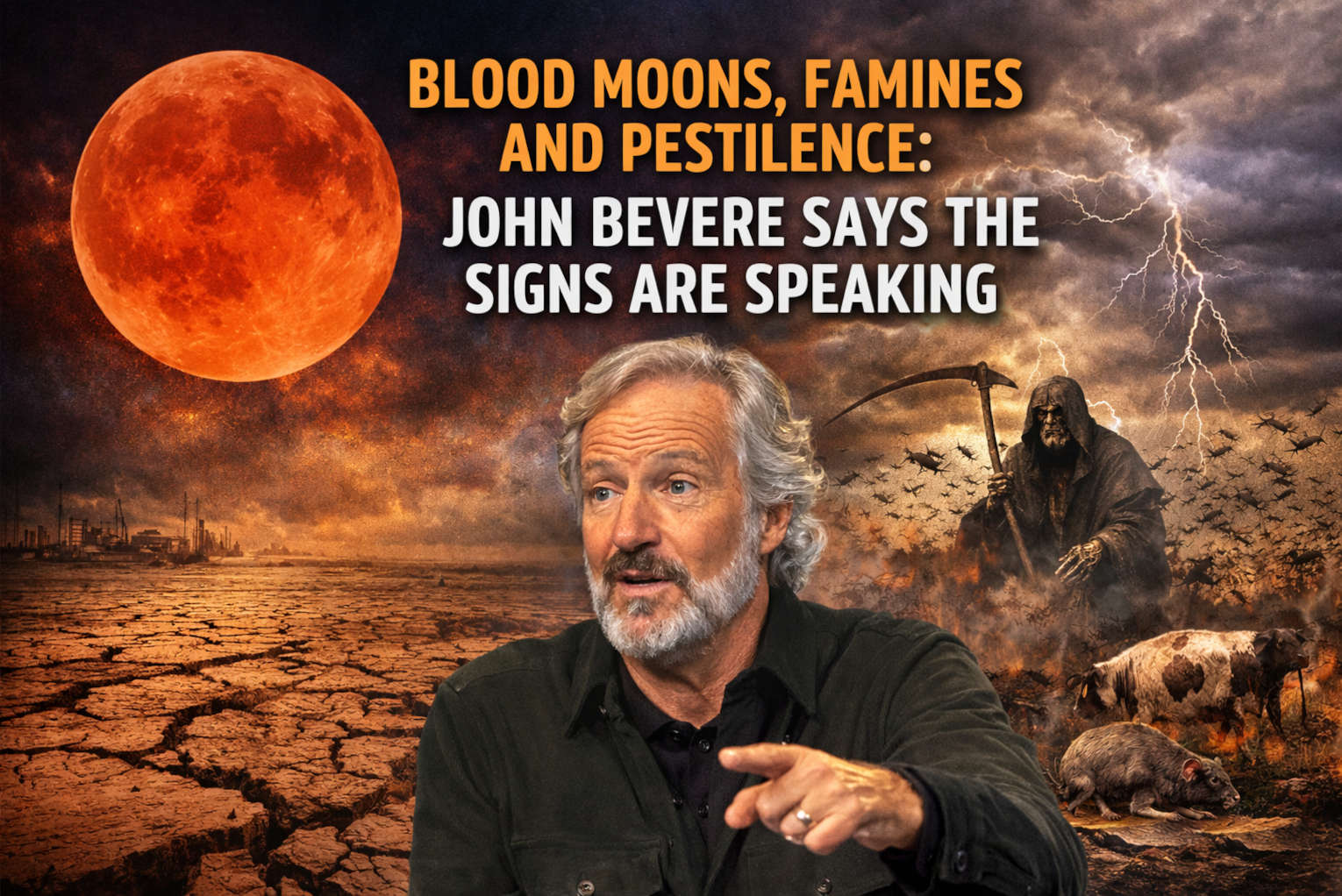

For decades, John Bevere avoided teaching on the second coming of Christ.
After 1,000 hours of study, he is urging believers not only to understand the signs of the times but to cultivate eager expectation.
In a recent conversation with Perry Stone, Bevere addressed three commonly discussed end-times indicators — blood moons, famines and pestilence — while redirecting the focus to what he believes truly prepares the church for Christ’s return.
Blood Moons, Famines and Pestilence
Bevere did not dismiss prophetic signs. Instead, he put them in proper order.
“I believe the signs, the wonders, the blood moons, the famines, the pestilence, they’re all important signs,” he said. “And Jesus spends time talking about it.”
He then shifted to what he considers central.
“But what’s more important is the wedding feast has come and the bride has made herself ready.”
For Bevere, celestial events and global instability are not meant to produce fear or speculation but readiness. He emphasized that the return of Christ is not merely an event to analyze but a relationship to anticipate.
“This isn’t just an event, the second coming. This is the uniting of two lovers. A bride and a groom that have been separated.”
Eager Expectation Produces Purity
One of the dominant points in Bevere’s remarks was what he repeatedly called eager expectation.
He said studying the return of Christ changed him personally.
“I started noticing the fruit in my own life,” he said. “I was kinder to my family. I didn’t get upset with my team as easy. The passion got escalated a couple notches.”
He connected that change to anticipation of Christ’s return.
“All who have this eager anticipation, this eager expectation… will purify themselves even as He is pure,” Bevere said, referencing 1 John 3:2. “All of a sudden, I realized there is a power in having that eager expectation.”
He argued that signs alone can create fascination, but anticipation produces holiness.
The Danger of Delay
Bevere contrasted eager expectation with what Jesus described as the servant who says, “My master delays his coming.”
“When we lose sight… they get a little too flirtatious with the world,” Bevere said. “They put off His coming. Now I’m really struggling walking in holiness.”
He pointed to Peter’s warning about mockers.
“Peter says there’s going to be mockers… and he said these mockers will follow the dictates of their own flesh,” Bevere said. “He’s actually talking about people in ministry.”
For Bevere, disbelief in Christ’s imminent return often leads to spiritual compromise.
Faith-Based vs. Fear-Based Eschatology
Bevere acknowledged that end-times teaching has sometimes been presented in ways that create fear or escapism.
“I saw people get lazy… stop paying their credit cards… they got an escape mentality and I didn’t like it,” he said.
He now distinguishes between fear-driven preparation and faith-driven readiness.
“When eschatology is presented correctly, it will produce faith, it will produce eagerness and it will make people want to serve more,” Bevere said. “When it is presented or heard incorrectly, it produces lethargic people and people that are afraid.”
He affirmed practical wisdom in preparation while rejecting panic-driven survivalism.
“Wisdom teaches us to prepare,” he said. “But when fear dictates us to prepare, that’s when it gets out of balance.”
Why Many Pastors Avoid the Topic
Bevere admitted he avoided teaching on the second coming for decades. He believes many pastors do the same.
“I would say the majority, it’s because they haven’t put in the time,” he said.
Using a puzzle illustration, he explained that partial understanding leads to confusion and controversy. Diligent study brings clarity.
“The message… for God to put ‘blessed is he who hears the words of this prophecy’… it’s the only book in the whole Bible He says that,” Bevere said, referring to Revelation. “I’m guilty… I avoided it for 35 years of ministry.”
Comfort, Not Controversy
While Bevere outlined his views on the timing of Christ’s return, he stressed that the subject should not divide believers.
“If anybody uses this to argue with their friends, you have missed the whole point,” he said. “This is given to comfort us.”
Blood moons, famines and pestilence are not headlines to fear but reminders to prepare. The emphasis is not speculation but transformation.
The return of Christ, he said, is not primarily about decoding timelines. It is about becoming a bride ready for her King.
James Lasher, a seasoned writer and editor at Charisma Media, combines faith and storytelling with a background in journalism from Otterbein University and ministry experience in Guatemala and the LA Dream Center. A Marine Corps and Air Force veteran, he is the author of The Revelation of Jesus: A Common Man’s Commentary and a contributor to Charisma magazine. For interviews and media inquiries, please contact [email protected].