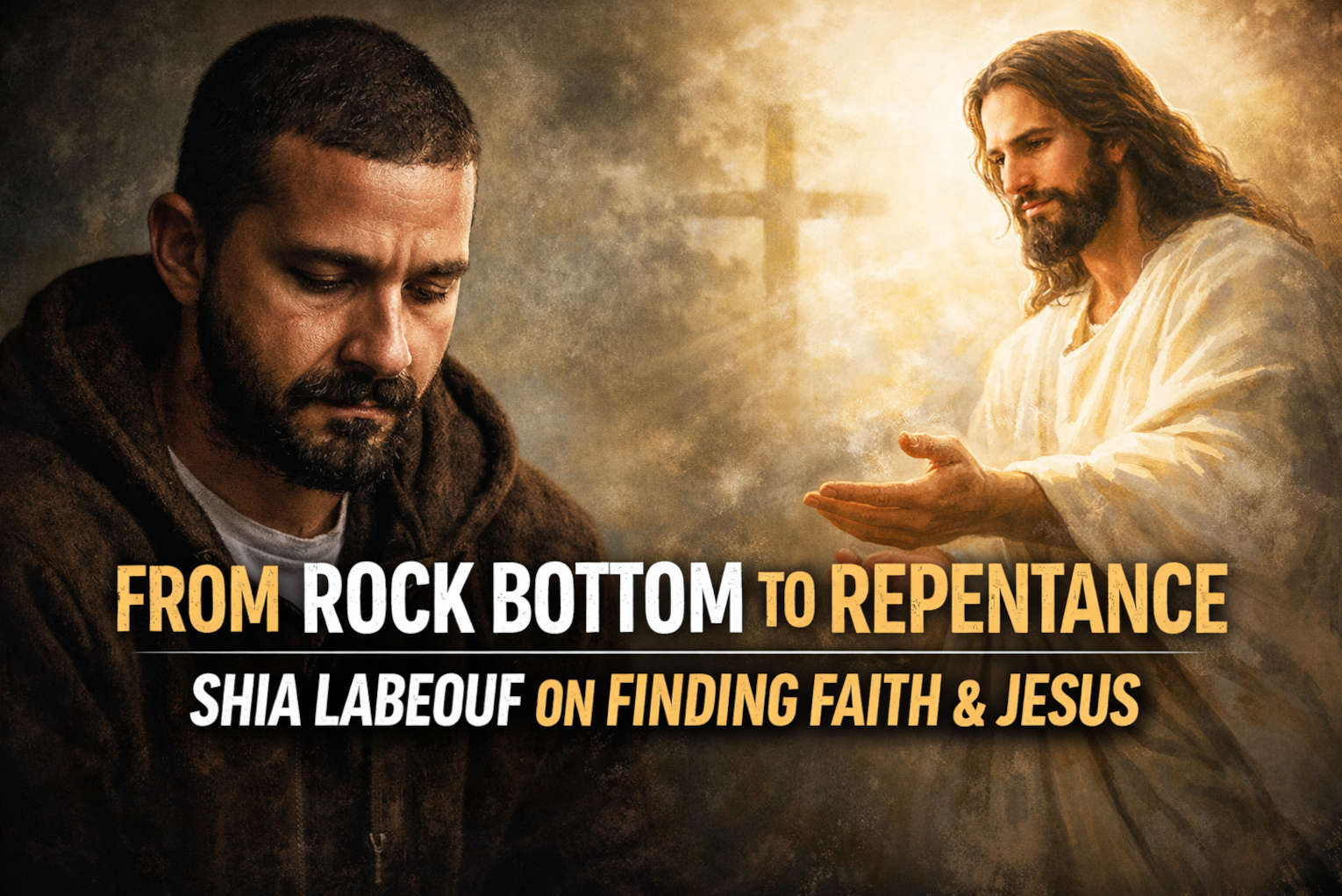

Shia LaBeouf is not hiding from the mess of his life.
In a wide ranging Channel 5 interview with Andrew Callaghan filmed in New Orleans, the actor spoke openly about a recent Fat Tuesday arrest and the fallout that followed. He also described what repentance looks like in real time, not as a clean public relations reset but as a man owning his sin and trying to walk forward with God.
“I got some contrition on my heart,” LaBeouf said early in the conversation. “It’s not nice to hurt people ever. It’s … lame. People got hurt. I got to deal with that. I’mma deal with that in full. I’ll eat it all. It was on me.”
He did not present himself as a finished product. He described himself as being “in the middle of something” and learning while the consequences still hang in the air. Still, his language kept circling back to the same anchor: God is involved.
“God’s involved, bro,” he said later. “I’m learning my lessons. I’m on my path.”
Contrition after the chaos
LaBeouf acknowledged the reality of what happened during Mardi Gras, including the public embarrassment and the legal process, while insisting he is not looking for excuses. He repeated that the blame sits with him.
“My behavior is dirty, ugly, disgusting,” he said. “So I got to eat it.”
In the middle of that honesty, he also spoke about what happens when a man stops defending himself and starts confessing. He described the first steps of making things right in language familiar to anyone who has walked through repentance and restitution.
“You got to make amends,” he said. “First thing you got to do is you got to say what you did. Then you got to say how it’s never going to happen again. And then you got to show and prove.”
Repentance is not a vibe. It is a turning from the old, and embracing the new.
Order John Eckhardt’s New Book, “The Power of Your Words” on Amazon.com!
If you met Jesus face-to-face
Callaghan asked LaBeouf what he would say to Jesus if he could meet Him.
“I wouldn’t say [__],” LaBeouf replied with tears welling up in his eyes. “I’d kiss Him. I’d just kiss His feet. I wouldn’t say nothing.”
That answer cuts through the noise. It points to reverence, surrender and the kind of humility pride cannot fake. It also reflects something LaBeouf returned to throughout the interview: faith is not a brand for him. He described it as a relationship.
“I’m in a full-blown love affair with Jesus,” he said. “And I believe what I believe.”
For the believer who has stumbled, that posture matters. The enemy pushes shame that says, “You have ruined everything.” The gospel answers with the cross that says, “Come home.” Jesus is not waiting for a perfect speech. He is worthy of worship from a heart that finally yields.
How he says he hit bottom
LaBeouf also described a moment he called his personal breaking point.
“I put a gun in my mouth,” he said. “I was ready to kill myself, blow my brains out, writing letters.”
He said he did not go through with it because of his mother and because of a call from someone connected to the recovery world.
“She kept me alive that night,” he said of his mother. He also described a man from the program who called and told him to talk in the morning, a moment that “bought me the night” and kept him alive.
That is what hitting bottom can look like. It is the end of self confidence. It is the moment a person realizes sin does not just stain the surface. It kills. And yet even there God reaches.
LaBeouf’s story also comes with an important reality. He is still clearly finding his way and growing in his faith. Like any new or returning believer he would benefit from discipleship and guidance from mature Christians who can help ground him in Scripture and accountability.
Every believer starts somewhere. Every Christian who now walks faithfully with the Lord once had to take that first step away from the old life.
The Christian walk is not about instant perfection. It is about turning from who we were and choosing the narrow path Jesus described. We stumble. We fall. But the grace of God keeps calling us forward.
LaBeouf’s honesty about repentance and brokenness serves as a reminder that no one is too far for God to reach. The same Jesus who receives a broken man on his knees also gives strength to stand up again.
If you are struggling with sin, relapse, shame or the weight of your past, keep your eyes on Jesus. Repentance is not the end of your story. It is the beginning of freedom.
James Lasher, a seasoned writer and editor at Charisma Media, combines faith and storytelling with a background in journalism from Otterbein University and ministry experience in Guatemala and the LA Dream Center. A Marine Corps and Air Force veteran, he is the author of The Revelation of Jesus: A Common Man’s Commentary and a contributor to Charisma magazine. For interviews and media inquiries, please contact [email protected].