

A new Daily Mail report takes readers on a curious journey into a 500–year–old Bible map and suggests it still shapes how we view territorial borders today. It is an intriguing claim, especially since the map itself was printed backwards.
According to the article, “this map is simultaneously one of publishing’s greatest failures and triumphs,” which certainly grabs attention.
The map appeared in a 1525 Old Testament printed in Zurich and drawn by Renaissance artist Lucas Cranach the Elder. It shows Israel divided among the 12 tribes descended from Jacob. That part is biblically accurate. Scripture traces each tribe’s inheritance across the Promised Land and records their encampments during the 40–year wilderness journey. The Daily Mail even acknowledges that the tribes were the “foundation of God’s chosen people and the ‘inheritance of all things by Christians.’”
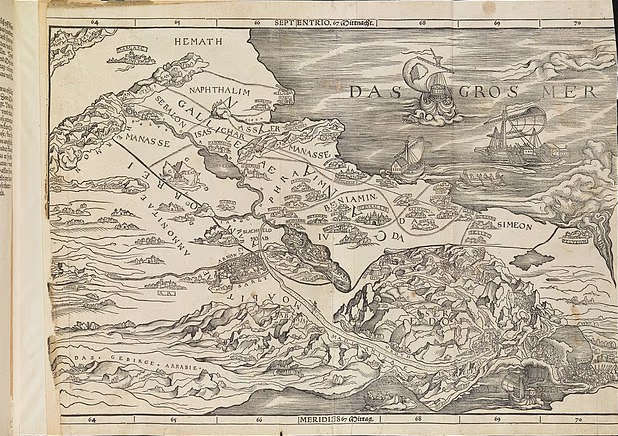
Where the reporting begins to wander is in its interpretation. The Bible does not teach that Christians replaced Jews as heirs of the land. It teaches that believers share spiritual inheritance through Christ without erasing Israel’s covenant identity. Romans 11 preserves both.
Likewise, the Daily Mail suggests that the tribal divisions were spiritual rather than territorial. Yet the book of Joshua presents borders as geography, not metaphor. The land was given to an actual people, with descriptions detailed enough to trace on a map even today.
The conversation becomes more revealing when Professor Nathan MacDonald remarks that “the Bible has never been an unchanging book.” He is referring to physical forms: scrolls becoming bound volumes, maps added and later removed, digital versions replacing printed ones. On that surface level, he is correct. People have encountered Scripture differently across centuries, and formats continue to evolve.
Order Jonathan Cahn’s Newest Book, “The Avatar” on Amazon.com!
What the secular study overlooks is that Christians distinguish between the container and the content. Paper, ink, maps and chapter numbers change, but the message remains the same. Generations have held translations in many languages, but the core story of covenant, redemption, judgment and promise remains intact. The tools around Scripture—whether ancient fold–out maps or modern study charts—do not rewrite the text.
The Daily Mail piece is fascinating because it looks at an imperfect map to claim shifting meaning, yet the map itself did not change biblical truth. If anything, it reflects humanity’s ongoing attempt to visualize what God already declared. Formats can distort or embellish, but they cannot undo what Scripture says.
So while academics debate the influence of a backward Holy Land map, believers continue to read the same enduring words. The Bible has traveled through scrolls, codices, printing presses and now screens, but its central message stands unmoved. The debate over where the Mediterranean was printed may be interesting, but the God who authored the story has never shifted one inch.
James Lasher, a seasoned writer and editor at Charisma Media, combines faith and storytelling with a background in journalism from Otterbein University and ministry experience in Guatemala and the LA Dream Center. A Marine Corps and Air Force veteran, he is the author of The Revelation of Jesus: A Common Man’s Commentary and a contributor to Charisma magazine.