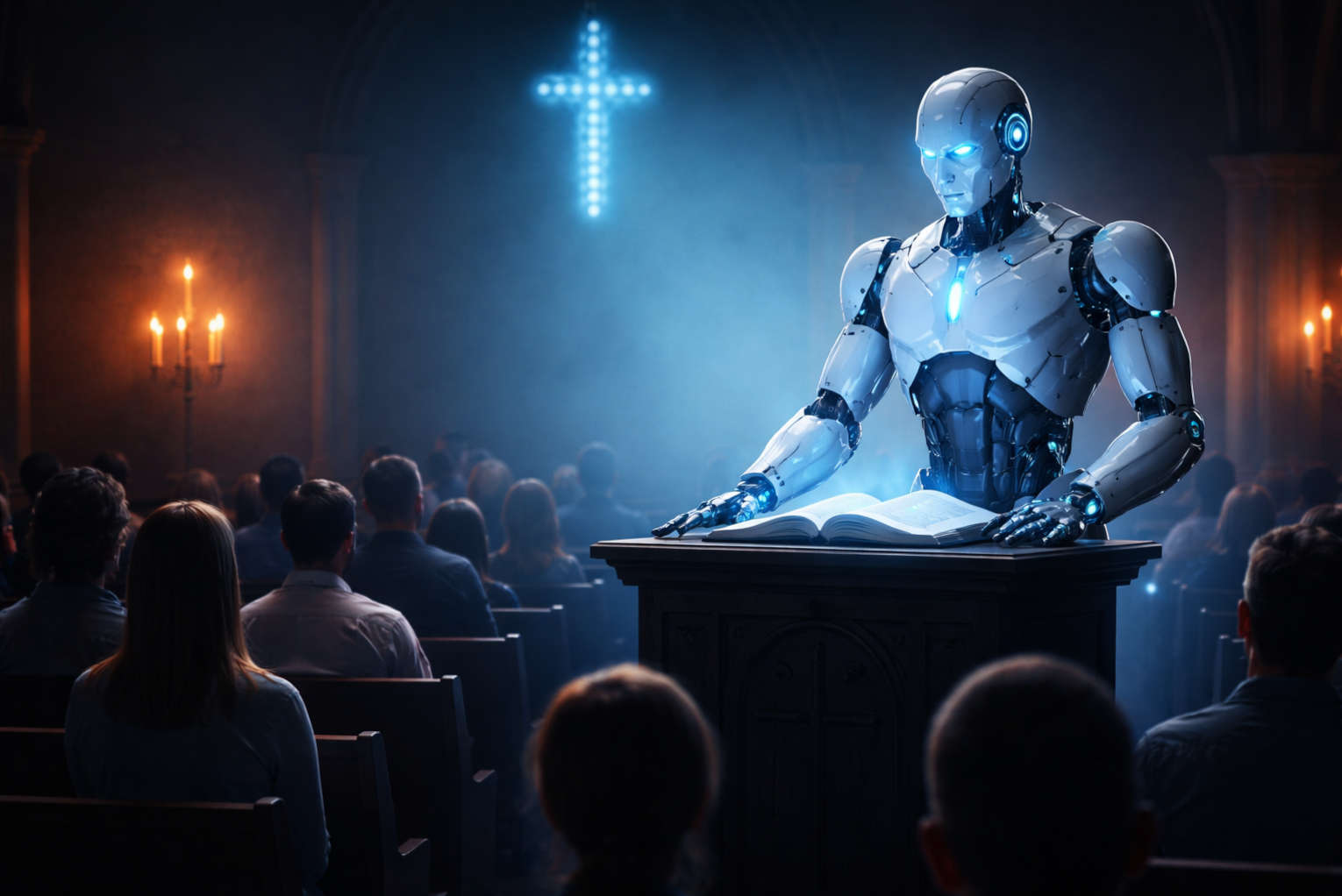

About a third of practicing American Christians now say the spiritual advice they receive from artificial intelligence is just as trustworthy as advice from a pastor. That is not speculation. It is data.
According to new research from Barna Group, and reported by The Christian Post, 30% of U.S. adults “somewhat” or “strongly” agree that spiritual advice from AI “is as trustworthy as advice from a pastor.” Among Generation Z and millennials, that number rises to 39% and 40%, respectively. Even 34% of practicing Christians agree.
Researchers noted that AI is “influencing everyday spiritual habits.” Four in 10 Christians say AI has helped them with prayer, Bible study and spiritual growth. More than 41% of Protestant pastors report using AI for Bible study preparation.
Daniel Copeland, Barna’s vice president of research, said, “Though the majority of practicing Christians remain the most cautious about embracing AI as a spiritual tool, their views are shifting and remain largely uninformed by their pastor.” He added, “There’s a real opportunity here for pastors to disciple their congregants on how to use this technology in a beneficial way.”
The views of many believers are shifting quickly.
We are watching authority migrate. For centuries, spiritual counsel flowed from Scripture, prayer and shepherds entrusted with the care of souls. Now a growing number of believers are comfortable receiving guidance from algorithms.
Pastor Ray Miller of First Baptist Church in Abilene, Texas, warned against technology becoming “another type of idol pulling at our attention.” He said, “Often, people turn to AI because they do not have another human being or pastor or priest to turn to, and it becomes convenient.”

Order Amanda Grace’s New Book, “Brace For Impact” on Amazon.com!
Convenience reshapes habits. Habits reshape trust.
Scripture describes a coming global system in Revelation 13 in which economic participation is tied to a mark. Whatever form that future system takes, it will require normalization and widespread dependence on digital systems.
Control does not arrive overnight. Systems become useful before they become necessary. They become trusted before they are mandated.
This is not an argument that AI is the mark of the Beast. It is an observation about trajectory. When believers instinctively turn to machines for spiritual clarity, something deeper is forming.
Ray Miller described AI as part of “a technological revolution unseen in human history since the advent of the printing press.” He asked, “What does it mean to be human, to be made in God’s image in an age of digital AI?”
That question cannot be outsourced.
The church must respond not with fear but with formation. Believers must be discipled into Scripture, prayer and discernment that cannot be downloaded.
The mark of the Beast will begin with misplaced trust long before it appears as policy.
James Lasher, a seasoned writer and editor at Charisma Media, combines faith and storytelling with a background in journalism from Otterbein University and ministry experience in Guatemala and the LA Dream Center. A Marine Corps and Air Force veteran, he is the author of The Revelation of Jesus: A Common Man’s Commentary and a contributor to Charisma magazine. For interviews and media inquiries, please contact [email protected].