
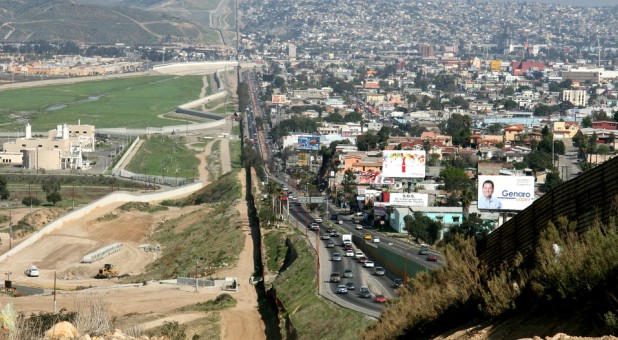
Is building a wall on our border a morally good action? As a professor who has taught biblical ethics for 41 years, I think it is—in fact, the Bible itself repeatedly views protective walls with favor.
Walls gave peace and security. In the world of the Old Testament, people built walls around cities to protect themselves from thieves, murderers and other criminals, and from foreign invaders who would seek to destroy the city. People could still enter the city, but they had to do so by the gate so that city officials would have some control over who was coming in and going out. Today’s debate is about a larger area—a national border, not a city—but the principles are the same.
A strong wall gave peace and security to the city, and one prayer of blessing for a city was, “Peace be within your walls and security within your towers!” (Ps. 122:7). There was also a spiritual component, for the Lord himself strengthened the gates in the walls so they would protect the children and the peace and prosperity of a city:
“Praise the LORD, O Jerusalem! Praise your God, O Zion! For He has strengthened the bars of your gates; He has blessed your children within you. He makes peace in your borders, and fills you with the finest of the wheat (Ps. 147:12-14).
After King David established his capital in Jerusalem, he prayed, “Do good to Zion in your good pleasure; build the walls of Jerusalem” (Ps. 51:18)—God’s blessing would include strong walls! After David came King Solomon, who finished and strengthened the wall around Jerusalem (1 Kings 3:1).
But the people of Israel strayed from God, and he brought judgment in the form of Babylonian invaders who broke down and destroyed the city wall: “So they burned the house of God, tore down the wall of Jerusalem, burned down all the palaces with fire, and destroyed all the precious items” (2 Chron. 36:19; see also Jer. 52:14). God’s judgment removed the walls! As long as the wall around Jerusalem was broken down, it was a mark of shame and derision: “The remnant that returned from captivity is there in the province enduring great affliction and reproach. Also, the wall of Jerusalem remains broken down, and its gates have been burned with fire” (Neh. 1:3).
The pathetic shame of a city without walls is also evident in this proverb: “He who has no rule over his own spirit is like a city that is broken down and without walls” (Prov. 25:28). The implication is that such a man and such a city are both headed for destruction.
After 70 years of exile in Babylon, the Jewish people were able to return and to rebuild Jerusalem’s wall. Nehemiah asked the Persian king Artaxerxes to give him the timber needed to build the wall and its gates: “The king granted me these things, because the good hand of my God was upon me” (Neh. 2:8). In this case, God’s blessing was evident when the leader of the government authorized the allocation of materials to build the wall.
Then Nehemiah needed laborers for the massive task of rebuilding the wall. He challenged the people, ” Come, and let us rebuild the wall of Jerusalem so that we will no more be a reproach” (Neh. 2:17b). Fortunately, “The people had a passion for the work” (Neh. 4:6), and an entire chapter of Nehemiah is devoted to recording the names of people who rebuilt the wall, specifying the section that each person repaired (Neh. 3). Such a record—having their names forever in the pages of the Hebrew Bible—was a significant honor for those who repaired the wall. It was a morally commendable act.
There was a great celebration when the wall was completed: “And at the dedication of the wall of Jerusalem they sought to bring the Levites … to celebrate the dedication appropriately with thanksgiving songs and singing, accompanied by cymbals, harps, and lyres. … Then I … appointed two great thanksgiving choirs: (Neh. 12:27, 31).
There is another wall in the Bible—at the very end of the New Testament. The apostle John has a vision of the New Jerusalem, a great city that comes down from heaven, and it includes a wall: “It had a great, high wall, with twelve gates, and at the gates twelve angels” (Rev. 21:12a). Whether this is literal or simply part of a symbolic prophetic vision (I don’t know), it is clear that the wall protects the peace and security of those who are within.
My conclusion from this overview is that the Bible views border walls as a morally good thing, something for which to thank God. Walls on a border are a major deterrent to evil, and they provide clear visible evidence that a city or nation has control over who enters it, something absolutely essential if a government is going to prevent a nation from devolving into more and more anarchy.
Objection: “We should be a nation that welcomes immigrants.” I agree wholeheartedly—if they come legally. But it is no kindness to them if the lack of a wall tempts them to risk death by walking across miles of parched desert, at the mercy of violent gangs, and then come into the U.S. without legal documentation, only to live here as a permanent legal underclass, easily exploited, living in constant fear of discovery. In addition, it diminishes respect for the law and destabilizes the nation when millions of people exist in the shadows, living outside the legal recordkeeping functions of the nation.
And there has to be some limit on the number we admit each year. I would like the number to be higher than it is, but a complete “open borders” policy would overwhelm the country. The U.S. population today is 328 million. The population of the world is 7.6 billion, or 23 times the US population. If we allowed in everyone who wanted to enter, as many as half the world’s population might want to come—giving us over 10 times our current population. Even if only 10 percent of the world (a very low estimate) came in through open borders, the U.S. would suddenly confront the impossible task of trying to assimilate 760 million new immigrants into a nation of 328 million. “Open borders” is not a realistic solution or one that could ever get enough popular support to pass Congress and become law. Building a wall with well-regulated gates declares that while we welcome immigrants, we—not they—are going to decide which ones, and how many.
The U.S. currently admits over 1,000,000 immigrants per year who come legally and stay permanently—far more than any other nation. If you think that number should be even higher (as I do), then suggest a higher number to your congressman and talk to your fellow citizens. Persuade people to agree with you and work for a change in the law. But don’t oppose a border wall, for that is just promoting more lawlessness.
Objection: “The Bible tells us to care for the sojourner.” I agree—but we still must have some means of regulating how many “sojourners” we allow into the country and who can qualify to enter—and a wall is the most effective way to do this. When the Bible says, “Love the sojourner, therefore, for you were sojourners in the land of Egypt” (Deut. 10:19, ESV), Old Testament professor James Hoffmeier has demonstrated that these “sojourners” (or “resident foreigners” in one translation; the Hebrew term is ger) were people who had entered another country legally, with the permission and knowledge of the country that admitted them. (The unmodified term “foreigner” in some translations is not specific enough to translate Hebrew ger.) A foreigner who had entered a country by stealth and did not have recognized standing as a resident alien was not considered a “sojourner” (Hebrew ger) but simply a “foreigner” (Hebrew nekaror zar).
Objection: “These are good people who are just seeking a better life.” Yes, many of them are, and we should welcome them—if they come legally. But we can’t ignore the fact that many others will not become “good neighbors”—some are drug runners, gang members and even terrorists. A wall makes it possible to screen out the people who have previously been deported for felonies and others who are most likely to commit crimes or simply become a drain on the economy rather than getting a productive job.
An effective border wall would also be the best way to keep children together with their parents. Under the present system, families 1) enter the U.S. illegally and 2) are caught, then 3) they plead for asylum and 4) they are incarcerated until their asylum petition can be evaluated. But if we had a completed wall, such requests for asylum would be decided at the border, before they ever entered the U.S. We would never have to detain either parents or children on U.S. soil in the first place.
Objection: “Walls don’t work.” That objection is not true. Sections of high, effective walls and fences have already transformed whole regions of San Diego and El Paso from high-crime zones into peaceful, much safer cities.
A high, double wall with modern electronic equipment to detect tunneling would stop perhaps 90-95 percent or even more of illegal border crossings. Once such a wall is complete, most Americans would feel that the border is finally under control, and the remaining questions about immigration could be resolved in an atmosphere of far less tension and animosity.
Walls that already work: In fact, we already have a highly effective system of “border walls” that nobody argues about—in our airports. Every time I return to the U.S. from a foreign country, I have to go through customs at the airport, and so does everybody else. The room where people wait in line to see a customs officer has walls to make sure that all arriving passengers have to go through passport control. I’ve never seen anyone protesting the existence of walls in the customs area or demanding that a section of the wall be removed so that people who don’t want to go through passport control can simply walk into the country whenever they want. That would be an open invitation to terrorists and other criminals, and it would make it impossible for the U.S. to place any limits at all on the number of people who came into the country and stayed without legal documentation.
Yet demanding “no passport controls at airports” is, it seems to me, exactly parallel to saying that we should not build a wall on our southern border. Why should airports be any different from other border entry points? Yes, we are a nation of immigrants, and we should eagerly welcome numerous immigrants into the U.S. every year, but they must come in legally, through the gates in the wall, not illegally and dangerously across an open desert. {eoa}
This article originally appeared on Townhall. Reprinted with permission.
Wayne Grudem is research professor of theology and biblical studies at Phoenix Seminary. This article expresses the opinion of the author and should not be understood to represent the opinion of Phoenix Seminary.
