
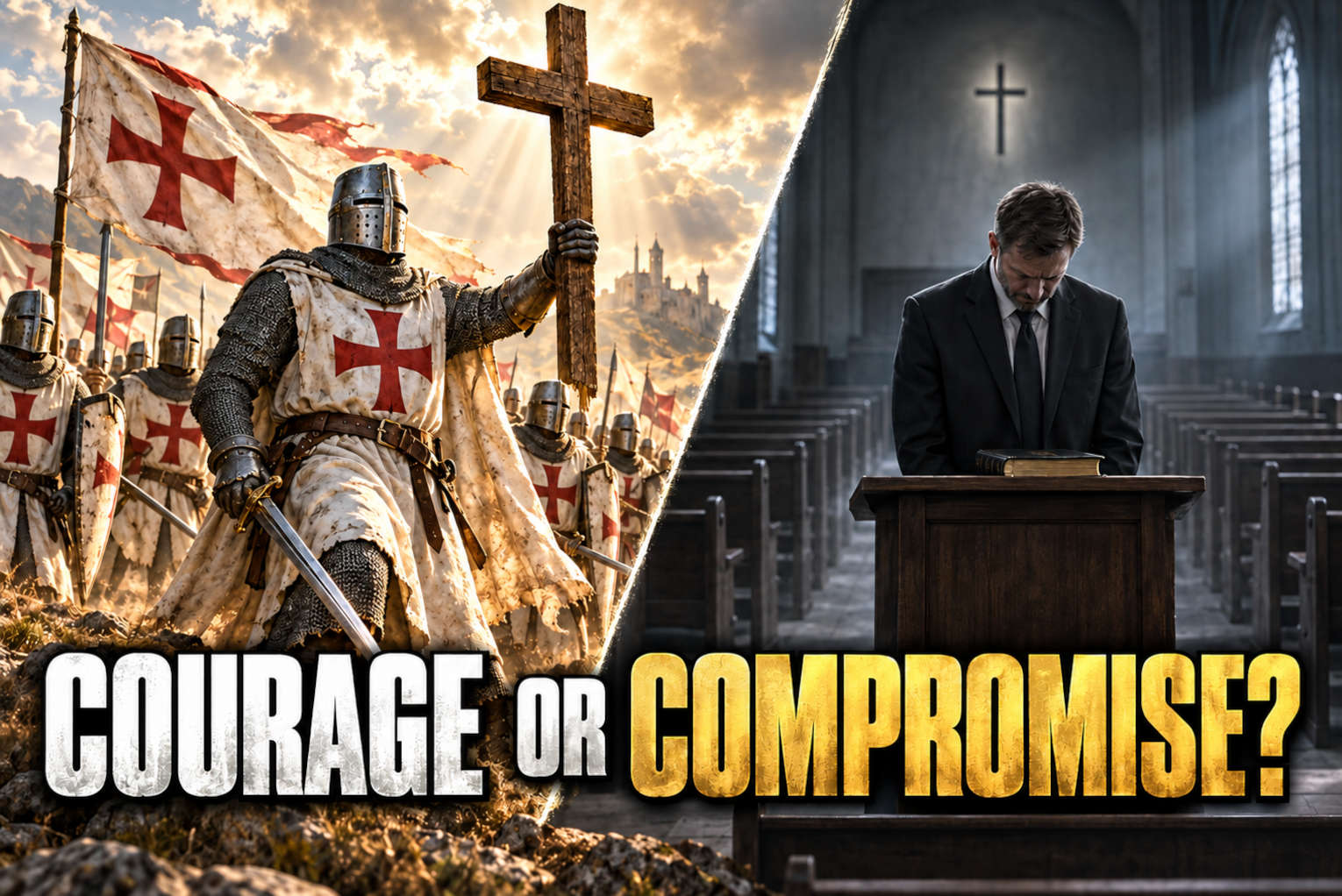
The West is being taught to distrust its Christian heritage, and historian Raymond Ibrahim argues that the consequences reach far beyond the classroom.
Churches lose their discernment. Governments lose their resolve. A civilization that misunderstands its past begins apologizing for the very faith that helped shape it.
That was Ibrahim’s warning during an interview with Patrick Bet-David on the PBD Podcast, where he challenged popular accounts of Christian-Muslim history and accused Western institutions of cultivating a dangerous historical amnesia.
“Fake history is much more dangerous than fake news,” Ibrahim said.
“Fake news is ephemeral. It does its mischief and then it’s gone,” he explained. But “fake history creates these overarching narratives in our mind and we see reality through them.”
Order Dinesh D’Souza’s New Book, “The Stones Cry Out” on Amazon.com!
The Christian lands erased from the story
Ibrahim, an American-born Coptic Christian whose family comes from Egypt, approached the subject through his research into Arabic and Greek historical sources.
He argued that the geography of early Christianity shatters the familiar assumption that Christian civilization was essentially European.
“Most of Christianity or Christendom was in North Africa in the Middle East,” he said, describing the world at the emergence of Islam in the seventh century.
Egypt, North Africa and Asia Minor figured prominently in his account. He described Christian communities overtaken by successive Islamic conquests, with churches destroyed and populations subjected to persecution.
Asia Minor carries particular significance in the discussion: It includes the locations of the churches addressed in Revelation, in what is now Turkey.
Ibrahim argued that leaving those centuries out of the story fundamentally distorts how people understand the Crusades.
“The First Crusade was actually a response to one of the worst emanations of Islamic atrocities against Christians that were going on at the time,” he said.
In his telling, Christians now inherit the guilt of medieval warfare while learning little about the Christians whose suffering preceded it.
“A lot of it, like I said, is historical amnesia,” Ibrahim said.
Who pays to shape the narrative?
The interview also turned toward American universities, where Ibrahim alleged that foreign money influences the presentation of Islamic history.
Recalling his studies at Georgetown University, he described an academic environment resistant to his conclusions and connected that experience to financial support from Gulf states.
“Obviously, they’re giving money for a reason because they want to influence what’s being taught,” he said.
His accusation reaches beyond disagreements over ancient battles. He argues that students absorb assumptions about Christianity and Islam that later shape public policy and religious attitudes.
History, in that argument, becomes a tool for teaching a civilization to distrust itself.
‘I call it doormat Christianity’
Ibrahim reserved some of his sharpest criticism for churches that confuse accommodation with Christian conviction.
He described a Quranic recitation at a Catholic church in Belgium that, in his interpretation, condemned the very religious imagery surrounding the gathering. His concern was that Christian hosts welcomed words they did not fully understand.
“I call it doormat Christianity,” he said.
He connected that posture to the erosion of Christianity’s influence in Western society.
“And secularism in many ways is a sort of abnegation of religion,” Ibrahim said.
He also distinguished a discussion of Islamic doctrine from the conduct of individual Muslims.
“I think I can speak about the religion and then we can talk about how Muslims fit into the religion,” he said.
Christian love requires discernment. We can love our neighbors while holding firmly to Scripture. Remembering the Christians who suffered for their faith should strengthen our resolve to stand faithfully in our own generation.
To watch the full interview, click here (Editor’s note: mild language).
James Lasher, a seasoned writer and editor at Charisma Media, combines faith and storytelling with a journalism background from Otterbein University and ministry experience in Guatemala and at the LA Dream Center. A Marine Corps and Air Force veteran, he is the author of The Revelation of Jesus: A Common Man’s Commentary and a contributor to Charisma magazine. For interviews and media inquiries, please contact [email protected].
