
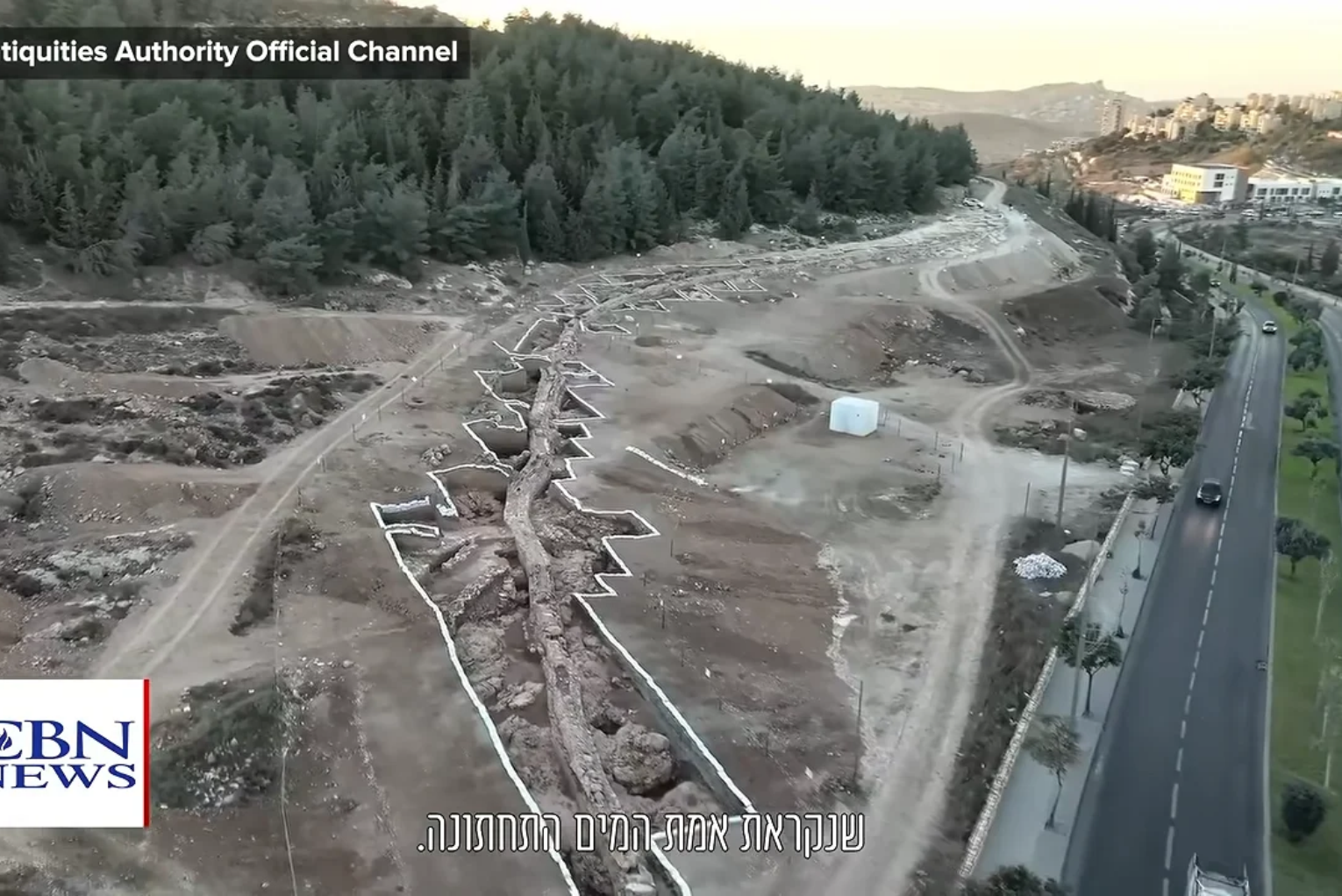
Another piece of the Temple Mount’s ancient story is coming into focus. This one involves a 2,000-year-old engineering marvel hidden beneath Israel’s landscape.
Israeli tour guide Yoav Rotem joined CBN News’ Raj Nair to unpack the discovery of an ancient aqueduct system that once carried water from the Bethlehem region all the way to Jerusalem and the Temple Mount during the Second Temple period.
And this was no small construction project.
“We’re talking about 13 miles of an aqueduct,” Rotem said.
Water traveled from springs around Gush Etzion, near Bethlehem, and the massive reservoirs known as Solomon’s Pools toward Jerusalem. To get it there, ancient builders had to navigate mountains and valleys, constructing bridges and carving tunnels along the route.
Rotem said an approximately 300-meter—or roughly 900-foot—section has been found nearly complete.
But here’s where the ancient engineering becomes astonishing.
Gravity moved the water along a slope of only about 0.1%. Rotem said scholars and professionals believe the enormous undertaking would have taken years to construct.
Rotem identified the Maccabees as the likely builders of the early system around the end of the second century B.C., while also noting clear Herodian influence at Solomon’s Pools.
To order Dinesh D’Souza’s new book, The Stones Cry Out, visit Amazon.com.
Then there’s the Temple Mount.
Rotem further explained that tremendous amounts of water were needed there, including for sacrifices. At the southern end of the Temple Mount were mikvaot, the ritual immersion pools used for purification.
“We’re starting to find the connections between these aqueduct and the filling of these immersion pools,” Rotem said.
And that’s where this archaeological discovery begins illuminating something believers still read about today: living water.
Rotem explained that water used for Jewish ritual immersion had to arrive naturally, such as rainwater or water from a spring, rather than simply being hauled in by bucket or forced through a pump.
Nair immediately recognized the spiritual imagery.
For Christians, “living water” points straight to Jesus. Christ told the Samaritan woman in John 4 that the water He gives becomes “a fountain of water springing up into everlasting life.”
Suddenly, those words aren’t floating in some distant, abstract world. Archaeology is giving us another window into a culture where water, purification and worship were tangible realities.
Perhaps just as stunning, Rotem said the aqueduct wasn’t simply forgotten after the Second Temple era. It remained in use until roughly a century ago, near the end of Ottoman rule.
Two thousand years later, stones and waterways are still speaking.
And once again, the land of the Bible offers a remarkable glimpse into the world surrounding Jerusalem, its worship and the Temple Mount.
Abby Trivett is a writer and editor for Charisma Media and has a passion for sharing the gospel through the written word. She holds two degrees from Regent University, a B.A. in Communication with a concentration in Journalism and a Master of Arts in Journalism. She is the author of the newly released book, The Power of Suddenly: Discover How God Can Change Everything in a Moment. For interviews and media inquiries, please contact [email protected]. Learn more about Abby at abbytrivett.com.
